Michael Wood embarks on a great historical adventure, exploring the stories, people and landscapes that have helped create China's distinctive character and genius over four thousand years. Is the history of the world's newest superpower, from its ancient past to the present day. Starting in Wuxi, Michael joins the Qin family reunion, when 300 relatives gather to worship their ancestors on Tomb Sweeping Day. 'Like the nation, the family has been through so much,' one says. 'Now everyone wants to know - what are our roots?' Looking for the origins of the Chinese state, he visits the excavations at Erlitou and sees an exquisite turquoise dragon sceptre from 2000 BC. China's first writing is found on 'oracle bones' dug up from the Shang royal tombs at Anyang in the 1920s. At the Beijing Planetarium, Michael travels back in time as astronomers plot the planetary conjunction that the ancients believed foretold the overthrow of the Shang Dynasty. Next, the Age of Philosophers and Confucius, whose book Analects has had greater influence worldwide than even the Bible, according to some. In Xi'an, we hear how the First Emperor united China and created the authoritarian Qin state that gave us the word China. Finally, Michael returns to the temple fair in Henan for a dramatic night ceremony to give thanks to the ancestors. China, Michael concludes, is rising again, not just because of its economic strength, but because of the incredible solidarity of the Han Chinese view of their own civilisation, their sense of family and, of course, the presence of the ancestors.
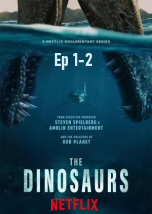
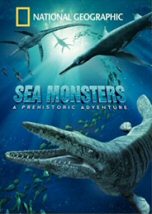
The setting alternates between prehistory and modern day times in which scientists study the fossilized remains of the creatures in the film. In 2009, a group of paleontologists discover a rare fossil in Kansas. The fossil was previously exposed by a summer rain, and it appears to be a marine reptile, tracing back over 70 million years. It was a female Dolichorhynchops and will be the inspiration for telling the story of Dolly, who travels the Kansas Inland Sea, 80 million years ago during the late Cretaceous period with her family. The film brings to life some of the most bizarre, ferocious and fascinating creatures to ever inhabit the ocean, incluing Tylosaurus, Xiphactinus, Cretoxyrhina, and Ammonite. It combines animation with recreations in a 3D prehistoric adventure. A journey to the bottom of the ancient oceans dramatizes awe-inspiring creatures.
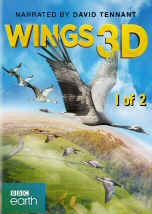
Narrated by David Tennant, Wings 3D is the breath-taking aerial adventure that takes goose bumps to new heights. Director John Downer uses breakthrough filming techniques and technology to bring you high-flying sights that will simply amaze you - because you won't believe what our feathered friends are doing up there. Remarkable 3D footage captures majestic bald eagles scanning over the Grand Canyon, resplendent parrots on the wing, manta rays soaring skyward from the sea, barn swallows dive-bombing for a drink, cranes high over Venice waterways and so much more. Your historic flight is ready for departure.
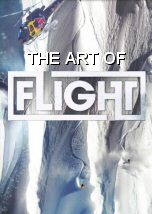
Snowboarding as you've never seen it, unless you are one of the handful of daredevils willing to risk life and limb for the glory revealed here. Jaw dropping footage with a pulse-pounding soundtrack, shot in some of the most rugged, remote and beautiful snow country on the planet. "The Art of Flight" gives iconic snowboarder Travis Rice and friends the opportunity to redefine what is possible in the mountains. Experience the highs, as new tricks are landed and new zones opened, alongside the lows, where avalanches, accidents, and wrong-turns strike. Directed by Curt Morgan ad converted by Venture 3D, one of Hollywood's leading 3D conversion companies, the feature combines meaningful storytelling and sport progressing action with some of the most captivating 3D visuals to date. The film was shot using state of the art equipment and technologies, much of which was custom designed for this project. The film transcends snowboarding with an inspirational message about adventure and exploration.
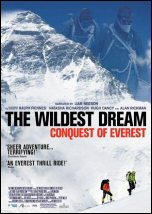
The film explores George Mallory's obsession with becoming the first person to reach the highest place on Earth. Told through the explorer's poignant and evocative letters to his wife, Ruth, previously unseen photos and film archive from 1924 (restored from the original nitrate especially for the film), dramatization and a modern-day expedition retracing the original route taken in 1924, Mallory's incredible adventure lives again. The expedition was led by renowned mountaineer Conrad Anker, whose life became inextricably linked with Mallory after he found Mallory s body on Everest in 1999. Using replica 1920s-era clothing and equipment, Anker sets out to solve the great mystery of whether Mallory succeeded in summiting Everest before he died he was last seen just 800 feet from the summit before the clouds closed in and he disappeared into legend. The most heart-breaking clue: All of Mallory's belongings were found intact on his body, except the photograph of his beloved Ruth, which he promised to leave at the top of the world if he succeeded.
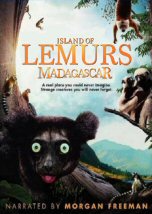
Morgan Freeman narrates Island of Lemurs: Madagascar, the incredible true story of nature's greatest explorers - lemurs. Scientist Patricia Wright has a passion for preserving the life of one particular creature: the lemur. These lively animals found in Madagascar face all sorts of threats, just like so many other animals in a world in which they are increasingly crowded out by humans. Her passion for the subject is compelling and plainly evident, but it's the silent testimony of the animals themselves that really makes the case. Countless hours of footage are trimmed down to create this tapestry depicting the lives of these creatures of remarkable intelligence and ingenuity. Their daily routines and extraordinary adventures are awesome to behold, as is the way that the community functions. A full immersion into the world of the lemurs means great insights on these unusual animals.







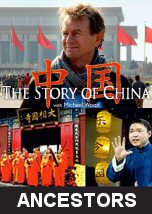




Starting in Wuxi, Michael joins the Qin family reunion, when 300 relatives gather to worship their ancestors on Tomb Sweeping Day. 'Like the nation, the family has been through so much,' one says. 'Now everyone wants to know - what are our roots?'
Looking for the origins of the Chinese state, he visits the excavations at Erlitou and sees an exquisite turquoise dragon sceptre from 2000 BC. China's first writing is found on 'oracle bones' dug up from the Shang royal tombs at Anyang in the 1920s. At the Beijing Planetarium, Michael travels back in time as astronomers plot the planetary conjunction that the ancients believed foretold the overthrow of the Shang Dynasty. Next, the Age of Philosophers and Confucius, whose book Analects has had greater influence worldwide than even the Bible, according to some. In Xi'an, we hear how the First Emperor united China and created the authoritarian Qin state that gave us the word China. Finally, Michael returns to the temple fair in Henan for a dramatic night ceremony to give thanks to the ancestors. China, Michael concludes, is rising again, not just because of its economic strength, but because of the incredible solidarity of the Han Chinese view of their own civilisation, their sense of family and, of course, the presence of the ancestors.