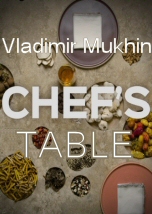
A powerful depiction of Vladimir Mukhin's struggle to resuscitate an almost forgotten russian cuisine, going against the established tradition. Be prepared for stunning images of culinary creations at White Rabbit, some will leave you uneased. A fifth-generation chef, Mukhin worked in his father’s kitchen as a young man, preparing Soviet-era classics. So, like generations of youths before him, Mukhin had to rebel against the old man. He left his small hometown of Essentuki for Moscow and became obsessed with modern techniques and food from across Europe. It wasn’t until he worked as a sous chef in France, when he collaborated on a menu with chef Christian Etienne, that Mukhin realized Russian cuisine could exist within modern cooking. 'His French clients who ate it were amazed,' he says. ¡They loved his Russian cooking.'
How does a chef trained in the finest kitchens of France translate his haute cuisine to fast food? Ludo’s obsession with a perfectly cooked bird can be traced back to France, where he learned to roast chicken. His love for the American classic was solidified in 1996 when he arrived in LA and ate at KFC for the first time. “It was the same sensation,” he’s said, the crunchy skin and juicy flesh, and the gap between his two worlds was bridged. In this episode we learn how a Frenchman became famous for a truly American dish.
La mer means, simply, 'the sea.' Ludo came up under mentors like Alain Passard and Mark Meneau, chefs with an almost pathological obsession with ingredients. His eyes light up when he describes the Lobsters of Brittany, the Oysters from Cancale, and the myriad of other extraordinary culinary jewels. In this episode, we explore how the oceanic bounty of France is some of the best anywhere by profiling the ingredients that can be pulled from it.
Ludo Lefebvre apprenticed under – and learned from – some of France’s most esteemed chefs, but it took a move to Los Angeles, starting a family and a rough restaurant review for him to figure out what he really wanted to do with his culinary future. This episode examines the ties between artists and their education, and how childlike wonder can, in fact, translate into a career. The question Ludo poses is whether an artist follows instinct, training or intuition… or perhaps all three.
In 1940, France has fallen and Hitler orders Operation Sealion, the invasion of Great Britain. But first the Luftwaffe must defeat the RAF for seaborne landings to succeed. In July 1940 an epic struggle in the skies above England begins. Only a brilliant defensive system and the bravery of young pilots stand in the Luftwaffe’s way. Wave after wave of German bombers are attacked by British planes. Featuring the last interview with the youngest Spitfire-pilot in the battle, Geoffrey Wellum.
The Allies plan for years how to break through Hitler’s Atlantic Wall in France. The deception operations are some of the most elaborate of the war, including a huge inflatable army in Kent. The D-Day fleet is the biggest assembled in history, with over 160,000 men crossing the channel to land on five Normandy beaches, each with differing success. But landing is just the beginning, what follows is one of the bloodiest and most extraordinary battles of WWII.





















A fifth-generation chef, Mukhin worked in his father’s kitchen as a young man, preparing Soviet-era classics. So, like generations of youths before him, Mukhin had to rebel against the old man. He left his small hometown of Essentuki for Moscow and became obsessed with modern techniques and food from across Europe. It wasn’t until he worked as a sous chef in France, when he collaborated on a menu with chef Christian Etienne, that Mukhin realized Russian cuisine could exist within modern cooking. 'His French clients who ate it were amazed,' he says. ¡They loved his Russian cooking.'