











Last Watched

"Gas"  Sort by

Leaping Tigers Naked Nagas

   2004    Culture
Following the Yangtze along Tiger Leaping Gorge into Yunnan in China, Palin reaches the easternmost end of the Himalayas. He gets a medical check-up before exploring medieval Lijiang with the director of the local orchestra. Heading over Myanmar to Nagaland in India he rides the steam train to Tipong Coalmine. In Assam he rides an elephant and then stays in a strange monastery.
Series: Himalaya with Michael Palin

Comets: Frozen Wanderers

   2012    Science
We think of comets as beautiful glowing balls of light streaking across our skies with their long sweeping tails, yet comets are so much more than just a cosmic firework display. Comets have a uniquely important place in modern science. As time machines from the early universe, they could hold the key to unlock the secrets of the cosmos. Comets could even be the origin of life itself. We follow the incredible odyssey of a comet as it sails through the solar system, watching it's every move as it evolves from a dormant chunk of ice and rock into a tumbling, violently active nucleus engulfed in a gaseous haze. What we learn is a revelation; comets are even more mysterious and fascinating than we had ever imagined.
Series: How the Universe Works

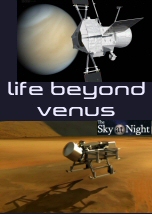
Life Beyond Venus

   2020    Science
Chris Lintott and Maggie Aderin-Pocock report on the reaction to the dramatic announcement of the discovery of phosphine gas in the clouds of Venus, a gas that could be a sign of life. Venus remains an inhospitable and unlikely host. But if not Venus, where in the solar system is the best place to look for alien life? Chris and Maggie investigate the latest missions to Mars and the icy moons of Jupiter and Saturn. Away from the search for life, Pete Lawrencepreviews the best meteor showers of the year.
Series: The Sky at Night

Gasp

   2018    Nature    HD
The extraordinary story of Earth and why it is special and uniquely brimming with life among a largely unknown but harsh cosmic arena. It will be told by eight astronauts from their unique perspective of being away from Earth. In the first episode, Astronaut Chris Hadfield reveals the unlikely and unexpectedly interconnected systems that allow life on our planet to breathe.
Series: One Strange Rock

Biggest Things in Space

   2008    Science
We can't compare anything on earth to the biggest things known in space. The Cosmic Web may connect objects in the universe with threads of Dark Matter. The Lyman-alpha blob is a bubble like structure containing countless galaxies--perhaps the biggest object in the entire universe. Regions of radio-emitting gas called "radio lobes" could be even bigger. Then there are super galaxy clusters which are hundreds of galaxies merged together due to cosmic collisions. Discover which is the largest planet, star, star cluster, constellation, black hole, volcano, galaxy, explosions, moon, storm, impact crater and "void" in space.
Series: The Universe

The World Set Free

   2014    Nature
This episode explores the nature of the greenhouse effect (discovered by Joseph Fourier and Svante Arrhenius), and the evidence demonstrating the existence of global warming from humanity's influence. Tyson begins by describing the long-term history of the planet Venus; based on readings from the Venera series of probes to the planet, the planet had once had an ocean and an atmosphere, but due to the release of carbon dioxide from volcanic eruptions, the runaway greenhouse effect on Venus caused the surface temperatures to increase and boiled away the oceans. Tyson then notes the delicate nature of the amount of carbon dioxide in the atmosphere can influence Earth's climate due to the greenhouse effect, and that levels of carbon dioxide have been increasing since the start of the 20th century. Evidence has shown this to be from mankind's consumption of oil, coal, and gas instead of from volcanic eruptions due to the isotopic signature of the carbon dioxide. The increase in carbon dioxide has led to an increase in temperatures, in turn leading to positive feedback loops of the melting polar ice caps and dethawing of the permafrost to increase carbon dioxide levels. Tyson then notes that humans have discovered means of harvesting solar power, such as Augustin Mouchot's solar-driven motor in the 19th century, and Frank Shuman's solar-based steam generator in the 1910's. Tyson points out that in both cases, the economics and ease of using cheap coal and oil caused these inventions to be overlooked at the time. Today, solar and wind-power systems would be able to collect enough solar energy from the sun easily. Tyson then compares the motivation for switching to these cleaner forms of energy to the efforts of the Space race and emphasizes that it is not too late for humanity to correct its course.
Series: Cosmos: A Spacetime Odyssey
How to Stay Young

How to Stay Young

2016  Medicine
Reel Rock

Reel Rock

2015  Culture
Tiger

Tiger

2020  History
The Universe

The Universe

2011  Science
Five Came Back

Five Came Back

2017  Art