










Last Watched

"Mountain"  Sort by

Surviving

   1995    Nature
the final episode deals with plants that live in hostile environments. Attenborough visits Ellesmere Island, north of the Arctic Circle, to demonstrate that even in a place that is unconducive to life, it can be found. Algae and lichens grow in or on rock, and during summer, when the ice melts, flowers are much more apparent. However, they must remain close to the ground to stay out of the chilling wind. In the Tasmanian mountains, plants conserve heat by growing into 'cushions' that act as solar panels, with as many as a million individual shoots grouped together as one. Others, such as the lobelia in Mount Kenya, have a 'fur coat' of dense hairs on their leaves. The saguaro cactus in the Sonoran Desert flourishes because of its ability to retain vast amounts of water, which can't be lost through leaves because it has none. Many desert dwellers benefit from an accelerated life cycle, blooming rapidly within weeks after rainfall. Conversely, Mount Roraima is one of the wettest places on Earth. It is a huge sandstone plateau with high waterfalls and nutrients are continuously washed away, so plants have to adapt their diet if they are to survive. A bladderwort is shown invading a bromeliad. Inhabitants of lakes have other problems to contend with: those that dominate the surface will proliferate, and the Amazon water lily provides an apt illustration. Attenborough ends the series with an entreaty for the conservation of plant species.
Series: The Private Life of Plants

Planet Earth III: Coasts

   2023    Nature
Discover amazing landscapes, the most amazing fights of animals on our planet, from the highest mountains to the deepest oceans, from the darkest caves to the hottest deserts with new technology. In the first episode, Sir David Attenborough explores the dangerous frontiers created by the world's coasts, where animals fight for survival amidst constant change. Cape fur seals, sea angels, lions, archer fish, flamingos and green turtles feature.
Series: Planet Earth III

Conquistadors: The Search for El Dorado

   2002    History
Francisco de Orellana failed to find El Dorado, but discovered the Amazon. Early in 1541, a rumor swept Quito that beyond the mountains, there lay a land richer than Mexico, or even Peru - a land of gold. The ruler of this land was so rich that he covered himself with gold dust every day and washed it off every evening. He was "the golden man", El Dorado. They had tree goals: to find La Canela, the land of cinnamon: to assess new lands for colonization; and to find El Dorado. On march 1541, They marched eastwards with more that 200 Spanish troops and thousands of native servants.
Series: Conquistadors

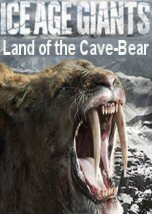
Land of the Cave-Bear

       Science
In the Land of the Cave Bear, Alice ventures to the parts of the northern hemisphere, hit hardest by the cold - Europe and Siberia. High in the mountains of Transylvania, a cave sealed for thousands of years reveals grisly evidence for a fight to the death between two staving giants, a cave bear and a cave lion. Yet Alice discovers that for woolly rhinos and woolly mammoths, the Ice Age created a bounty. The Mammoth Steppe, a vast tract of land which went half way round the world, provided food all year round, for those that liked the cold. It was these mammoths that Europe's most dangerous predators hunted for their survival.
Series: Ice Age Giants

Volcano

   2007    Nature
Volcanoes are one of nature’s most awesome and destructive forces, but they are also the life force and architect of our planet. They can raise up great mountains and create new land, or they can level cities and destroy entire civilizations. They provide a glimpse of the power of Earth’s internal heat source, without which it would have become a dead planet millions of years ago. In this episode, Iain takes us on a journey to some of the most dramatic places on Earth, starting in Ethiopia.
Series: Earth, The Power of the Planet

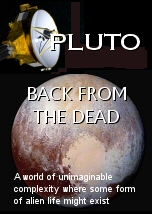
Pluto: Back From the Dead

   2020    Science
The incredible story of how Pluto has been propelled from an unremarkable ball of ice on the edge of the solar system to a world of unimaginable complexity - where some form of alien life might exist.
New discoveries from the edge of the solar system are transforming what is known about Pluto, thanks to the New Horizons space probe that took the first-ever close up images of the planet. Pluto was once thought to be geologically dead, but the pictures revealed it to be an active world of stunning complexity, with mountains carved from ice, a nitrogen glacier that appeared to be moving and a recently active volcano, with data sent back lead some scientists to speculate that there may even be life on Pluto today.
Series: Space Deepest Secrets
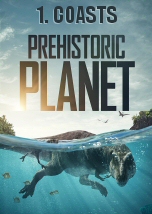
Prehistoric Planet

Prehistoric Planet

2022  Science
Reel Rock

Reel Rock

2014  Culture
Top Gear

Top Gear

2012  Technology
Leaving Neverland

Leaving Neverland

2019  Culture
The Art of Russia

The Art of Russia

2009  Art