This series takes viewers on a journey to the frontiers of science, where researchers are tackling some of the biggest questions about life and the cosmos. The universe is hiding something. In fact, it is hiding a lot. Everything we experience on Earth, the stars and galaxies we see in the cosmos—all the 'normal' matter and energy that we understand—make up only 5% of the known universe. The other 95% is made up of two mysterious components: 'dark matter' and 'dark energy.' We can’t see them, but we know they’re there. And what’s more —these two shadowy ingredients are locked in an epic battle to control the very fate of the universe. Now, scientists are trying to shed light on the so-called 'dark sector' as the latest generation of detectors rev up, and powerful telescopes peer deeper into space than ever before to observe how it behaves. Will the discoveries help reveal how galaxies formed? In the series finale, Nova Wonders journeys to the stars and back to investigate what we know —and don’t know. Find out how scientists are discovering new secrets about the history of the universe, and why they’re predicting a shocking future.
A look at two missions attempting one of the most difficult feats of space exploration - to collect a rock from another world. The film checks in on the US and Japanese attempts to bring a piece of an asteroid back to Earth. The missions have taken decades of planning, but the results will be worth it. We find out how studying these space rocks can teach us about the origins of our solar system and may one day help save Earth from a catastrophic collision.
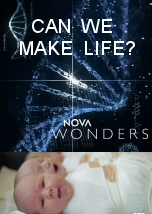
'It's alive!' Since Dr. Frankenstein spoke those famous words, we've been alternately enthralled and terrified by the idea of creating life in the lab. Now, a revolution in genetic engineering and thrilling innovations in synthetic biology are bringing that dream—or nightmare, as the case may be—closer to reality. New tools allow researchers to use cells to create their own DNA and edit it into existing genomes with more ease and less cost than ever before. Along with renewed hopes for treating some genetic diseases, there's serious talk of using the newest technologies to bring long-extinct animals back from the dead – like the team hoping to resurrect the woolly mammoth. Science fiction is quickly becoming science fact. Another daring genetic experiment to bioengineer animals could prevent Lyme disease. But the power to make life comes with deep ethical questions. What are the potential rewards—and dangers—of tinkering with nature? This films explores the benefits and the burden of risk surrounding the controversial new technology.
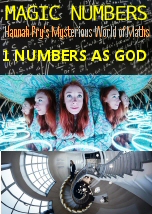
Mathematician Dr Hannah Fry explores the mystery of maths. It underpins so much of our modern world that it's hard to imagine life without its technological advances, but where exactly does maths come from? Is it invented like a language or is it something discovered and part of the fabric of the universe? It's a question that some of the most eminent mathematical minds have been wrestling with. To investigate this question, Hannah goes head first down the fastest zip wire in the world to learn more about Newton's law of gravity, she paraglides to understand where the theory of maths and its practice application collide, and she travels to infinity and beyond to discover that some infinities are bigger than others. In this episode, Hannah goes back to the time of the ancient Greeks to find out why they were so fascinated by the connection between beautiful music and maths. The patterns our ancestors found in music are all around us, from the way a sunflower stores its seeds to the number of petals in a flower. Even the shapes of some of the smallest structures in nature, such as viruses, seem to follow the rules of maths. All strong evidence for maths being discovered. But there are those who claim maths is all in our heads and something we invented. To find out if this is true, Hannah has her brain scanned. It turns out there is a place in all our brains where we do maths, but that doesn't prove its invented. Experiments with infants, who have never had a maths lesson in their lives, suggests we all come hardwired to do maths. Far from being a creation of the human mind, this is evidence for maths being something we discover. Then along comes the invention of zero to help make counting more convenient and the creation of imaginary numbers, and the balance is tilted in the direction of maths being something we invented. The question of whether maths is invented or discovered just got a whole lot more difficult to answer
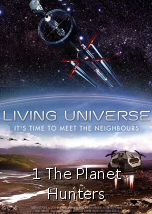
The next great voyage of human exploration has already begun: the search for life on planets orbiting distant stars. With extraordinary CGI, the world's most inspiring scientists, via extreme environments on Earth and around the solar system, the film takes viewers aboard the next generation of space ships, across the cosmos and beneath the clouds of the exo-planets to discover The Living Universe. Part 1: 'The Planet Hunters' For as long as we’ve had eyes to see and minds to wonder we’ve marveled at the stars. Since the discovery of the first so-called exoplanet in 1994, the Planet Hunters have transformed the way we see the universe. It is the year 2157, and spacecraft Artemis enters the final phase of construction.
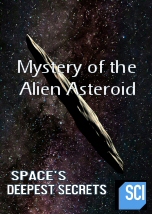
When a mysterious cigar-shaped object is spotted tumbling through our solar system, experts race to uncover it's true nature. The object, nicknamed Oumuamua, meaning 'a messenger that reaches out from the distant past' in Hawaiian, was discovered by the Pan-STARRS 1 telescope in Hawaii. Since its discovery, scientists have been at odds to explain its unusual features and precise origins, with researchers first calling it a comet and then an asteroid before finally deeming it the first of its kind: a new class of 'interstellar objects.' A recent paper by researchers at the Harvard Smithsonian Center for Astrophysics raises the possibility that the elongated dark-red object, which is 10 times as long as it is wide and travelling at speeds of 196,000 mph, might have an 'artificial origin.' The theory is based on the object's 'excess acceleration,' or its unexpected boost in speed as it travelled through and ultimately out of our solar system.

















Now, scientists are trying to shed light on the so-called 'dark sector' as the latest generation of detectors rev up, and powerful telescopes peer deeper into space than ever before to observe how it behaves. Will the discoveries help reveal how galaxies formed? In the series finale, Nova Wonders journeys to the stars and back to investigate what we know —and don’t know. Find out how scientists are discovering new secrets about the history of the universe, and why they’re predicting a shocking future.