When a mysterious cigar-shaped object is spotted tumbling through our solar system, experts race to uncover it's true nature. The object, nicknamed Oumuamua, meaning 'a messenger that reaches out from the distant past' in Hawaiian, was discovered by the Pan-STARRS 1 telescope in Hawaii. Since its discovery, scientists have been at odds to explain its unusual features and precise origins, with researchers first calling it a comet and then an asteroid before finally deeming it the first of its kind: a new class of 'interstellar objects.' A recent paper by researchers at the Harvard Smithsonian Center for Astrophysics raises the possibility that the elongated dark-red object, which is 10 times as long as it is wide and travelling at speeds of 196,000 mph, might have an 'artificial origin.' The theory is based on the object's 'excess acceleration,' or its unexpected boost in speed as it travelled through and ultimately out of our solar system.
We are living in a new golden age of exploration. Planet hunters are searching far beyond our solar system and they are actually finding new worlds orbiting other suns. Thousands of these alien worlds have already been found, but this is the story of perhaps the greatest discovery yet, a star 40 light-years away with seven Earth-sized planets: Trappist-1. This new discovery of seven alien Earth-like planets in a faraway solar system is a major milestone in our hunt for extraterrestrial life, and experts investigate the secrets of Trappist -1's mysterious worlds to reveal if we're truly alone in the universe.
Questions are raised about the search for intelligent life beyond the Earth, with UFOs and other close encounters refuted in favor of communications through SETI and radio telescope such as the Arecibo Observatory. The probability of technically advanced civilizations existing elsewhere in the Milky Way is interpreted using the Drake equation and a future hypothetical Encyclopedia Galactica is discussed as a repository of information about other worlds in the galaxy. The Cosmos Update notes that there have been fewer sightings of UFOs and more stories of abductions, while mentioning the META scanning the skies for signals.
This is the ultimate hidden kingdom - the urban jungle. In the colourful and chaotic streets of Rio, a young marmoset is separated from his street gang and forced to confront of the dangers of the city alone. In the futuristic metropolis of Tokyo, a rhinoceros beetle escapes his captors and begins an extraordinary journey through this alien world to find sanctuary.
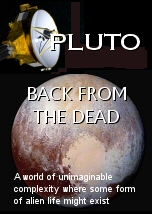
The incredible story of how Pluto has been propelled from an unremarkable ball of ice on the edge of the solar system to a world of unimaginable complexity - where some form of alien life might exist. New discoveries from the edge of the solar system are transforming what is known about Pluto, thanks to the New Horizons space probe that took the first-ever close up images of the planet. Pluto was once thought to be geologically dead, but the pictures revealed it to be an active world of stunning complexity, with mountains carved from ice, a nitrogen glacier that appeared to be moving and a recently active volcano, with data sent back lead some scientists to speculate that there may even be life on Pluto today.































A recent paper by researchers at the Harvard Smithsonian Center for Astrophysics raises the possibility that the elongated dark-red object, which is 10 times as long as it is wide and travelling at speeds of 196,000 mph, might have an 'artificial origin.' The theory is based on the object's 'excess acceleration,' or its unexpected boost in speed as it travelled through and ultimately out of our solar system.