It is the year 2546. Corporations rule the world, and an agent is on a secret mission to explore the untold stories of the past. His journey leads him into a secret virtual reality where one corporation has recreated the 1980s, an era that witnessed the birth of video game development, an event in which a politically and economically restricted small European country, Hungary, had a significant role. He discovers a strange but exciting world, where computers were smuggled through the Iron Curtain and serious engineers started developing games. This small country was still under Soviet pressure when a group of people managed to set up one of the first game development studios in the world, and western computer stores started clearing room on their shelves for Hungarian products. These developers really didn't know it was impossible, because they created games including amazing technical feats that even engineers at Commodore thought their machines weren't capable of.
With the advent of Bitcoin, the world's first digital currency, for the first time in history money is no longer controlled by banks or governments, but by the people who use it. But where did this currency come from? How does it work? And is it truly the way forward, or just a flash in the pan? Magic Money answers these questions and more as it explores the mysterious origins of Bitcoin, its role in society, and how it could shape the future in an eye opening film.
Artificially intelligent machines are taking over. They’re influencing our everyday lives in profound and often invisible ways. They can read handwriting, interpret emotions, play games, and even act as personal assistants. They are in our phones, our cars, our doctors’ offices, our banks, our web searches... the list goes on and is rapidly growing ever longer. But how does today’s A.I. actually work—and is it truly intelligent? And for that matter, what is intelligence? The world’s brightest computer programmers are trying to build brighter machines by reverse-engineering the brain and by inventing completely new kinds of computers, with exponentially greater speed and processing power. The documentary looks at how far we’ve come and where machines are headed as their software becomes ever more... cerebral. How close are we from a world in which computers take over—from diagnosing cancer to driving our cars to targeting weapons? If we place more and more of our lives under the control of these artificial brains, what are we putting at risk?
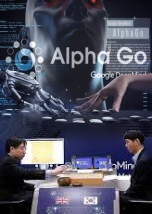
With more board configurations than there are atoms in the observable universe, the ancient Chinese game of 'Go' has long been considered a grand challenge for artificial intelligence. On March 9, 2016, the worlds of Go and AI collided in South Korea for an extraordinary best-of-five-game competition, coined the Google DeepMind Challenge Match. Hundreds of millions of people around the world watched as a legendary Go master took on an unproven AI challenger for the first time in history. AlphaGo chronicles a journey from the halls of Cambridge, through the backstreets of Bordeaux, past the coding terminals of DeepMind in London, and, ultimately, to the seven-day tournament in Seoul. As the drama unfolds, more questions emerge: What can artificial intelligence reveal about a 3000-year-old game? What can it teach us about human mind?
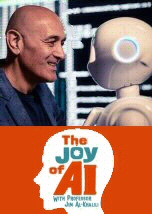
Professor Jim Al-Khalili looks at how we have created machines that can simulate, augment, and even outperform the human mind - and why we shouldn't let this spook us. He reveals the story of the pursuit of AI, the emergence of machine learning and the recent breakthroughs brought about by artificial neural networks. He shows how AI is not only changing our world but also challenging our very ideas of intelligence and consciousness.
Along the way, we'll investigate spam filters, meet a cutting-edge chatbot, look at why a few altered pixels makes a computer think it's looking at a trombone rather than a dog and talk to Demis Hassabis, who heads DeepMind and whose stated mission is to 'solve intelligence, and then use that to solve everything else'. Stephen Hawking remarked 'AI could be the biggest event in the history of our civilisation. Or the worst'. Jim argues that AI is a potent new tool that should enhance our lives, not replace us.
Bitcoin is the world's leading virtual currency, but unlike real money, it is not backed by a government or properly regulated. Bitcoin is exchanged and held digitally by users - which is attractive to criminals selling drugs, pornography and arms. But now Bitcoin is moving into the mainstream and being openly marketed as an investment opportunity. The film investigates what Bitcoin is and what it means, going inside a Bitcoin mine in Iceland - where currency is made - and spending time with the Bitcoin millionaires of Silicon Valley. The programme also hears from others who have been scammed out of their life savings and investors who think the cryptocurrency is an enormous scam and that the writing is on the wall. Around the world, authorities are sounding the alarm that Bitcoin is too risky - is it too late, or too crazy, to try to become a Bitcoin millionaire?













He discovers a strange but exciting world, where computers were smuggled through the Iron Curtain and serious engineers started developing games. This small country was still under Soviet pressure when a group of people managed to set up one of the first game development studios in the world, and western computer stores started clearing room on their shelves for Hungarian products. These developers really didn't know it was impossible, because they created games including amazing technical feats that even engineers at Commodore thought their machines weren't capable of.