






Last Watched

"Gen"  Sort by

What Makes Me

   2015    Medicine
'What Makes Me?', explores the question of how the brain gives rise to our thoughts, emotions, our memories and personality. Philosophers and great thinkers have for millennia pondered the question of how physical stuff can give rise to mental processes. Last century, the new field of neuroscience joined the discussion, and Dr David Eagleman explains that to a neuroscientist, the answers to such questions lie in a deep understanding of the brain.
Series: The Brain with David Eagleman
Why Do I Need You

   2015    Medicine
In ‘Why Do I Need You?’ Dr. David Eagleman explores how the human brain relies on other brains to thrive and survive. Our fundamentally social nature can hold the key to our sucdess as a species. Our brains are so fundamentally wired to interact that we are something more like a single vast super-organism. In this age of digital connection, we desperately need to understand how human brains interact if we want our civilization to have a future, if we want to avoid fanaticism and to embrace cooperation. This neural interdependence begins at birth. Dr. David Eagleman invites a group of babies to a puppet show to showcase their ability to discern who is trustworthy, and who isn’t.
Series: The Brain with David Eagleman
Flowering

   1995    Nature
The third episode is devoted to the ways in which plants reproduce. Pollen and a stigma are the two components needed for fertilisation. Most plants carry both these within their flowers and rely on animals to transport the pollen from one to the stigma of another. To do this, they attract their couriers with colour, scent and nectar. It isn't just birds that help pollination: some mammals and reptiles also do so. However, it is mostly insects that are recruited to carry out the task. To ensure that pollen is not wasted by being delivered to the wrong flower, some species of plant have developed exclusive relationships with their visitors, and the gentian and its attendant carpenter bees is one example. Since pollen can be expensive to produce in terms of calories, some plants, such as orchids, ration it by means of pollinia and a strategically placed landing platform. Other orchids offer no reward for pollination, but instead mislead their guests by mimicking their markings and aroma, thus enticing males to 'mate' with them (Pseudocopulation). The most extreme fertilisation method is one of imprisonment, and one plant that uses it is the dead horse arum. It is often found near gull colonies, and mimics the appearance and smell of rotting flesh. Blow-flies are attracted to it, and are forced to stay the night before being allowed to depart in the morning, laden with pollen. Finally, Attenborough introduces the world's largest inflorescence: that of the titan arum.
Series: The Private Life of Plants

Fractals Hunting the Hidden Dimension

   2010    Science
The ultimate adventure in scientific inquiry, this fascinating program follows the exploits of a small group of pioneering mathematicians who discovered a whole area of study that is revolutionizing all branches of understanding in the world: fractal geometry. Fractals are most recognized as a series of circular shapes with a border surrounded by jagged "tail-like" objects. The program, aimed at the average viewer does a fine job of explaining the background of fractals, first by beginning with the story of Pixar co-founder, Loren Carpenter's work at Boeing, developing 3D terrain from scratch using fractals. From there the program starts at the beginning with an introduction to Benoit Mandelbrot and his revolutionary work. The explanations are full of solid factual information but never talk above the level of a viewer who has some understanding of basic mathematical principles. Once the concept is presented the program spends the rest of the time showing how prevalent the fractal is in life. For a program about a mathematical concept, "Fractals" is very engaging, showing how the process was applied to special effects as far back as the Genesis planet from "Star Trek II" all the way to the spectacular finale on Mustafar in "Star Wars: Episode III." I found myself astonished at how fractals were the source of the lava in constant motion and action during the Obi-Wan/Anakin fight. What is more amazing is when the program delves into practical applications such as cell phone antennas, and eventually the human body. For the average person who enjoys watching science related programs, even on a sporadic basis, "Fractals" will prove to be a very worthwhile experience. The program is well produced, integrating talking head interviews (including some with Mandelbrot himself) with standard "in the field" footage. The structure of the program is very logical and never finds itself jumping around without direction. In simplest terms, this is a program as elegant as the designs it focuses on.

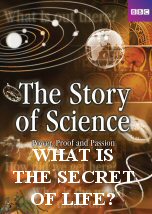
What is the Secret of Life

   2010    Science
The story of how the secret of life has been examined through the prism of the most complex organism known - the human body. It begins with attempts to save the lives of gladiators in Ancient Rome, unfolds with the macabre work and near-perfect drawings of Leonardo in the Renaissance, through the idea of the 'life force' of electricity, to the microscopic world of the cell. It reveals how a moral crisis unleashed by work on the nuclear bomb helped trigger a great breakthrough in biology - understanding the structure and workings of DNA.
Series: The Story of Science

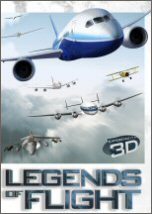
Legends of Flight

   2010    Technology    3D    HD
A film that will not only delight and entertain the aviation enthusiast but also educate and inspired renewed interest in aviation by the traveling public, the media and young people who may ultimately aspire to a career in aviation. It dramatized the design challenged, the financial risks and the many lessons learned from a century of aviation trial and error, bringing us to the dawn of a new era of revolutionary aircraft, the 787 Dreamliner and the A380". The film will focus on the 787 to facilitate audience understanding of the dynamic design differences between the two latest aircraft technologies. Search aviation history for the ultimate flying experience with some of today's greatest pilots. See how the airplanes of the 20th century helped influence the radical new design of 21st century aircraft. See how high tech manufacturers around the world use modern technology to coordinate the design and construction of new aircraft. Fly in the cockpit with chief test pilot, Mike Carriker, as he takes the new 787 Dreamliner on its first test flight.
Reel Rock

Reel Rock

2014  Culture
Top Science Stories

Top Science Stories

2020  Science
Walking with Dinosaurs

Walking with Dinosaurs

2025  Science
Motivation

Motivation

2017  Culture
How the Universe Works

How the Universe Works

2014  Science
The Last Dance

The Last Dance

2020  Culture
Universe

Universe

2021  Science