





Last Watched

"Sea"  Sort by

Mars: the New Evidence

   2010    Science
In the last few years, the Red Planet has yielded up many new clues that life may have once existed there...and may even exist there today. There is now have proof that water once flowed on the surface, that Mars once had lakes, and that the frozen poles are mostly water, not carbon dioxide as previously thought. Mars has snow--an aurora--and lightning generated by dust storms. Most intriguing of all are the seasonal plumes of methane that just may point to bacteria living below the surface.
Series: The Universe
Search for ET

   2007    Science
Are we alone? SETI--the Search for Extraterrestrial Intelligence--is a privately funded project using radio telescopes and optical telescopes to scan the stars for signals.
Series: The Universe

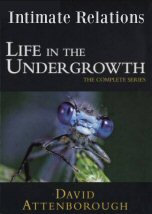
Intimate Relations

   2005    Nature
The world of invertebrates exists in a web of relationships with plants and other animals. Unique footage of the world's smallest insect (a fairy wasp only quarter of a millimetre long) shows it flying underwater to find the eggs of water beetles in which to lay its own brood. Some ants 'farm' the trees that give them shelter, creating areas known as 'Devil's gardens'. To make sure these grow without competition, they kill off other seedlings in the surrounding vegetation. The blister beetle's larvae huddle together on the end of a piece of grass and mimic a female bee. When a male bee tries to mate with the 'female', the larvae grab on to his belly. Confused, he flies away and searches for a real female. When he eventually finds her and mates with her, the beetle larvae hurriedly swap from his front on to her back, and hence get carried back to her nest where they eat her pollen supplies.
Series: Life in the Undergrowth

When Knowledge Conquered Fear

   2014    Science
The episode begins with Tyson describing how pattern recognition manifested in early civilization as using astronomy and astrology to predict the passing of the seasons, including how the passage of a comet was often taken as an omen. Tyson continues to explain that the origin of comets only became known in the 20th century due to the work of Jan Oort and his hypothesis of the Oort cloud. Tyson then continues to relate the collaboration between Edmond Halley and Isaac Newton in the last part of the 17th century in Cambridge. The collaboration would result in the publication of Philosophiæ Naturalis Principia Mathematica, the first major work to describe the laws of physics in mathematical terms, despite objections and claims of plagiarism from Robert Hooke and financial difficulties of the Royal Society of London. Tyson explains how this work challenged the prevailing notion that God had planned out the heavens, but would end up influencing many factors of modern life, including space flight. Tyson further describes Halley's contributions including determining Earth's distance to the sun, the motion of stars and predicting the orbit of then-unnamed Halley's Comet using Newton's laws. Tyson contrasts these scientific approaches to understanding the galaxy compared to what earlier civilizations had done, and considers this advancement as mankind's first steps into exploring the universe. The episode ends with an animation of the Milky Way and Andromeda galaxies' merging based on the principles of Newton's laws.
Series: Cosmos: A Spacetime Odyssey

Blues for a Red Planet

   1980    Science
The episode, devoted to the planet Mars, begins with scientific and fictional speculation about the Red Planet during the late nineteenth and early twentieth centuries (H. G. Wells' The War of the Worlds, Edgar Rice Burroughs' science fiction books, and Percival Lowell's false vision of canals on Mars). It then moves to Robert Goddard's early experiments in rocket-building, inspired by reading science fiction, and the work by Mars probes, including the Viking, searching for life on Mars. The episode ends with the possibility of the terraforming and colonization of Mars and a Cosmos Update on the relevance of Mars' environment to Earth's and the possibility of a manned mission to Mars.
Series: Cosmos

The Edge of Forever

   1980    Science
Beginning with the origins of the universe in the Big Bang, Sagan describes the formation of different types of galaxies and anomalies such as galactic collisions and quasars. The episodes moves further into ideas about the structure of the Universe, such as different dimensions (in the imaginary Flatland and four-dimensional hypercubes), an infinite vs. a finite universe, and the idea of an oscillating Universe (similar to that in Hindu cosmology). The search into other ideas such as dark matter and the multiverse is shown, using tools such as the Very Large Array in New Mexico. Cosmos Update shows new information about the odd, irregular surfaces of galaxies and the Milky Way perhaps being a barred spiral galaxy
Series: Cosmos