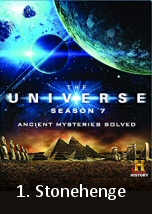
Perhaps the most mysterious structure on Earth, Stonehenge has stood on a plain in Southern England for 5000 years. Its foundations predate the Great Pyramids. It is one of mankind's most ancient mysteries. Why is it here? Is it a temple? A burial ground? A place for sacrifice? Or could the mystery of Stonehenge be revealed in its builders' desire to explore the unknown heavens and touch the universe? Using the cutting-edge computer-generated imagery that takes us into deep space, we'll also go inside a virtual Stonehenge to see what the ancients saw and push this prehistoric marvel to give up its age-old secrets. In this episode we explore the possibility that this was a prehistoric astronomical observatory. Here ancient astronomer priests may have divined the complex movements of the Sun and Moon, recognizing patterns that would not be discovered elsewhere for thousands of years. The primitive Shamans may have also been the first astronomers to predict eclipses.
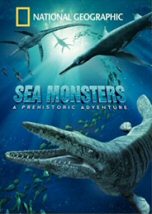
The setting alternates between prehistory and modern day times in which scientists study the fossilized remains of the creatures in the film. In 2009, a group of paleontologists discover a rare fossil in Kansas. The fossil was previously exposed by a summer rain, and it appears to be a marine reptile, tracing back over 70 million years. It was a female Dolichorhynchops and will be the inspiration for telling the story of Dolly, who travels the Kansas Inland Sea, 80 million years ago during the late Cretaceous period with her family. The film brings to life some of the most bizarre, ferocious and fascinating creatures to ever inhabit the ocean, incluing Tylosaurus, Xiphactinus, Cretoxyrhina, and Ammonite. It combines animation with recreations in a 3D prehistoric adventure. A journey to the bottom of the ancient oceans dramatizes awe-inspiring creatures.
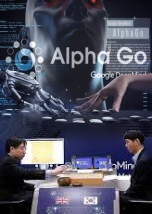
With more board configurations than there are atoms in the observable universe, the ancient Chinese game of 'Go' has long been considered a grand challenge for artificial intelligence. On March 9, 2016, the worlds of Go and AI collided in South Korea for an extraordinary best-of-five-game competition, coined the Google DeepMind Challenge Match. Hundreds of millions of people around the world watched as a legendary Go master took on an unproven AI challenger for the first time in history. AlphaGo chronicles a journey from the halls of Cambridge, through the backstreets of Bordeaux, past the coding terminals of DeepMind in London, and, ultimately, to the seven-day tournament in Seoul. As the drama unfolds, more questions emerge: What can artificial intelligence reveal about a 3000-year-old game? What can it teach us about human mind?
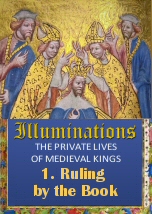
Dr Janina Ramirez unlocks the secrets of illuminated manuscripts that were custom-made for kings and explores the medieval world they reveal. 'Ruling by the Book.' Janina begins her journey with the first Anglo-Saxon rulers to create a united England, encountering books in the British Library's Royal manuscripts collection which are over a thousand years old and a royal family tree which is five metres long. Janina finds out about a king who had a reputation for chasing nuns and reads a book created as a wedding gift for a ten-year-old prince. She roams from Westminster Abbey to other ancient English spiritual sites such as Winchester, St Albans and Malmesbury, and sees for herself how animal skins can be transformed into the finest vellum.
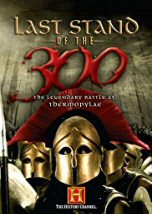
In the year 480 B.C., the Greeks and the Persians fight one of the most famous battles in history at a place called Thermopylae. Here, the mighty Persian war machine, which has conquered most of the known world, will attempt an expansion into Europe. The only thing standing in their way will be an army led by 300 Spartans, the greatest soldiers the world has ever known. They will fight to the very last man, and in doing so will protect the cradle of democracy during its infancy, and the battle will go down in history as the greatest military stand of all time.
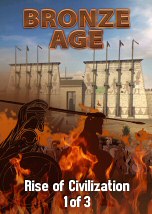
The Bronze Age covers 2,000 years of history in the Aegean/Mediterranean, Egypt and Near East from roughly 3000 BC to 1000 BC. New animations produced by Pixeldust include the reconstruction of four ancient capitals, including the Egyptian city of Thebes and the early Greek capital of Mycenae. What singled out this period and the new societies and cities that emerged? The development of formal writing is one among several important factors.



















In this episode we explore the possibility that this was a prehistoric astronomical observatory. Here ancient astronomer priests may have divined the complex movements of the Sun and Moon, recognizing patterns that would not be discovered elsewhere for thousands of years. The primitive Shamans may have also been the first astronomers to predict eclipses.