

Last Watched

"Gen"  Sort by

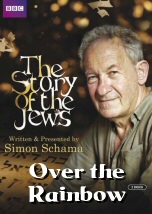
Over the Rainbow

   2013    Culture
With optional Hebrew subtitles. Simon Schama's history of the Jewish experience plunges into the lost world of the shtetl, the Jewish towns and villages sewn across the hinterlands of Eastern Europe which became the seedbed of a uniquely Jewish culture. Shtetl culture would make its mark on the modern world, from the revolutionary politics of the Soviet Union to the mass culture of Tin Pan Alley and Hollywood. It was also the birthplaces of Hasidism, the most visible, iconic and, arguably, most misunderstood expression of Jewish faith and fervour. This chapter of the story travels from the forests of Lithuania, where Simon's own family logged wood and fought wolves, to the streets of the Lower East Side where the sons of shtetl immigrants wrote the American songbook. With grim inevitability, the story returns to Eastern Europe in 1940 - where the genocidal mechanisms of the 'final solution' were beginning to grind the shtetl world into dust and ash.
Series: The Story of the Jews

Champs

   2015    Culture
Boxing, 'the poor man's sport', has long given kids from America's roughest neighborhoods an opportunity to escape violence with violence. But with success in the ring comes new fights for which there is no training: champions are made and broken in the blink of an eye, and young men thrust into the spotlight are often ill-equipped for the fame, fortune, and hangers-on that accompany a title belt". And for many, the toughest bouts are fought during retirement, when health and financial issues begin to mount. Built around the stories of heavyweight legends as Mike Tyson, Evander Holyfield and Bernard Hopkins, We will examine their lives in and out of the ring.

How Do I Decide

   2015    Medicine
The human brain is the most complex object we’ve discovered in the universe, and every day much of its neural circuitry is taken up with the tens of thousands of decisions we need to make. ‘How do I decide?’ is a journey through the unseen world of decisions, and how they get made. Decisión-making is what allows us to navigate a course through life. Discover how important emotions are in making decissions and, as we learn more about our own brains, we can break away from slavery to our impulses. Neuroscience shows that you're made up of multiple competing drives and by understanding how choices battle it out in the brain, we can learn how to make better decisions.
Series: The Brain with David Eagleman

Who Will We Be

   2015    Medicine
In ‘Who will we be?’ Dr. David Eagleman journeys into the future, and asks what’s next for the human brain, and for our species. We stand at a major turning point, one where we might take control of our own development. We face a future of uncharted possibilities in which our relationship with our own body, our relationship with the world, the very basic nature of who we are is set to be transformed. For thousands of generations, humans have lived the same life cycle over and over. We are born, we control a fragile body, we experience a limited reality, and we die. But science and technology are giving us tools to transcend that evolutionary story. Our brains don't have to remain as we have inherited them. We are capable of extending our reality, of inhabiting new bodies, and possibly shedding our physical forms altogether. And we are discovering the tools to shape our own destiny. Who we become is up to us.
Series: The Brain with David Eagleman

The Social Struggle

   1995    Nature
Fourth episode examines how plants either share environments harmoniously or compete for dominance within them. Attenborough highlights the 1987 hurricane and the devastation it caused. However, for some species, it was that opportunity for which they had lain dormant for many years. The space left by uprooted trees is soon filled by others who move relatively swiftly towards the light. The oak is one of the strongest and longest-lived, and other, lesser plants nearby must wait until the spring to flourish before the light above is extinguished by leaves. Tropical forests are green throughout the year, so brute force is needed for a successful climb to the top of the canopy: the rattan is an example that has the longest stem of any plant. As its name suggests, the strangler fig 'throttles' its host by growing around it and cutting off essential water and light. Some can take advantage of a fallen tree by setting down roots on the now horizontal trunk and getting nutriment from the surrounding moss and the fungi on the dead bark. The mountain ash (eucalyptus regnans) grows so tall, that regeneration becomes a considerable problem. It is easily flammable, so its solution is to shed its seeds during a forest fire and sacrifice itself. It therefore relies on the periodic near-destruction of its surroundings in order to survive. Attenborough observes that catastrophes such as fire and drought, while initially detrimental to wildlife, eventually allow for deserted habitats to be reborn.
Series: The Private Life of Plants

The Private Life of Plants Living Together

   1995    Nature
The fifth programme explores the alliances formed between the animal and plant worlds. Attenborough dives into Australia's Great Barrier Reef and contrasts the nocturnal feeding of coral, on microscopic creatures, with its daytime diet of algae. Some acacias are protected by ants, which will defend their refuge from any predator. Besides accommodation, the guards are rewarded with nectar and, from certain species, protein for their larvae as well. Fungi feed on plants but can also provide essential nutriment to saplings (Mycorrhiza). The connection is never broken throughout a tree's life and a quarter of the sugars and starches produced in its leaves is channelled back to its fungal partners. Meanwhile, fungi that feed on dead wood leave a hollow trunk, which also benefits the tree. Orchids enjoy a similar affiliation. Lichens are the product of a relationship between fungi and a photosynthetic associate, usually algae. They are extremely slow-growing, and a graveyard is the perfect location to discover their exact longevity. Mistletoe is a hemiparasite that obtains its moisture from a host tree, while using own leaves to manufacture food. Its seeds are deposited on another by the mistletoe tyrannulet, following digestion of the fruit. The dodder (Cuscuta) is also parasitic, generally favouring nettles, and siphons its nourishment through periodic 'plugs' along its stem. The rafflesia has no stem or leaves and only emerges from its host in order to bloom — and it produces the largest single flower: one metre across.
Series: The Private Life of Plants
The Germanic Tribes

The Germanic Tribes

2007  History
Walking with Dinosaurs

Walking with Dinosaurs

2025  Science
Empire of the Tsars

Empire of the Tsars

2017  History
The Sky at Night

The Sky at Night

2024  Science
Long Way Up

Long Way Up

2020  Culture