Planets beyond our solar system are known to astronomers as exoplanets. They are at trillions of miles from Earth and yet, it might be possible to detect a faint signature of life in them. From the light of the stars they orbit that passes through the atmosphere of an exoplanet, it is possible to capture the chemical fingerprint of the elements in that atmosphere. The fictional world Eden is orbiting not one star, but two. The light from its twin stars powers photosynthesis, pumping more oxygen into the atmosphere than in Earth, allowing life to thrive. Grazers are constantly alert to danger, because the canopy is home to predators perfectly evolved to live among the trees. In Episode 3, another topic are fungi and the role they could play on exoplanets. Ecologist Thomas Crowther talks about the role mycelial networks play in the Rothiemurchus forest in Scotland.
What sort of alien civilizations might exist in the vastness of space? Terra is the fictional world imagined in Episode 4, a planet nine billion years old, twice as old as Earth. Old enough that a truly advanced intelligence could evolve. It was once a fertile world, now it is barren. But life can still thrive here in artificial domes. Over time, they've evolved not to need their bodies. They exist only as neural tissue. They never age, they never die. They're monitored and maintained by robots. If alien civilizations are statistically so likely, why haven't astronomers found any sign of them? Where is everyone? Every time we look at an individual star, that's like dropping a bucket in the ocean. We're going to have to look at a lot of stars and to search through a lot of data until we find the clue that leads us to another civilization.
Without the chemistry of photosynthesis, ozone, and a molecule called Rubisco, none of us would be here. So how did we get so lucky? To find out, host David Pogue investigates the surprising molecules that allowed life on Earth to begin, and ultimately thrive. Along the way, he finds out what we’re all made of—literally.
In the third episode, the discovery of extraterrestrial life might face an impossible challenge: the physics of the universe itself; but using cutting-edge tech, experts might be on the verge of a groundbreaking find -- and the evidence could already be in hand.
Stars helped create us, building and spreading the ingredients for life to develop. But there will definitely be a point in the future when, in the future when, you look up, you will no longer be able to see stars. For billions of years, stars brought life to the universe. Now, they're dying out in a star apocalypse. What's causing the die-off, and what happens to life when the lights go out?
David Attenborough reveals the extraordinary ways that some animals use colour to hide and disappear into the background. New science reveals how the Bengal tiger in central India uses its orange-black stripes to hide from its colour-blind prey. In Kenya’s Masai Mara, the zebra’s black-and-white pattern confuses predators with an extraordinary effect called motion dazzle. And on the island of Cuba, a small snail uses colourful stripes in a surprising way to hide from its enemies. Other animals use colour to trick and to deceive. On Australia’s Great Barrier Reef, a blue-striped blenny uses colours to mimic other fish and launch a sudden attack. In the grasslands of Zambia, the chick of a pin-tailed whydah mimics the patterns of its nest mates to ensure that it is not detected as an imposter. And specialist cameras reveal how a tiny crab spider uses bright ultraviolet colours to lure in its victims.











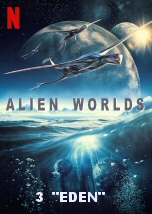







The fictional world Eden is orbiting not one star, but two. The light from its twin stars powers photosynthesis, pumping more oxygen into the atmosphere than in Earth, allowing life to thrive. Grazers are constantly alert to danger, because the canopy is home to predators perfectly evolved to live among the trees. In Episode 3, another topic are fungi and the role they could play on exoplanets. Ecologist Thomas Crowther talks about the role mycelial networks play in the Rothiemurchus forest in Scotland.