







Last Watched

"Gen"  Sort by

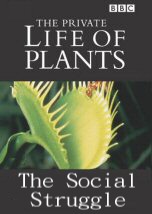
The Social Struggle

   1995    Nature
Fourth episode examines how plants either share environments harmoniously or compete for dominance within them. Attenborough highlights the 1987 hurricane and the devastation it caused. However, for some species, it was that opportunity for which they had lain dormant for many years. The space left by uprooted trees is soon filled by others who move relatively swiftly towards the light. The oak is one of the strongest and longest-lived, and other, lesser plants nearby must wait until the spring to flourish before the light above is extinguished by leaves. Tropical forests are green throughout the year, so brute force is needed for a successful climb to the top of the canopy: the rattan is an example that has the longest stem of any plant. As its name suggests, the strangler fig 'throttles' its host by growing around it and cutting off essential water and light. Some can take advantage of a fallen tree by setting down roots on the now horizontal trunk and getting nutriment from the surrounding moss and the fungi on the dead bark. The mountain ash (eucalyptus regnans) grows so tall, that regeneration becomes a considerable problem. It is easily flammable, so its solution is to shed its seeds during a forest fire and sacrifice itself. It therefore relies on the periodic near-destruction of its surroundings in order to survive. Attenborough observes that catastrophes such as fire and drought, while initially detrimental to wildlife, eventually allow for deserted habitats to be reborn.
Series: The Private Life of Plants
The Private Life of Plants Living Together

   1995    Nature
The fifth programme explores the alliances formed between the animal and plant worlds. Attenborough dives into Australia's Great Barrier Reef and contrasts the nocturnal feeding of coral, on microscopic creatures, with its daytime diet of algae. Some acacias are protected by ants, which will defend their refuge from any predator. Besides accommodation, the guards are rewarded with nectar and, from certain species, protein for their larvae as well. Fungi feed on plants but can also provide essential nutriment to saplings (Mycorrhiza). The connection is never broken throughout a tree's life and a quarter of the sugars and starches produced in its leaves is channelled back to its fungal partners. Meanwhile, fungi that feed on dead wood leave a hollow trunk, which also benefits the tree. Orchids enjoy a similar affiliation. Lichens are the product of a relationship between fungi and a photosynthetic associate, usually algae. They are extremely slow-growing, and a graveyard is the perfect location to discover their exact longevity. Mistletoe is a hemiparasite that obtains its moisture from a host tree, while using own leaves to manufacture food. Its seeds are deposited on another by the mistletoe tyrannulet, following digestion of the fruit. The dodder (Cuscuta) is also parasitic, generally favouring nettles, and siphons its nourishment through periodic 'plugs' along its stem. The rafflesia has no stem or leaves and only emerges from its host in order to bloom — and it produces the largest single flower: one metre across.
Series: The Private Life of Plants
Crash Landing on Mars

   2011    Technology
What might happen if the first manned mission to Mars crashes hundreds of miles from the rocket that would take them back home? Could they survive the crash, and travel across the brutal Martian surface to their home ship? We'll show what the astronauts would have to do to survive dust storms and space radiation, while extracting vital resources like water from the Martian soil itself. It's a dramatic vision of the very near future, where survival can depend on pre-industrial technology and human ingenuity.

God and the Universe

   2011    Science    3D    HD
Since the dawn of civilization, humans have wondered who or what created the universe. Religion offers a spiritual answer, but do the latest discoveries in physics show evidence of a transcendent intelligence, or simply that the laws of physics by themselves could have led to the universe in which we live? This episode embarks on a mind-bending scientific search for God, asking physicists and theologians if the seemingly miraculous way the universe has been calibrated to support life is evidence of a creator...whether string theory will eventually be able to rule out the existence of God...why Stephen Hawking says the universe could have been created spontaneously...and how an advanced civilization in another universe could have conceivably created our own.
Series: The Universe

Aliens

   2010    Nature    HD
Stephen Hawking, the world's most famous living scientist explores the greatest mysteries of the cosmos. In three landmark instalments he reveals the wonders of the universe as never seen before. Definitive, provocative, surprising, and beautiful, Into the Universe with Stephen Hawking is a fascinating look through the mind's eye of one of the finest brains on the planet. In 'Aliens' Hawking considers one of the most important mysteries facing humankind - the possibility of alien, intelligent life. He leads us on a journey rendered in eye-popping detail, from the moons of Jupiter to a galaxy maybe not so far, far away. We will meet possible aliens and wonder at their form, we will delve into the very principles of what it is to call something alive, and we will calculate the likelihood of 'contact' being made.
Series: Into The Universe with Stephen Hawking

The Story of Everything

   2010    Science    HD
In less than two eye-popping hours, Stephen Hawking reveals the wonders of the cosmos to a new generation. Delve into the mind of the world's most famous living scientist and reveal the splendor and majesty of the universe as never seen before. See how the universe began, how it creates stars, black holes and life -- and how everything will end.
Series: Into The Universe with Stephen Hawking
The Sky at Night

The Sky at Night

2018  Science
Leaving Neverland

Leaving Neverland

2019  Culture
The Toys that Made Us

The Toys that Made Us

2017  Technology
The Dinosaurs

The Dinosaurs

2026  Science
The Universe

The Universe

2007  Science
The Sky at Night

The Sky at Night

2024  Science