




Last Watched

"Eating"  Sort by

Return

   2013    History
With optional Hebrew subtitles. Simon Schama's history of the Jewish experience ends with an examination of how the Holocaust and the creation of Israel have fundamentally changed what it means to be Jewish. Mixing personal recollection with epic history, Simon tells the story of the remarkable personalities and unprecedented events which turned the Zionist dream of creating a modern state of Israel into reality - and the consequences for the world. With contributions from writer David Grossman, photographer Micha Bar-Am, kibbutz founder Freddie Kahan, West Bank settler Zvi Cooper and Palestinian villager Yacoub Odeh. This film explores the tension between the high ideals and dire necessities that led to the creation of a Jewish homeland and the realities of conflict, dispossession and occupation that have followed in its wake.
Series: The Story of the Jews

A LEGO Brickumentary

   2014    Technology
Since the birth of their trademark toy in 1958, The LEGO Group has produced over 400 billion bricks. But more and more, LEGO bricks aren't just for kids, and some take them very seriously. Adult Fans of LEGO around the globe are unashamedly declaring their love of the brick, brick artists are creating stunning and surprising creations, and LEGO master builders are building human scale and larger structures. LEGO bricks are being used educationally, therapeutically, and have provided a universal system for human creativity and our innate desire "to build." This documentary playfully delves into the extraordinary impact of the LEGO brick, its massive global fan base, and the innovative uses for it that has sprung up around the world.

Curing Cancer

   2017    Medicine
A thought-provoking and imaginative perspective on a scientific discovery. Follow maverick doctors who supercharge killer T cells, creating a breakthrough treatment for cancer.

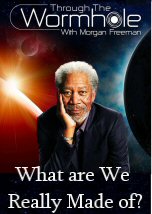
What are We Really Made of

   2011    Science
What is the universe made of? If you answered stars, planets, gas and dust, you'd be dead wrong. Thirty years ago, scientists first realized that some unknown dark substance was affecting the way galaxies moved. Today, they think there must be five times our understanding of the universe and the nature of reality itself has drastically changed over the last 100 years - and it's on the verge of another seismic shift. In a 17-mile-long tunnel buried 570 feet beneath the Franco-Swiss border, the world's largest and most powerful atom smasher, the Large Hadron Collider, is powering up. Its goal is nothing less than recreating the first instants of creation, when the universe was unimaginably hot and long-extinct forms of matter sizzled and cooled into stars, planets, and ultimately, us. These incredibly small and exotic particles hold the keys to the greatest mysteries of the universe. What we find could validate our long-held theories about how the world works and what we are made of -- or, all of our notions about the essence of what is real will fall apart.
Series: Through the Wormhole

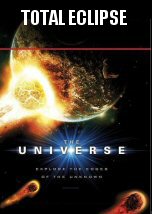
Total Eclipse

   2010    Science
Once they were dreaded and thought to be dragons eating the sun--but modern science has dispelled mythology and we now look forward to total Solar Eclipses as one of the most spectacular phenomena in the heavens. Explore the complex movements of Earth, Moon and Sun that produce these unusual events and hear details why we may be the only intelligent beings in the known Universe to witness eclipses like we see on Earth. Man-made eclipses also figure into the science in the form of instruments called "coronagraphs." They blot out the sun and reveal its corona, uncovering secrets which, while enlightening, also warn of a disaster that could make our advanced technology crash and burn. Finally, travel into deep space, where the tiny eclipses caused by planets circling distant stars is now beginning to reveal hundreds more stars where "exoplanets" exist... perhaps even those in habitable zones like the Earth.
Series: The Universe

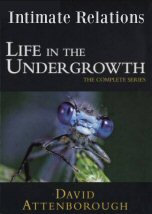
Intimate Relations

   2005    Nature
The world of invertebrates exists in a web of relationships with plants and other animals. Unique footage of the world's smallest insect (a fairy wasp only quarter of a millimetre long) shows it flying underwater to find the eggs of water beetles in which to lay its own brood. Some ants 'farm' the trees that give them shelter, creating areas known as 'Devil's gardens'. To make sure these grow without competition, they kill off other seedlings in the surrounding vegetation. The blister beetle's larvae huddle together on the end of a piece of grass and mimic a female bee. When a male bee tries to mate with the 'female', the larvae grab on to his belly. Confused, he flies away and searches for a real female. When he eventually finds her and mates with her, the beetle larvae hurriedly swap from his front on to her back, and hence get carried back to her nest where they eat her pollen supplies.
Series: Life in the Undergrowth
Modern Masters

Modern Masters

2024  Art
Ancient Apocalypse

Ancient Apocalypse

2022  History
The Rehearsal Season 2

The Rehearsal Season 2

2025  Culture
Human

Human

2025  History
Leaving Neverland

Leaving Neverland

2019  Culture
Planet Dinosaur

Planet Dinosaur

2011  Science