










Last Watched

"Plant"  Sort by

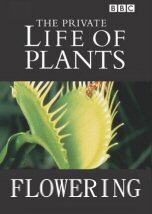
Flowering

   1995    Nature
The third episode is devoted to the ways in which plants reproduce. Pollen and a stigma are the two components needed for fertilisation. Most plants carry both these within their flowers and rely on animals to transport the pollen from one to the stigma of another. To do this, they attract their couriers with colour, scent and nectar. It isn't just birds that help pollination: some mammals and reptiles also do so. However, it is mostly insects that are recruited to carry out the task. To ensure that pollen is not wasted by being delivered to the wrong flower, some species of plant have developed exclusive relationships with their visitors, and the gentian and its attendant carpenter bees is one example. Since pollen can be expensive to produce in terms of calories, some plants, such as orchids, ration it by means of pollinia and a strategically placed landing platform. Other orchids offer no reward for pollination, but instead mislead their guests by mimicking their markings and aroma, thus enticing males to 'mate' with them (Pseudocopulation). The most extreme fertilisation method is one of imprisonment, and one plant that uses it is the dead horse arum. It is often found near gull colonies, and mimics the appearance and smell of rotting flesh. Blow-flies are attracted to it, and are forced to stay the night before being allowed to depart in the morning, laden with pollen. Finally, Attenborough introduces the world's largest inflorescence: that of the titan arum.
Series: The Private Life of Plants
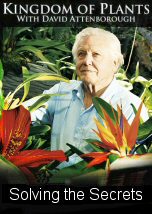

Solving the Secrets

   2012    Nature    3D    HD
Bladderwort utricularia is a pond-dweller that is among the fastest known, its traps snapping shut in less than a millisecond. As the seasons change, David demonstrates how plants operate on a different time scale to us; how they modify their lives according to the time of year. We discover insects’ hidden links with plants, both as pests and pollinators. UV-sensitive 3D cameras reveal the invisible alter-ego of plants and their flowers’ mesmerizing patterns; a parallel-dimension of strange colours and stunning patterns through which plants communicate with them. With the aid of visual effects, David steps among the swirling vortices of plant scent; communication signals with which plants are inextricably plugged in to the natural world. And using a tuning fork, he demonstrates how plants and insects can even communicate with music. As autumn envelopes the Gardens, fungi reveal themselves not as the enemies of plants but their vital allies. In Kew’s atmospheric Fungarium, David discovers a specimen that has the power of mind control and another that lives underground where it has grown to be so big it can be counted as the largest single organism on the planet. It is 6 times bigger than Kew Gardens itself.
Series: Kingdom of Plants

Only the Dead

   2016    History
A war story unlike any ever seen. A story of what happens when one ordinary man, Time magazine war correspondent Michael Ware, transplanted into the Middle East by the reverberations of 9/11, butts into history. Ware handpicked and given a shattering video tape by the most feared, most hated terrorists on the planet to announce his arrival of the world stage sets out on an epic journey into the deepest recesses of the conflict as he seeks answers. Answers that he thinks will lead him to the Truth. The invasion of Iraq has ended, and the Americans are celebrating victory. The year is 2003. Alone and in secret one man, Abu Musab al Zarqawi is planning the real war. Step- by-step he lays out his plan in a letter to Osama bin Laden: the suicide truck bombings; the bloody horrors of the civil war; the televised beheadings. He carries out his grand design to transform the invasion into one of the most brutal conflicts our time and a catastrophe for the planet...and he does it all on camera. He gives the tape to Michael Ware. The tape sets our correspondent off on an epic voyage as he seeks answers. As he seeks what he thinks will be the Truth.

Boko Haram and Unnatural Selection

   2015    Culture
The terrorist group Boko Haram is responsible for thousands of deaths in Nigeria. Now, the government is determined to drive these militants from the country. But is the hunt for insurgents causing as much harm as it's preventing? Former Navy SEAL and new VICE correspondent Kaj Larsen travels to Nigeria to see what this cat-and-mouse game means for the people caught in the middle of the fight. 'Unnatural Selection': For centuries, scientists have been working to change the genetic traits of plants and animals. Now, the new gene-editing method CRISPR has made that process astonishingly simple - so simple it could easily be used on humans. Isobel Yeung reports from Brazil, Scotland, China and the U.S. on the technological advances that could reshape evolution as we know it.

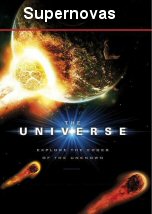
Supernovas

   2008    Science
A stellar explosion, the supernova is the sensational death of a star. It can shine as bright as 100 billion Suns and radiate as much energy as the Sun would emit over 10 billion years. Jets of high-energy light and matter are propelled into space and can cause massive Gamma Ray Bursts and emit intense X-ray radiation for thousands of years. Astronomers believe that this process creates the very building blocks of planets, people and plants. Meet the world's leading Supernova hunters, and take a look at recorded supernovas throughout history.
Series: The Universe

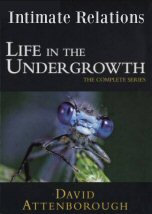
Intimate Relations

   2005    Nature
The world of invertebrates exists in a web of relationships with plants and other animals. Unique footage of the world's smallest insect (a fairy wasp only quarter of a millimetre long) shows it flying underwater to find the eggs of water beetles in which to lay its own brood. Some ants 'farm' the trees that give them shelter, creating areas known as 'Devil's gardens'. To make sure these grow without competition, they kill off other seedlings in the surrounding vegetation. The blister beetle's larvae huddle together on the end of a piece of grass and mimic a female bee. When a male bee tries to mate with the 'female', the larvae grab on to his belly. Confused, he flies away and searches for a real female. When he eventually finds her and mates with her, the beetle larvae hurriedly swap from his front on to her back, and hence get carried back to her nest where they eat her pollen supplies.
Series: Life in the Undergrowth
100 Foot Wave

100 Foot Wave

2021  Culture
Frozen Planet

Frozen Planet

2011  Nature
Sex Explained

Sex Explained

2020  Medicine
Food Inc

Food Inc

2009  Technology
The Story of God

The Story of God

2016  Culture
The Gene Code

The Gene Code

2011  Science
Minimalism

Minimalism

2015  Culture