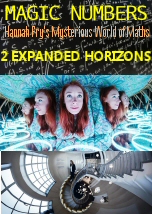
Dr Hannah Fry travels down the fastest zip wire in the world to learn more about Newton's ideas on gravity. His discoveries revealed the movement of the planets was regular and predictable. James Clerk Maxwell unified the ideas of electricity and magnetism, and explained what light was. As if that wasn't enough, he also predicted the existence of radio waves. His tools of the trade were nothing more than pure mathematics. All strong evidence for maths being discovered. But in the 19th century, maths is turned on its head when new types of geometry are invented. No longer is the kind of geometry we learned in school the final say on the subject. If maths is more like a game, albeit a complicated one, where we can change the rules, surely this points to maths being something we invent - a product of the human mind. To try and answer this question, Hannah travels to Halle in Germany on the trail of perhaps one of the greatest mathematicians of the 20th century, Georg Cantor. He showed that infinity, far from being infinitely big, actually comes in different sizes, some bigger than others. This increasingly weird world is feeling more and more like something we've invented. But if that's the case, why is maths so uncannily good at predicting the world around us? Invented or discovered, this question just got a lot harder to answer.
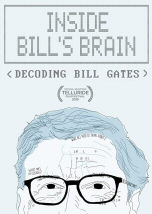
The search for climate change solutions requires passion, resources and a sense of urgency -- three qualities Bill Gates clearly possesses. Bill has founded a start-up called TerraPower. After extensive computer modelling, the idea showed promise. Its new reactor greatly reduced the chance of human error. Fuelled by depleted uranium, the travelling wave reactor functions like a slow-burning candle and requires refuelling only once every decade. Bill and his team believed they had finally developed the ideal energy source, a reactor that was clean, efficient, and most importantly, safe.
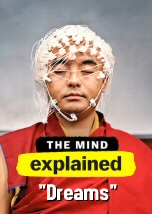
The second episode of the series looks at dreams and tries to explain what happens in the brain and body after we go to sleep. It looks at the significance of dreams and what dreams can teach us about ourselves. It talks to neuroscientists who discuss slow-wave sleep and REM (rapid eye movement) sleep during which dreams occur. It looks at the history of dream interpretation and its validity.
Across the world, rising demands for food, water and materials have pushed resources to the limit. Many parts of the world have major challenges over fresh water. A lot of soils have a lot of residual pesticides and herbicides. At the same time waste is piling higher. All this demands a new wave of innovation. The challenge is to make more of the things we need without the environmental cost.
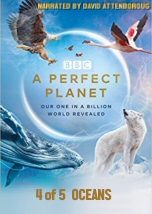
Oceans are the largest ecosystem on earth, covering two thirds of our world’s surface and providing half the oxygen in our atmosphere. They are home to as much as 80 per cent of all life on earth, and nearly three billion people rely on them for their primary source of food. But our planet’s oceans would be little more than stagnant wastelands, and life on planet earth would cease to exist, were it not for one simple factor: a global network of powerful ocean currents. Every drop of seawater on earth rides these currents, taking 1,000 years to complete a single circuit. Without the constant mixing of currents, tides and waves, our oceans would stop supporting life - and a healthy ocean is vital to a healthy planet.
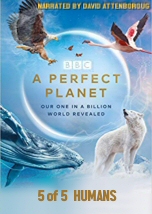
A new force threatens our perfect planet. In the past, five mass extinction events were caused by cataclysmic volcanic eruptions. It was not the lava or ash that wiped out life, but an invisible gas released by volcanoes: carbon dioxide. Almost every part of modern life depends on energy created by burning fossil fuels, and this produces CO2 in huge amounts. Humans are changing our planet so rapidly, it’s affecting earth’s life support systems: our weather, our oceans and the living world. The greatest change to be made is in how we create energy, and the planet is brimming with natural power that can help us do just that. It’s these forces of nature - the wind, the sun, waves and geothermal energy - that hold the key to our future. Through compelling animal-led stories and expert interviews, we discover how CO2 is destabilising our planet. We meet rescued orphaned elephants in Kenya, victims of ever worsening droughts, and join ocean patrols off the coast of Gabon fighting to save endangered sharks. In the Amazon, we witness wildlife teams saving animals in the shrinking forests, and in San Diego we enter a cryogenic zoo preserving the DNA of endangered species before they become extinct.















But in the 19th century, maths is turned on its head when new types of geometry are invented. No longer is the kind of geometry we learned in school the final say on the subject. If maths is more like a game, albeit a complicated one, where we can change the rules, surely this points to maths being something we invent - a product of the human mind. To try and answer this question, Hannah travels to Halle in Germany on the trail of perhaps one of the greatest mathematicians of the 20th century, Georg Cantor. He showed that infinity, far from being infinitely big, actually comes in different sizes, some bigger than others. This increasingly weird world is feeling more and more like something we've invented. But if that's the case, why is maths so uncannily good at predicting the world around us? Invented or discovered, this question just got a lot harder to answer.