



Last Watched

"Han"  Sort by

January to March

   2014    Nature
In this second episode we travel from January to the March equinox. Kate Humble gets closer to the Sun than she has ever been before, whilst Helen Czerski visits a place that gets some of the biggest and fastest snowstorms on Earth.
Series: Orbit: Earth Extraordinary Journey

Comets: Frozen Wanderers

   2012    Science
We think of comets as beautiful glowing balls of light streaking across our skies with their long sweeping tails, yet comets are so much more than just a cosmic firework display. Comets have a uniquely important place in modern science. As time machines from the early universe, they could hold the key to unlock the secrets of the cosmos. Comets could even be the origin of life itself. We follow the incredible odyssey of a comet as it sails through the solar system, watching it's every move as it evolves from a dormant chunk of ice and rock into a tumbling, violently active nucleus engulfed in a gaseous haze. What we learn is a revelation; comets are even more mysterious and fascinating than we had ever imagined.
Series: How the Universe Works

The Last Lions

   2011    Nature
Fifty years ago there were close to half-a-million lions in Africa. Today there are around 20,000. To make matters worse, lions, unlike elephants, which are far more numerous, have virtually no protection under government mandate or through international accords. This is the jumping-off point for a disturbing, well-researched and beautifully made cri de coeur from husband and wife team Dereck and Beverly Joubert, award-winning filmmakers from Botswana who have been Explorers-in-Residence at National Geographic for more than four years. Pointing to poaching as a primary threat while noting the lion's pride of place on the list for eco-tourists-an industry that brings in 200 billion dollars per year worldwide-the Jouberts build a solid case for both the moral duty we have to protect lions (as well as other threatened "big cats," tigers among them) and the economic sense such protection would make. And when one takes into account the fact that big cats are at the very top of the food chain-and that their elimination would wreak havoc on all species below them, causing a complete ecosystem collapse-the need takes on a supreme urgency.

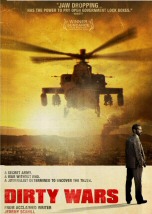
Dirty Wars

   2013    Culture
Investigative journalist Jeremy Scahill travels to Afghanistan, Yemen, Somalia, and other countries where the United States has taken military action in the War on Terror. In Afghanistan, he investigates the United States military and government cover-up of the deaths of five civilians, including two pregnant women killed by US soldiers from the Joint Special Operations Command. After investigating the attack, Scahill travels to other sites of JSOC intervention, interviewing both proponents and opponents, and the survivors, of such raids,including U.S. Senator Ron Wyden. Scahill also investigates the assassinations of American citizens Anwar al-Awlaki and his son Abdulrahman al-Awlaki, meeting with their family at their home in Yemen. Scahill suggests that the War on Terror is in fact a "self-fulfilling prophecy" and causes the radicalization of Muslims. He also discusses the case of Yemeni investigative journalist Abdulelah Haider Shaye who was detained, tried and sentenced on terrorism-related charges after reporting on American drone strikes.

More Than Human

   2015    Technology
Scientific advancements are challenging the concept of what it means to be human. Technology embedded in our bodies is fairly common: artificial limbs, pacemakers. But new research is taking us beyond replacement parts and into a new realm that is changing the nature of the human body and the human mind. Will the fusion of biology and technology change how we think, how we feel, how we experience the world?

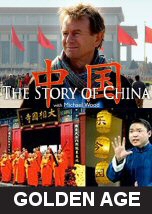
The Golden Age

   2016    History
This episode tells the tale of what's broadly considered China's most creative dynasty - the Song (960-1279). Michael Wood heads to the city of Kaifeng, the greatest city in the world before the 19th century. Here in Twin Dragon Alley, locals tell him the legend of the baby boys who became emperors.
He explores the ideas and inventions that made the Song one of greatest eras in world culture, helped by China's most famous work of art, the Kaifeng scroll, which shows the life of the city in around 1120. A chef makes Michael a recipe from a Song cookbook, while a guide to 'how to live happy, healthy lives for old people', published in 1085 and still in print, is discussed with local women doing their morning exercises. The Song was also a great era for scientific advance in China. Michael steers a huge working replica of an astronomical clock, made by China's Leonardo da Vinci.
Then at a crunch Chinese Premier League match, Michael tells us the Chinese invented football! The golden age of the northern Song ended in 1127, when invaders sacked Kaifeng, but they survived in the south. At their new capital, Hangzhou, Wood joins locals dancing by the West Lake, while in the countryside he meets Mr Xie with his records of 40 generations of ancestors. The final defeat of the Song took place in a naval battle in the estuary of the Pearl River in 1279. When all was lost, rather than surrender to the Mongols, a loyal minister jumped into the sea with the young boy emperor in his arms. 'So ended the glory of the Song', Wood concludes, 'but a new age would arise... as in China, it always has!'.
Series: The Story of China
Leaving Neverland

Leaving Neverland

2019  Culture
Super/Natural

Super/Natural

2022  Nature
Life on Our Planet

Life on Our Planet

2023  Science
Cosmos

Cosmos

1980  Science
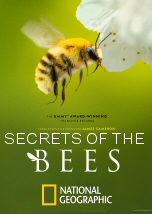
Secrets of the Bees

Secrets of the Bees

2026  Nature
Walking with Dinosaurs

Walking with Dinosaurs

2025  Science
The Human Body

The Human Body

1998  Medicine