





Last Watched

"NES"  Sort by

The Most Dangerous Place in the Universe

   2007    Science
Take a tour of the cosmic hot zones--black holes, galaxy mergers, gamma ray bursts and magnetars. Super black holes can literally lasso Earth out of the solar system. A clash between two galaxies can result in a ritual called galactic cannibalism. Magnetars are a cosmic magnetic force so strong it could wipe out data on every credit card.
Series: The Universe
The Alien Planets

   2007    Science
Have planet hunters finally found proof of other Earth like worlds? Astronomers have now discovered over two hundred alien worlds, beyond our solar system, that were unknown just a decade ago. Discover planets that rage with fiery hurricanes and bizarre planets covered by water so dense that it forms a kind of hot ice. Among these weird worlds, Earth actually seems like the oddball.
Series: The Universe

Nebulas

   2008    Science
Take a tour through the Art Gallery of the Galaxy and view what are considered the "crown jewels" of the heavens. Nebulas are mysterious clouds of gas that aren't classified as stars, planets, moons or asteroids. Astronomers use the most sophisticated techniques to view them since they are practically invisible to the naked eye. Nothing less than stunning, nebulas glow, reflect or obscure the galaxy's light with amazing swirls of color. Nebulas mark the regions where the nothingness of space first coalesces, where stars are born and where stars die. Cutting-edge computer graphics are used to bring the universe down to earth.
Series: The Universe

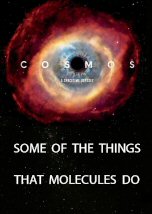
Some of the Things That Molecules Do

   2014    Science    HD
The story begins with Tyson sitting at a campfire, and telling how the wolf changed through artificial selection, and selective breeding into the dog breeds around today. He then enters the Ship of Imagination, and explains natural selection with the process that helped to create the polar bears. Along the way he talks about DNA, genes and mutation. Next he goes to a forest and describes the Tree of life, this leads him to discussing the evolution of the eye. He then discusses extinction, by going to a monument called the Halls of Extinction, dedicated to the broken branches of the tree of life. Explaining the five great Extinction events. He then tells how some life has survived, and then focuses on the tardigrade. From there he talks about what other kinds of life might have been created on other worlds. He then goes to Saturn's moon Titan. From there he speculates about life and how it first began. He then returns to Earth and tells about abiogenesis and how life changed and evolved. The show ends with an animated sequence from the original series of life's evolution from one cell to humans.
Series: Cosmos: A Spacetime Odyssey

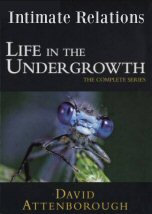
Intimate Relations

   2005    Nature
The world of invertebrates exists in a web of relationships with plants and other animals. Unique footage of the world's smallest insect (a fairy wasp only quarter of a millimetre long) shows it flying underwater to find the eggs of water beetles in which to lay its own brood. Some ants 'farm' the trees that give them shelter, creating areas known as 'Devil's gardens'. To make sure these grow without competition, they kill off other seedlings in the surrounding vegetation. The blister beetle's larvae huddle together on the end of a piece of grass and mimic a female bee. When a male bee tries to mate with the 'female', the larvae grab on to his belly. Confused, he flies away and searches for a real female. When he eventually finds her and mates with her, the beetle larvae hurriedly swap from his front on to her back, and hence get carried back to her nest where they eat her pollen supplies.
Series: Life in the Undergrowth

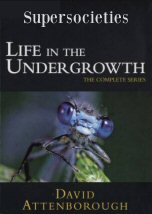
Supersocieties

   2005    Nature
Invertebrates don't always operate alone. True society was the last feature to evolve in invertebrates, as recently as the time of Tyrannosaurus. In the last programme see the tensions below the surface in some of the great social structures built by insects, and witness the carnage when an ant colony and a termite colony wage war.
Series: Life in the Undergrowth
Leaving Neverland

Leaving Neverland

2019  Culture
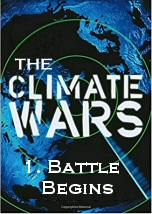
The Climate Wars

The Climate Wars

  Nature
Human

Human

2025  History
Ancient Apocalypse

Ancient Apocalypse

2022  History
Oceans

Oceans

2009  Nature