








Last Watched

"Ant "  Sort by

Supersocieties

   2005    Nature
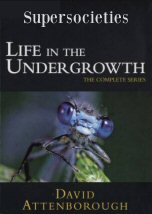
Invertebrates don't always operate alone. True society was the last feature to evolve in invertebrates, as recently as the time of Tyrannosaurus. In the last programme see the tensions below the surface in some of the great social structures built by insects, and witness the carnage when an ant colony and a termite colony wage war.
Series: Life in the Undergrowth

A Sky Full of Ghosts

   2014    Science
Tyson begins the episode by explaining the nature of the speed of light and how much of what is seen of the observable universe is from light emanated from billions of years in the past. Tyson further explains how modern astronomy has used such analyzes via deep time to identify the Big Bang event and the age of the universe. Tyson proceeds to describe how the work of Isaac Newton, William Herschel, and James Clerk Maxwell contributed to understanding the nature of electromagnetic waves and gravitational force, and how this work led towards Albert Einstein's Theory of Relativity, that the speed of light is a fundamental constant of the universe and gravity can be seen as distortion of the fabric of space-time. Tyson describes the concept of dark stars as postulated by John Michell which are not visible but detectable by tracking other stars trapped within their gravity wells, an idea Herschel used to discover binary stars. Tyson then describes the nature of black holes, their enormous gravitational forces that can even capture light, and their discovery via X-ray sources such as Cygnus X-1. Tyson uses the Ship of Imagination to provide a postulate of the warping of spacetime and time dilation as one enters the event horizon of the black hole, and the possibility that these may lead to other points within our universe or others, or even time travel. Tyson ends on noting that Herschel's son, John would be inspired by his father to continue to document the known stars as well as contributions towards photography that play on the same nature of deep time used by astronomers.
Series: Cosmos: A Spacetime Odyssey

Hiding in the Light

   2014    Science
This episode explores the wave theory of light as studied by mankind, noting that light has played an important role in scientific progress, with such early experiments from over 2000 years ago involving the camera obscura by the Chinese philosopher Mozi. Tyson describes the work of the 11th century Arabic scientist Ibn al-Haytham, considered to be one of the first to postulate on the nature of light and optics leading to the concept of the telescope, as well as one of the first researchers to use the scientific method. Tyson proceeds to discuss the nature of light as discovered by mankind. Work by Isaac Newton using diffraction through prisms demonstrated that light was composed of the visible spectrum, while findings of William Herschel in the 19th century showed that light also consisted of infrared rays. Joseph von Fraunhofer would later come to discover that by magnifying the spectrum of visible light, gaps in the spectrum would be observed. These Fraunhofer lines would later be determined to be caused by the absorption of light by electrons in moving between atomic orbitals when it passed through atoms, with each atom having a characteristic signature due to the quantum nature of these orbitals. This since has led to the core of astronomical spectroscopy, allowing astronomers to make observations about the composition of stars, planets, and other stellar features through the spectral lines, as well as observing the motion and expansion of the universe, and the existence of dark matter.
Series: Cosmos: A Spacetime Odyssey

Bhutan to the Bay of Bengal

   2004    Culture
In Bhutan, Palin finds himself back in the land of yaks for a last look at the high Himalaya. Trekking to Chomolhari base camp he meets a nomad with a penchant for yak songs before heading down to Paro to witness the Buddhist festival or Tsechu. In a bar in Thimphu, he discusses reincarnation and the pursuit of happiness with Benji and Khendum, two of the king's cousins, and en route to Bangladesh is taken by Benji to see the rare black-neck cranes. On his journey south through Bangladesh, Michael visits the ship-breaking beaches of Chittagong and grid-locked Dhaka. He meets a man who made a fortune in Birmingham in the poultry business, and a woman who lends money only to women. On a 1920s paddle steamer he is serenaded with the words of Bengal's Shakespeare, and he completes his epic Himalayan journey aboard a fishing boat that carries him out into the Bay of Bengal and a westering sun.
Series: Himalaya with Michael Palin

Secret Forests

   2014    Nature
This is the story of two tiny animals coming of age. In the wild woods of North America, a young chipmunk is gathering a vital store of nuts ahead of his first winter - in his way are ruthless rivals and giant predators. In the steaming rainforest, a young tree-shrew is forced deep into the jungle to find food. She must draw on all her intelligence and agility if she is to escape the ultimate jungle predator - a reticulated python!
Series: Hidden Kingdoms

Last of the Giants

   2013    Science
Even after thousands of years of ice crushing the northern hemisphere and temperatures of 20 degrees lower than those of today, many of the great giants of the ice age still walked the earth. It was only when the world had warmed up again that mammoths, woolly rhinos, sabre-toothed cats, giant ground sloths and glyptodonts finally became extinct. Professor Alice Roberts sets off on her last voyage back to the Ice Age to discover why.
Series: Ice Age Giants
Leaving Neverland

Leaving Neverland

2019  Culture
Top Gear

Top Gear

2012  Technology
The Man with 1000 Kids

The Man with 1000 Kids

2024  Culture
Ancient Apocalypse

Ancient Apocalypse

2024  History
Long Way Up

Long Way Up

2020  Culture
The Last Dance

The Last Dance

2020  Culture
Human: The World Within

Human: The World Within

2021  Medicine
How to Change Your Mind

How to Change Your Mind

2022  Medicine