






Last Watched

"Biology"  Sort by

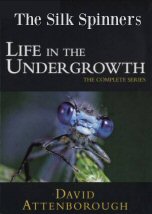
The Silk Spinners

   2005    Nature
Silk is the invertebrates' great invention, used in a range of ways from from the protective stalks of lacewing eggs to the amazing hanging threads of New Zealand's 'glow worms'. Spiders, though, have taken silk-spinning to extremes. The common wolf spider has no web, but the female is a gentle parent, encasing her eggs in silk and carrying the precious bundle wherever she goes. The bolas spider uses a ball of sticky silk soaked in a copy of moth pheromone to lure its prey. Millions of communal spiders live and feed together in a vast, towering web - an arachnophobe's nightmare.
Series: Life in the Undergrowth

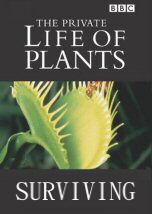
Surviving

   1995    Nature
the final episode deals with plants that live in hostile environments. Attenborough visits Ellesmere Island, north of the Arctic Circle, to demonstrate that even in a place that is unconducive to life, it can be found. Algae and lichens grow in or on rock, and during summer, when the ice melts, flowers are much more apparent. However, they must remain close to the ground to stay out of the chilling wind. In the Tasmanian mountains, plants conserve heat by growing into 'cushions' that act as solar panels, with as many as a million individual shoots grouped together as one. Others, such as the lobelia in Mount Kenya, have a 'fur coat' of dense hairs on their leaves. The saguaro cactus in the Sonoran Desert flourishes because of its ability to retain vast amounts of water, which can't be lost through leaves because it has none. Many desert dwellers benefit from an accelerated life cycle, blooming rapidly within weeks after rainfall. Conversely, Mount Roraima is one of the wettest places on Earth. It is a huge sandstone plateau with high waterfalls and nutrients are continuously washed away, so plants have to adapt their diet if they are to survive. A bladderwort is shown invading a bromeliad. Inhabitants of lakes have other problems to contend with: those that dominate the surface will proliferate, and the Amazon water lily provides an apt illustration. Attenborough ends the series with an entreaty for the conservation of plant species.
Series: The Private Life of Plants

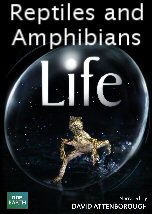
Life: Reptiles and Amphibians

   2009    Nature
Reptiles and amphibians look like hang-overs from the past. But they overcome their shortcomings through amazing innovation. The pebble toad turns into a rubber ball to roll and bounce from its enemies. Extreme slow-motion shows how a Jesus Christ lizard runs on water, and how a chameleon fires an extendible tongue at its prey with unfailing accuracy. The camera dives with a Niuean sea snake, which must breed on land but avoids predators by swimming to an air bubble at the end of an underwater tunnel. In a TV first, Komodo dragons hunt a huge water-buffalo, biting it to inject venom, then waiting for weeks until it dies. Ten dragons strip the carcass to the bone in four hours.
Series: Life

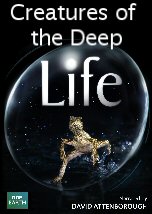
Life: Creatures of the Deep

   2009    Nature
Marine invertebrates are some of the most bizarre and beautiful animals on the planet, and thrive in the toughest parts of the oceans. Divers swim into a shoal of predatory Humboldt squid as they emerge from the ocean depths to hunt in packs. When cuttlefish gather to mate, their bodies flash in stroboscopic colours. Time-lapse photography reveals thousands of starfish gathering under the Arctic ice to devour a seal carcass. A giant octopus commits suicide for her young. A camera follows her into a cave which she walls up, then she protects her eggs until she starves. The greatest living structures on earth, coral reefs, are created by tiny animals in some of the world's most inhospitable waters.
Series: Life

Bear Necessities

   2008    Science
One animal embodies all that is amazing about survival. It has adapted to wildly varying habitats and evolved unique weapons of survival; its greatest asset is its ferocious bite and it is evolutions ultimate survivor, but what species is it? Find out if a new bear species could be about to evolve before our very eyes.
Series: Evolutions

Messengers

   2011    Science
Professor Brian Cox travels from the fossils of the Burgess Shale to the sands of the oldest desert in the world to show how light holds the key to our understanding of the whole universe, including our own deepest origins. To understand how light holds the key to the story of the universe; you first have to understand its peculiar properties. Brian considers how the properties of light that lend colour to desert sands and the spectrum of a rainbow can lead to profound insights into the history and evolution of our universe. Finally, with some of the world's most fascinating fossils in hand, Brian considers how but for an apparently obscure moment in the early evolutionary history of life, all the secrets of light may have remained hidden. Because although the universe is bathed in light that carries extraordinary amounts of information about where we come from, it would have remained invisible without a crucial evolutionary development that allowed us to see. Only because of that development can we now observe, capture and contemplate the incredible wonders of the universe that we inhabit.
Series: Wonders of the Universe
Our Universe

Our Universe

2022  Nature
Leaving Neverland

Leaving Neverland

2019  Culture
The Human Body

The Human Body

1998  Medicine
How to Grow a Planet

How to Grow a Planet

2012  Science
Cosmos: Possible Worlds

Cosmos: Possible Worlds

2020  Science
Earthflight

Earthflight

2012  Nature
Seven Ages of Rock

Seven Ages of Rock

2007  Art
Planet Earth

Planet Earth

2007  Nature