



In episodes 13 and 14, the war reaches a decisive new stage as the Allies prepare to launch Operation Overlord and open the long-awaited second front in Nazi-occupied France. Behind the invasion of Normandy lies an enormous gamble of planning, deception, weather, timing and nerve, with Dwight D. Eisenhower carrying the weight of one of the most dangerous military decisions in history. From the beaches of D-Day to the struggle to break through Hitler’s Atlantic Wall, the episode captures the fear, scale and sacrifice of the operation that begins the liberation of Western Europe. The story then moves to World War II’s often overlooked Asian theater, where Allied forces and Japan fight across jungles, mountains, plains and impossible supply routes. In Burma, India and China, commanders such as Joseph Stilwell, William Slim and Lord Mountbatten face a brutal war of disease, exhaustion, monsoon terrain and relentless Japanese resistance. From the Burma Road and the deadly airlift over the Hump to the fighting at Myitkyina, Imphal and Saipan, these episodes reveal a vast and punishing conflict far from Europe’s headlines, where survival itself becomes a battle and victory demands endurance on a staggering scale.
The final hours of WW2 changed the course of history. As the Americans inch closer to Japan the Japanese fight with greater intensity. The question now is how to end the conflict. Starve them into capitulation? Many in US command believe the Japanese will never surrender. The alternative is to stage a massive invasion that would dwarf D-Day? The massacre of millions would be inevitable. But then a third and far darker option becomes available: the atom bomb.
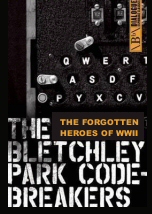
The film reveals the secret story behind one of the greatest intellectual feats of World War II, a feat that gave birth to the digital age. In 1943 Bill Tutte, a 24-year-old maths student and a GPO engineer called Tommy Flowers combined to hack into Hitler's personal super code machine - not Enigma but an even tougher system, which he called his 'secrets writer'. Their break turned the Battle of Kursk, powered the D-day landings and orchestrated the end of the conflict in Europe. But it was also to be used during the Cold War - which meant both men's achievements were hushed up and never officially recognised.
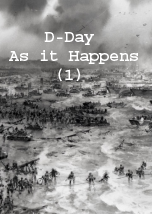
D-Day: As It Happens D-Day: As It Happens tells the story of this pivotal event in 20th-century history in a completely new way. Using newly-analysed archive footage, viewers can track the progress of seven people who were there on the day, each of them a real participant in the 1944 invasion. And they can do so moment by moment in real time, encountering the twists and turns of the fighting at the same time as the D-Day seven did, and learning their fate as the action unfolds in parallel with the present, Narrated by Peter Snow, with Channel 4 presenter and former marine Arthur Williams, and experts including former British Army officer Colonel Tim Collins and front-line journalist Lorna Ward. The first programme tells the back stories of the real people that the event is following in real time and sets out their missions over the following 24 hours. The D-Day seven include a paratrooper, a midget submariner, a nurse and a military cameraman.
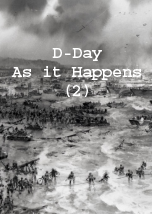
D-Day: As It Happens is a 24-hour history event to be broadcast across TV, web, mobile devices and social media, telling the story of this pivotal event in 20th-century history in a completely new way. Using newly-analysed archive footage, viewers can track the progress of seven people who were there on the day, each of them a real participant in the 1944 invasion. And they can do so moment by moment in real time, encountering the twists and turns of the fighting at the same time as the D-Day seven did, and learning their fate as the action unfolds in parallel with the present, Narrated by Peter Snow, with Channel 4 presenter and former marine Arthur Williams, and experts including former British Army officer Colonel Tim Collins and front-line journalist Lorna Ward. The second programme reveals what happened to the seven real people the event is following in real time, and also rounds up the events of D-Day.
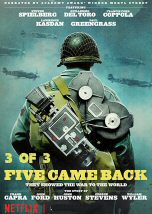
The five directors, John Ford, William Wyler, John Huston, Frank Capra, and George Stevens, return to Hollywood after the war but are forever haunted by what they saw. Ford goes on a drinking bender after filming the carnage at D-Day. Stevens is wholly unprepared for the horrors of Dachau and realizes he is not there to film propaganda but to capture evidence of crimes against humanity. Wyler, who lost his hearing during the war, fears his career is over. Huston chronicles soldiers suffering from postraumatic stress disorder in the film Let There Be Light, only to have it suppressed by the U.S. government.
The story then moves to World War II’s often overlooked Asian theater, where Allied forces and Japan fight across jungles, mountains, plains and impossible supply routes. In Burma, India and China, commanders such as Joseph Stilwell, William Slim and Lord Mountbatten face a brutal war of disease, exhaustion, monsoon terrain and relentless Japanese resistance. From the Burma Road and the deadly airlift over the Hump to the fighting at Myitkyina, Imphal and Saipan, these episodes reveal a vast and punishing conflict far from Europe’s headlines, where survival itself becomes a battle and victory demands endurance on a staggering scale.