In the second episode, the murder of a political staffer in 2016 spawns a myriad of unfounded conspiracy theories as the man's family and the truth hang in the balance. Following Seth Rich's murder, his parents filed a lawsuit with Fox News after conspiracy theories about his murder spread across the internet. Mary Rich told NPR that the combined trauma of her son's death and the attacks by conspiracy theorists caused intense and lasting distrust. After the case was resolved, Rich's parents said in a statement at the time that they were 'pleased with the resolution of this matter and sincerely hope that the media will take genuine precautions in the future'.
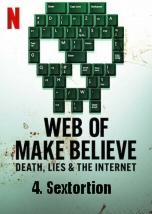
In the fourth episode, several women recall their harrowing experiences with one man's heinous attempts at virtual blackmail, aimed at obtaining sensitive sexual material. A woman tells us: 'I received a message from a man who said: Send me a naked picture or I will kill you'. This young woman was able to add her case to those of other women who were encouraged to denounce and expose the harasser. No one is completely invisible on the Internet.
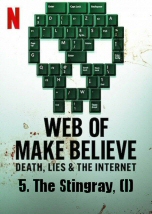
In the fifth episode we will see from counterfeit Beanie Babies to very real tax crime. One person wonders if could make refunds in the name of dead people. It turns out that it can. We will also see an attempted fraud by two hackers to the IRS: the United States federal agency in charge of tax collection. These skilled hackers revisit cyber schemes that landed them in the sight of law enforcement.
The last episode explores Mescaline, the psychoactive molecule in San Pedro and peyote cacti, a sacred medicine that Native Americans have had to fight for the right to use. At the Indigenous practices there's always an elder, someone who knows the territory very well, who's presiding. There's usually a group, a community is involved, There's always an intention, a purpose to what you're doing, and you're treating it as sacred, in order to achieve altered states of consciousness, which contribute to worship in various ways, or celebration or healing. But maybe all this is not so new to Western culture after all. In the old Greek histories of Eleusis, people who were initiated there got the drink, the kykeon, and then they had the illumination. The precise recipe is a mystery, but we know that the kykeon was a psychoactive brew that was used at the Eleusinian mysteries, a sacred annual ritual of enlightenment practiced by some of the world's greatest minds including Socrates, Plato, and Aristotle. So why did this ritual come to an end more than 1,000 years ago? Was the possibility of illumination or achieving a higher consciousness considered threatening to the powers that be? Have the drug wars been merely an extension of that fear? Psychedelics has a major part in how we can heal as a community, how we can heal as a city, and how we can heal as a country. The current renaissance of psychedelics could not come at a better time as the world confronts a crisis in mental health. But psychedelics have much to offer. The psychedelic experience changes the mind in ways that will help scientists better understand how it works. All these altered states allow us to probe what is the greatest mystery in all of nature. The emergence from mere matter of something as miraculous as consciousness. But an even bigger question is whether psychedelics might help us address the environmental crisis of how we think about our place in nature. One of the greatest gifts of psychedelics is how they reanimate the natural world, allowing us to perceive the subject, the spirit of all species, not just our own. And to feel a deeper sense of interconnectedness with nature.
In this sixth and final episode, the FBI escalates its pursuit of an elusive hacker, but he soon turns the tables by questioning the legality of a key tool in their investigation. We'll also find out how one man is being watched by the government for alleged Russian election interference. Is he responsible, or just a patsy for more powerful people? We'll have to get to the end to find out.
Magic mushrooms, long considered sacred by the Indigenous Mazatec in Mexico, become the subject of scientific studies measuring the intense effects of its Psilocybin and its potential therapeutic use. In the second episode, we are introduced to Ben, who’s battled with crippling Obsessive-Compulsive Disorder (OCD) his entire life. When he had his firstborn, Ben’s life became full of panic attacks regarding his son’s safety, and he knew something had to change. Ben signed up for a psilocybin-assisted therapy clinical trial which was testing whether the psychedelic could help people with severe OCD. In the session under the influence of psilocybin, Ben felt decomposed and eventually grew into a tree. While living as a tree, he saw his human self, playing with his child. Though this sounds scary, from Ben’s perspective, it was beautiful. He was one with the universe, seeing himself in the ultimate third-person perspective. Finally, he saw how it could be different if he didn’t let his OCD control him. And several months out, all the symptoms disappeared. Ben’s story is one of many told in this series, which gives hope that help is right around the corner for the millions who suffer —often in silence— with debilitating mental disorders. But Michael Pollan’s work is showcasing the success stories. Often, even in the most successful trials, psychedelic-assisted therapy only helps up to a third of people enter remission. More frequently, patients are helped —sometimes substantially— but they still suffer with their illnesses and some people aren’t helped at all.











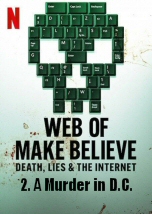


Following Seth Rich's murder, his parents filed a lawsuit with Fox News after conspiracy theories about his murder spread across the internet. Mary Rich told NPR that the combined trauma of her son's death and the attacks by conspiracy theorists caused intense and lasting distrust. After the case was resolved, Rich's parents said in a statement at the time that they were 'pleased with the resolution of this matter and sincerely hope that the media will take genuine precautions in the future'.