Will explore the strategy, deception and feats of engineering plants use to thrive in the changing weather of different seasons. In the face of conditions ranging from ice and snow to raging fires, survival is often a question of perfect timing - particularly when contending with intense competition and surprising predators. In this episode, David Attenborough travels to Finland to show one of the most extreme examples of seasonal plant life in the Arctic Circle. He also travels to California to see how climate change is affecting giant sequoias. These ancient trees like all other seasonal plants depend on the predictability of the seasons and our current changing climate threatens their survival.
The meteoric rise of renewable energy has consequences for our electricity supply. While coal and gas fired power stations can generate electricity whenever you need it, renewables are intermittent by nature. So we need a backup plan for when the wind stops or the sun goes down. All over the world, engineers and scientists are racing to solve one key problem; how to safely and efficiently store electricity at a huge scale but at a low cost. The quest is producing some truly remarkable ideas and this episode details three of them.
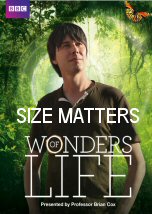
In this mind-bending series, Professor Jim Al-Khalili explores the vast range of size in the universe, from tiny atoms to gigantic, interconnected galaxies. In the first episode, Jim will enter the world of objects that are too tiny to glimpse with the naked eye. Starting with the smallest insects, he moves on to encounter living cells with amazing superpowers and confronts some of humanity's deadliest enemies in the form of viruses. Going smaller still, he encounters wondrous new nanomaterials such as graphene, discovered by physicist Andre Geim. These are revolutionising engineering, medicine, computing, electronics and environmental science. Finally, Jim comes face to face with the fundamental building blocks of the world around us – atoms – and reveals why understanding the science of the 'small' is crucial to the future of humanity.
During 1959-1961 both the Americans and Soviets are planning manned space flight, and we see both sides preparing to do so with the development of the Vostok programme (Russia) and Project Mercury (USA). After difficulties and failures on both sides, the Soviets succeed in putting Yuri Gagarin into space first, with the Americans putting Alan Shepard up shortly afterwards.









In this episode, David Attenborough travels to Finland to show one of the most extreme examples of seasonal plant life in the Arctic Circle. He also travels to California to see how climate change is affecting giant sequoias. These ancient trees like all other seasonal plants depend on the predictability of the seasons and our current changing climate threatens their survival.