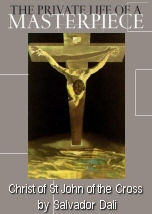






Salvador Dali's strange crucifixion is often called the greatest religious painting of the 20th century. Yet its artist was a notorious blasphemer some of whose work had outraged the Catholic Church. The Christ of St John of the Cross by Salvador Dali is the first of two extraordinary crucifixions painted by Dali in the early 1950s. The painting is based on a 'cosmic dream' Dali is said to have had, in which the nucleus of the atom was a figure of Christ himself. The painting offers a surrealist view of the crucifixion of Christ, and is based on a drawing by the 16th century Spanish friar Saint John of the Cross. But Dali's vision was somewhat unique, using an unusual artistic perspective in which Christ is seen from above. His Christ of St. John of The Cross was inspired by a weird mix of Spanish mysticism and nuclear physics, with his Christ being modelled by a Hollywood stuntman. It's also a masterpiece of painting technique.
The Greek tale of Jason and the Golden Fleece has been told for 3,000 years. It's a classic hero's quest tale - a sort of ancient Greek mission impossible - in which the hero embarks on a sea voyage into an unknown land, with a great task to achieve. He is in search of a magical ram's fleece, which he has to find in order to reclaim his father's kingdom of Iolkos from the usurper King Pelias. Michael Wood discovers a story of heroism, treachery, love and tragedy that would make Hollywood proud.
An intellectual freedoms documentary based around the interpersonal triumphs, and defeats of the three main characters against the largest industry in the known universe. The media industry. Based on the lives of the three founders of The Pirate Bay: Peter Sunde, Fredrik Neij and Gottfrid Svartholm
It sounds like a Hollywood blockbuster: a deadly asteroid is on a collision course with Earth. But in reality, it's only a matter of time before a giant space rock threatens to wipe out civilization. An asteroid took out the dinosaurs sixty-five million years ago. Are we next? This episode analyzes the threat and explores the many ways--from a nuclear bomb to ingenious new technology--that experts are proposing to stop Armageddon
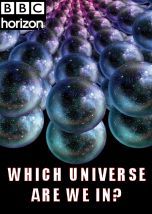
Imagine a world where infinite copies of you are playing out every storyline of your life. It sounds like a plot stolen straight from Hollywood, but far from it. This is the multiverse. Until very recently the whole idea of the multiverse was dismissed as a fantasy, but now this strangest of ideas is at the cutting edge of science. And for a growing number of scientists, the multiverse is the only way we will ever truly make sense of the world we are in. Do multiple universes exist? And if so, which one are we actually in?" Imagine a world where dinosaurs still walk the earth. A world where the Germans won World War II and you are president of the United States. Imagine a world where the laws of physics no longer apply.
With optional Hebrew subtitles. Simon Schama's history of the Jewish experience plunges into the lost world of the shtetl, the Jewish towns and villages sewn across the hinterlands of Eastern Europe which became the seedbed of a uniquely Jewish culture. Shtetl culture would make its mark on the modern world, from the revolutionary politics of the Soviet Union to the mass culture of Tin Pan Alley and Hollywood. It was also the birthplaces of Hasidism, the most visible, iconic and, arguably, most misunderstood expression of Jewish faith and fervour. This chapter of the story travels from the forests of Lithuania, where Simon's own family logged wood and fought wolves, to the streets of the Lower East Side where the sons of shtetl immigrants wrote the American songbook. With grim inevitability, the story returns to Eastern Europe in 1940 - where the genocidal mechanisms of the 'final solution' were beginning to grind the shtetl world into dust and ash.
The painting offers a surrealist view of the crucifixion of Christ, and is based on a drawing by the 16th century Spanish friar Saint John of the Cross. But Dali's vision was somewhat unique, using an unusual artistic perspective in which Christ is seen from above. His Christ of St. John of The Cross was inspired by a weird mix of Spanish mysticism and nuclear physics, with his Christ being modelled by a Hollywood stuntman. It's also a masterpiece of painting technique.