



Last Watched

"Pan"  Sort by

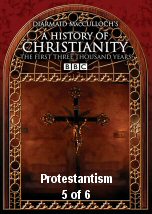
Protestantism The Evangelical Explosion

   2011    Culture
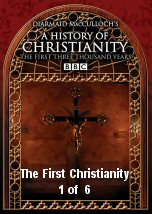
Diarmaid MacCulloch traces the growth of an exuberant expression of faith that has spread across the globe - Evangelical Protestantism. Today, it is associated with conservative politics, but the whole story is distinctly more unexpected. It is easily forgotten that the evangelical explosion has been driven by a concern for social justice and the claim that one could stand in a direct emotional relationship with God. It allowed the Protestant faith to burst its boundaries from its homeland in Europe. In America, its preachers marketed Christianity with all the flair and swashbuckling enterprise of American commerce. In Africa, it converted much of the continent by adapting to local traditions, and now it is expanding into Asia. But is Korean Pentecostalism and its message of prosperity in the here and now an adaptation too far?
Series: A History of Christianity

The Southwest Islands

   2017    Nature
In the far south west of Japan, there is a chain of islands stretching towards the tropics - a place where all life is influenced by the power of the sea, and where volcanoes and typhoons are forces to be reckoned with. The journey begins at an island at the top of the chain and travels south, revealing unexpected stories of isolation, unique wildlife and unsolved mysteries.
Series: Japan Earth Enchanted Islands

Asia and Australia

   2012    Nature
In this bird's-eye view of two continents, demoiselle cranes negotiate a dangerous Himalayan pass on their way to India while high-flying bar-headed geese take the fast track five miles above. In Rajasthan, vultures watch hunting tigers hoping for a meal and pigeons visit a temple dedicated solely to sacred rats. Pigeons are also our guide to the greatest gatherings of camels on Earth and learn to dodge buzzards around the battlements of Jodhpur Fort. 9,000 cranes overwinter in the most unlikely of spots - a barbed wire compound in the centre of a desert town. In Australia, rainbow lorikeets drop in on Sydney and patrol Australia's Gold Coast. In the outback, white cockatoos swirl in thousands and budgerigars pass Uluru (Ayers Rock) and gather in the biggest flocks ever recorded. In China, swallows and swifts visit the Great Wall and the Forbidden City of Beijing. In Japan, the country's most revered birds - Japanese cranes are fed fish by appreciative locals and are joined in strange, momentary harmony by hungry red foxes, white-tailed eagles and Steller's eagles. As peace descends, Japanese cranes dance beautifully in the snow.
Series: Earthflight

Combat Zones

   2017    History
In the second episode, the directors learn their vision for the films is not always permissible by the U.S. government. Wyler is shocked by the racism he encounters against African American soldiers and refused to make a film recruiting black soldiers. Meanwhile, the films' racist depiction of the Japanese versus human depiction of the Germans causes worry for the War Department, which at that time planned to redistribute the Japanese-American population from internment camps into towns across the United States.
Series: Five Came Back

Age of Extremes

   2017    History
Lucy Worsley continues her journey through Russia in the footsteps of the Romanovs, the most powerful royal dynasty in modern European history. In this episode she examines the extraordinary reign of Catherine the Great, and the traumatic conflict with napoleonic France that provides the setting for the novel War and Peace. At the magnificent palace of Peterhof near St Petersburg, Lucy charts the meteoric rise of Catherine the Great, who seized the Russian throne from her husband Peter III in 1762 and became the most powerful woman in the world. Catherine was a woman of huge passions - for art, for her adopted country (she was German by birth) and for her many lovers.
Catherine expanded her empire through military victories overseas, while at home she encouraged education and introduced smallpox inoculation to Russia. But Catherine struggled to introduce deeper reforms, and the institution of serfdom remained largely unchanged. Lucy explains how this injustice fuelled a violent rebellion. Nevertheless, Catherine left Russia more powerful on the world stage than ever. But all she had achieved looked set to be undone when Napoleon invaded Russia in 1812. Lucy relives the pivotal battle of Borodino, when the Russian army finally confronted the French forces; the traumatic destruction of Moscow; and, under Catherine's grandson Alexander, the eventual victory over the French that provided the Romanov dynasty with its most glorious hour.
Series: Empire of the Tsars

The Road to Revolution

   2017    History
The years 1825-1918 were bloody and traumatic, a period when four tsars tried - and failed - to deal with the growing pressure for constitutional reform and revolution. In 1861, millions of enslaved serfs were freed by the Tsar-Liberator, Alexander II. But Alexander paid the ultimate penalty for opening the Pandora's box of reform when he was later blown up by terrorists on the streets of St Petersburg. Elsewhere, there was repression, denial, war and - in the case of the last tsar, Nicholas II - a fatalistic belief in the power of God, with Nicholas's faith in the notorious holy man Rasputin being a major part in his undoing. Lucy Worsley also details the chilling murder of Nicholas and his family in 1918, and asks whether all of this horror have been avoided.
Series: Empire of the Tsars
The Hunt

The Hunt

2015  Nature
The Hunt

The Hunt

2015  Nature
The Hunt

The Hunt

2015  Nature
The Hunt

The Hunt

2015  Nature
Wild Russia

Wild Russia

2009  Nature
Top Science Stories

Top Science Stories

2020  Science