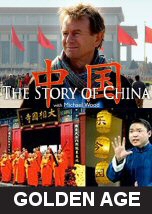
This episode tells the tale of what's broadly considered China's most creative dynasty - the Song (960-1279). Michael Wood heads to the city of Kaifeng, the greatest city in the world before the 19th century. Here in Twin Dragon Alley, locals tell him the legend of the baby boys who became emperors. He explores the ideas and inventions that made the Song one of greatest eras in world culture, helped by China's most famous work of art, the Kaifeng scroll, which shows the life of the city in around 1120. A chef makes Michael a recipe from a Song cookbook, while a guide to 'how to live happy, healthy lives for old people', published in 1085 and still in print, is discussed with local women doing their morning exercises. The Song was also a great era for scientific advance in China. Michael steers a huge working replica of an astronomical clock, made by China's Leonardo da Vinci. Then at a crunch Chinese Premier League match, Michael tells us the Chinese invented football! The golden age of the northern Song ended in 1127, when invaders sacked Kaifeng, but they survived in the south. At their new capital, Hangzhou, Wood joins locals dancing by the West Lake, while in the countryside he meets Mr Xie with his records of 40 generations of ancestors. The final defeat of the Song took place in a naval battle in the estuary of the Pearl River in 1279. When all was lost, rather than surrender to the Mongols, a loyal minister jumped into the sea with the young boy emperor in his arms. 'So ended the glory of the Song', Wood concludes, 'but a new age would arise... as in China, it always has!'.
The Internet is an uncontrollable labyrinth of content and imagery that operates under loose laws and partial anonymity - a new frontier where people can do anything and see anything, whether they should or not. In this lawless landscape, who's in control? The protectors? The abusers? In this episode meet the content moderators who watch the worst of the Internet so you don't have to; a convicted hacker whose punishment was the virtual prison of the unplugged; plus, a blackhat hacker who encrypts and holds computer files hostage.
Michael Ruppert is an independent journalist who has made a minor career out of telling people news that most folks do not want to know. Ruppert, a former police officer, predicted the Wall Street debacle of 2008 several years before the fact, at a time when most analysts were still imagining infinite growth for the stock market and major investment banks. Since then, his vision of the world's future has grown only darker. As Ruppert sees it, civilization and the global economy has yet to wean itself off fossil fuels, and when the world's supply of oil finally runs out, it will lead to a global financial catastrophe that will leave no one unscathed. But while most of what Ruppert has to say bears the ring of truth, there's a small audience for his dire message -- the primary medium for his work is a self-published newsletter, and his most recent book has done so poorly in the marketplace that he faces eviction from his home. Is Ruppert right? And if he is, why doesn't anyone care? Filmmaker Chris Smith profiles Michael Ruppert and gives him a chance to explain his apocalyptic vision of the future at length
After the murder of his brother Frank, Al Capone is out for revenge against William Dever and the Chicago police. He plots to kill every undercover cop that was in Cicero on the day of Frank’s death. Before he can set his plan in motion, however, Johnny Torrio returns from Italy and reclaims his control of their criminal empire. Torrio forbids Capone from killing cops, fearing it would spark an all-out war. Despite Capone’s personal loss, Torrio returns to a booming business that’s raking in $10 million a month. However, as Torrio and Capone’s empire grows, it becomes harder to keep smaller factions under control. After a small group of Italian mobsters attacks one of Dean O’Banion’s distilleries, O’Banion blames Torrio and decides to end their business partnership. He announces his retirement to Torrio and offers Torrio an opportunity to buy him out. Torrio meets O’Banion at the Seine Brewery on May 19, 1924, with the buyout money. Chicago police raid the brewery and arrest Torrio while letting O’Banion walk free: O’Banion had set the whole thing up. With prior convictions, Torrio serves a mandatory prison sentence but is first released on bail. He vows to kill O’Banion as payback and gives Capone his blessing to kill O’Banion. Capone spends months planning the hit. Capone knows that catching O’Banion off guard is nearly impossible, so he places an order with O’Banion’s flower shop for nearly $20,000 worth of flowers, knowing that O’Banion personally oversees his biggest arrangements. On November 10, 1924, O’Banion works in his shop preparing the flower delivery. Two of Capone’s men enter the shop and fatally gun O’Banion down. Four days later, Chicago’s most powerful Irish gangster is laid to rest in one of the most lavish funerals Chicago has ever seen. More than two dozen cars are required to transport floral arrangements as a crowd of 10,000 mourns the death of the infamous gangster. Torrio and Capone attend the funeral, infuriating O’Banion’s top lieutenants, Hymie Weiss and Bugs Moran. Chaos breaks out as smaller gangs through the city begin a turf war. It’s the beginning of an era of bloodshed in Chicago known as the Beer Wars. Over 300 people are murdered at a rate of 75 to 100 murders a year.
In 2000, Bill and Hillary Clinton owed millions of dollars in legal debt. Since then, they’ve earned over $130 million. Where did the money come from? Most people assume that the Clintons amassed their wealth through lucrative book deals and high-six figure fees for speaking gigs. Now, Peter Schweizer shows who is really behind those enormous payments. He detailed patterns of official corruption in Washington that led to congressional resignations and new ethics laws. He follows the Clinton money trail, revealing the connection between their personal fortune, their “close personal friends,” the Clinton Foundation, foreign nations, and some of the highest ranks of government.
At a time when the Earth’s surface is changing faster than ever in human history, watch cities grow, forest disappear and glaciers melt. In the ever-growing grey of cities one man is feeding thousands of parakeets; in Sumatra a female orang-utan and her daughter face life in a forest under threat; while in Tanzania local people use satellites to replant a forest, securing the future for a family of chimpanzees. This is our home as we’ve never seen it before.






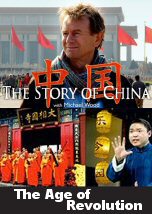




He explores the ideas and inventions that made the Song one of greatest eras in world culture, helped by China's most famous work of art, the Kaifeng scroll, which shows the life of the city in around 1120. A chef makes Michael a recipe from a Song cookbook, while a guide to 'how to live happy, healthy lives for old people', published in 1085 and still in print, is discussed with local women doing their morning exercises. The Song was also a great era for scientific advance in China. Michael steers a huge working replica of an astronomical clock, made by China's Leonardo da Vinci.
Then at a crunch Chinese Premier League match, Michael tells us the Chinese invented football! The golden age of the northern Song ended in 1127, when invaders sacked Kaifeng, but they survived in the south. At their new capital, Hangzhou, Wood joins locals dancing by the West Lake, while in the countryside he meets Mr Xie with his records of 40 generations of ancestors. The final defeat of the Song took place in a naval battle in the estuary of the Pearl River in 1279. When all was lost, rather than surrender to the Mongols, a loyal minister jumped into the sea with the young boy emperor in his arms. 'So ended the glory of the Song', Wood concludes, 'but a new age would arise... as in China, it always has!'.