A decade after An Inconvenient Truth brought climate change into the heart of popular culture comes the riveting and rousing follow-up that shows just how close we are to a real energy revolution. Vice President Al Gore continues his tireless fight, traveling around the world training an army of climate champions and influencing international climate policy. Cameras follow him behind the scenes-in moments private and public, funny and poignant-as he pursues the empowering notion that while the stakes have never been higher, the perils of climate change can be overcome with human ingenuity and passion. Renowned filmmakers Bonni Cohen and Jon Shenk have taken the baton from 2006 Academy Award-winner Davis Guggenheim. What started then as a profound slide show lecture has become a gorgeously cinematic excursion. Our extraordinary former vice president invites us along on an inspirational journey across the globe that delivers the tools to heal our planet. The question is: Will we choose to take the baton?
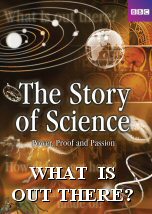
An informative and ambitious journey exploring how the evolution of scientific understanding is intimately interwoven with society's historical path. The Story Of Science tells the forces that came together to create scientific knowledge; the practical business of making instruments and machines; the great forces of history – revolutions, voyages of discovery and artistic movements – and the dogged determination of scientists and experimenters. This is the story of how scientific ideas shaped the modern world and how science made history. Michael Mosley begins the first episode with the story of one of the great upheavals in human history - how we came to understand that our planet was not at the centre of everything in the cosmos, but just one of billions of bodies in a vast and expanding universe. He reveals the critical role of medieval astrologers in changing our view of the heavens, and the surprising connections to the upheavals of the Renaissance, the growth of coffee shops and Californian oil and railway barons. Michael shows how important the practical skills of craftsmen have been to this story and finds out how Galileo made his telescope to peer at the heavens and by doing so helped change our view of the universe forever.
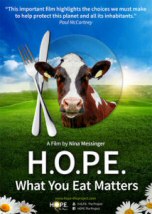
Half of the population in Western society suffers from being overweight. Cardio-vascular diseases, diabetes and cancer are epidemic. Our meat consumption has quintupled over the past 50 years. 65 billion land animals are being slaughtered every year for food consumption. One third of the global grain production is fed to animals for fattening while 1.8 billion people worldwide suffer from hunger and starvation. Can there really be a solution to all these problems? H.O.P.E. is a life-changing documentary uncovering and revealing the effects of our typical Western diet high in animal-based foods. It contrasts the limited interests of the pharmaceutical and agricultural industry with the all-encompassing interests of living beings on this planet and with the power of responsible consumer action. H.O.P.E. is an urgent call to action to all of us to commit to a change towards sustainability and safeguarding our living environment.
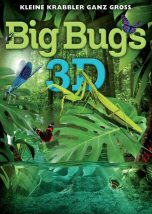
The world of bugs normally passes beneath our notice, yet shrink yourself to their size, see them in 3D and you’ll enter a world you’d never believe existed. Big Bugs in 3D uses specially developed 3D technology to take the viewer on a global journey, from Mexico and the rainforests of Asia to our own backyards. There are perhaps four and a half million different kinds of bugs sharing the planet with us. They exist in a bewildering variety of forms, some more like creatures from an alien world. Big Bugs asks how and why these creatures have become so successful.
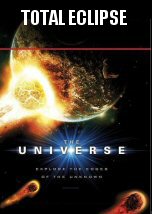
Once they were dreaded and thought to be dragons eating the sun--but modern science has dispelled mythology and we now look forward to total Solar Eclipses as one of the most spectacular phenomena in the heavens. Explore the complex movements of Earth, Moon and Sun that produce these unusual events and hear details why we may be the only intelligent beings in the known Universe to witness eclipses like we see on Earth. Man-made eclipses also figure into the science in the form of instruments called "coronagraphs." They blot out the sun and reveal its corona, uncovering secrets which, while enlightening, also warn of a disaster that could make our advanced technology crash and burn. Finally, travel into deep space, where the tiny eclipses caused by planets circling distant stars is now beginning to reveal hundreds more stars where "exoplanets" exist... perhaps even those in habitable zones like the Earth.
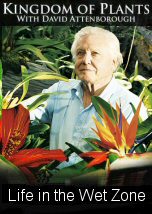
Written and presented by David Attenborough, who said: 'One of the most wonderful things about filming plants is that you can reveal hidden aspects of their lives, you can capture the moment as one plant strangles another, and as they burst into flower. But whilst time-lapse photography allows you to see things that no human being has ever seen before". David begins his journey inside the magnificent Palm House, a unique global rainforest in London. Here, he explores the extraordinary plants that are so well adapted to wet and humid environments and unravels the intimate relationships between wet zone plants and the animals that depend on them. It was in the wet zones of the world that plants first moved on to land and in the Waterlily House David reveals how flowers first evolved some 140 million years ago. Watching a kaleidoscope of breath-taking time-lapses of these most primitive of flowers swelling and blooming in 3D, he is able to piece together the very first evolutionary steps that plants took to employ a wealth of insects to carry their precious pollen for the first time. David discovers clues to answer a question that even had Charles Darwin stumped: how did flowering plants evolve so fast to go on to colonise the entire planet so successfully?



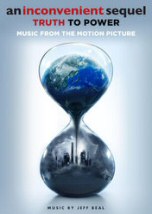

Renowned filmmakers Bonni Cohen and Jon Shenk have taken the baton from 2006 Academy Award-winner Davis Guggenheim. What started then as a profound slide show lecture has become a gorgeously cinematic excursion. Our extraordinary former vice president invites us along on an inspirational journey across the globe that delivers the tools to heal our planet. The question is: Will we choose to take the baton?