Last Watched

"Search"  Sort by

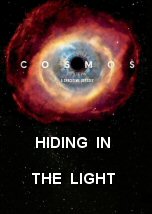
Hiding in the Light

   2014    Science
This episode explores the wave theory of light as studied by mankind, noting that light has played an important role in scientific progress, with such early experiments from over 2000 years ago involving the camera obscura by the Chinese philosopher Mozi. Tyson describes the work of the 11th century Arabic scientist Ibn al-Haytham, considered to be one of the first to postulate on the nature of light and optics leading to the concept of the telescope, as well as one of the first researchers to use the scientific method. Tyson proceeds to discuss the nature of light as discovered by mankind. Work by Isaac Newton using diffraction through prisms demonstrated that light was composed of the visible spectrum, while findings of William Herschel in the 19th century showed that light also consisted of infrared rays. Joseph von Fraunhofer would later come to discover that by magnifying the spectrum of visible light, gaps in the spectrum would be observed. These Fraunhofer lines would later be determined to be caused by the absorption of light by electrons in moving between atomic orbitals when it passed through atoms, with each atom having a characteristic signature due to the quantum nature of these orbitals. This since has led to the core of astronomical spectroscopy, allowing astronomers to make observations about the composition of stars, planets, and other stellar features through the spectral lines, as well as observing the motion and expansion of the universe, and the existence of dark matter.
Series: Cosmos: A Spacetime Odyssey

Lands of Gold

   2013    History
Through the mountains and jungles of Colombia, Cooper goes in search of the truth behind one of the greatest stories ever told - the legend of El Dorado. His journey takes him from Bogota to the Caribbean coast, through territories once dominated by two cultures, the Muisca and the Tairona, who flourished for centuries before the arrival of the Spanish in the 16th century. Cooper reveals forgotten peoples who valued gold in a way the Western world still struggles to understand, travelling to an astonishing lost city and meeting the last survivors of an ancient civilisation.
Series: Lost Kingdoms of South America

Falling

   2011    Science
Professor Brian Cox takes on the story of the force that sculpts the entire universe - gravity. Gravity seems so familiar, and yet it is one of the strangest and most surprising forces in the universe. Starting with a zero gravity flight, Brian experiences the feeling of total weightlessness, and considers how much of an effect gravity has had on the world around us. But gravity also acts over much greater distances. It is the great orchestrator of the cosmos. It dictates our orbit around the sun, our relationship with the other planets in our solar system, and even the way in which our solar system orbits our galaxy. Yet the paradox of gravity is that it is actually a relatively weak force. Brian takes a face distorting trip in a centrifuge to explain how it is that gravity achieves its great power, before looking at the role it plays in one of the most extraordinary phenomena in the universe - a neutron star. Although it is just a few kilometres across, it is so dense that its gravity is 100, 000 million times as strong as on Earth. Over the centuries our quest to understand gravity has allowed us to understand some of the true wonders of the universe, and Brian reveals that it is scientists' continuing search for answers that inspires his own sense of wonder.
Series: Wonders of the Universe

Human Planet: The Jungles

   2011    Culture
The rainforest is home to more species of plants and animals than any other habitat on the planet. But for humans, life there is not as easy as it looks. Life in the trees requires great skill, ingenuity and sheer bravery. The Matis of Brazil carve 4-metre-long blow-pipes to hunt monkeys - in near total silence. Deep in the Congo forests, Tete defies death by scaling a giant tree using nothing more than a liana vine, and he must then negotiate an angry swarm of bees - all to collect honey for his family. Three children from Venezuela's Piaroa tribe venture deep into the jungle to hunt tarantulas - to toast for lunch! In West Papua the Korowai tribe show-off their engineering skills by building a high-rise home 35 metres up in the tree tops. Most memorable of all, in Brazil we join a unique monitoring flight in search an un-contacted tribe...
Series: Human Planet

The Rivers

   2011    Culture
Rivers provide the essentials of life: fresh food and water. They often provide natural highways and enable us to live in just about every environment on Earth. But rivers can also flood, freeze or disappear altogether!Cities - Surviving the Urban Jungle Human Planet joins Sam Niang, a Laotian fisherman, as he walks a high wire strung above the raging Mekong River rapids on an extraordinary commute to work. There's also a look at the remarkable partnership between Samburu tribesmen and wild elephants in their search for water in the dried-out river beds of Northern Kenya. Plus, a father who must take his two children on a six-day trek down a frozen river - the most dangerous school run on Earth, and the ice dam busters of Ottowa with their dynamite solution to a city centre hold-up.

The Cost of Free

   2010    Technology
In the third programme of the series, Aleks gives the lowdown on how, for better and for worse, commerce has colonized the web - and reveals how web users are paying for what appear to be 'free' sites and services in hidden ways. Joined by some of the most influential business leaders of today's web, including Eric Schmidt (CEO of Google), Chad Hurley (CEO of YouTube), Bill Gates, Martha Lane Fox and Reed Hastings (CEO of Netflix), Aleks traces how business, with varying degrees of success, has attempted to make money on the web. She tells the inside story of the gold rush years of the dotcom bubble and reveals how retailers such as Amazon learned the lessons. She also charts how, out of the ashes, Google forged the business model that has come to dominate today's web, offering a plethora of highly attractive, overtly free web services, including search, maps and video, that are in fact funded through a sophisticated and highly lucrative advertising system which trades on what we users look for. Aleks explores how web advertising is evolving further to become more targeted and relevant to individual consumers. Recommendation engines, pioneered by retailers such as Amazon, are also breaking down the barriers between commerce and consumer by marketing future purchases to us based on our previous choices. On the surface, the web appears to have brought about a revolution in convenience. But, as companies start to build up databases on our online habits and preferences, Aleks questions what this may mean for our notions of privacy and personal space in the 21st century
Series: The Virtual Revolution
Wild Wild Country

Wild Wild Country

2018  Culture
Mammals

Mammals

2024  Nature
Marilyn and the Mob

Marilyn and the Mob

2026  History
Reel Rock

Reel Rock

2014  Culture
Zeitgeist

Zeitgeist

2007  Culture
Top Gear

Top Gear

2012  Technology