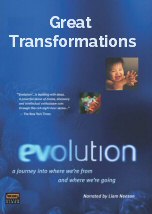







We sure lucked out with Planet Earth. Blue skies, rolling hills, water everywhere. But our home didn't come like this out of the box. Earth was a real fixer-upper, and it took some seriously hard work to build this paradise. Nearly four billion years of renovation. Some tiny, some huge, to make this house a home. Creatures on Earth don't just live and die. They actually change the world around them. The story of how for nearly 4 billion years, microbes, plants and animals have emerged and sculpted the planet's surface and atmosphere in the strangest of ways.
More than 90% of all crashes have a human driver as the cause. So if you want to solve traffic fatalities, the best solution is driverless vehicles. It's an ambitious goal, but only possible because of the recent breakthroughs in deep learning. Artificial intelligence is one of those key pieces that has made it possible now to do driverless cars where it wasn't possible ten years ago. For computers, until very, very recently, to do even the most basic visual tasks, like seeing a picture of a person and knowing that it's a person was remarkably hard. That's obviously fundamental to being able to understand the world around you with the sensors that you have. And we've made also gigantic strides in being able to perform complex tasks.
Today, worldwide, we each eat 27 pounds of chicken a year. Chicken's astonishing growth has been propelled and satisfied by a business that creates lives, and harvests them, at breathtaking speed and volume. But now the massive scale of production has exposed those in the chicken business to dangers large and small. The ruthlessly efficient world of chicken production pits vulnerable growers against each other and leaves them open to vicious acts of sabotage.
Following the wildly successful 'Cosmos: A Spacetime Odyssey,' Neil deGrasse Tyson returns as host to translate more revelations of science into a lavish transporting experience, taking audiences on a series of spiritual voyages of exploration. The show reveals previously uncharted realms, including lost worlds, worlds yet to come, and the worlds that humans may one day inhabit. Ann Druyan, original creative collaborator to Carl Sagan, whose iconic docuseries 'Cosmos' provided inspiration for this series, serves as executive producer alongside Seth MacFarlane. Episode 1 takes viewers on a wild ride with the Ship of Imagination in an adventure spanning billions of years into the evolution of life.
NASA's revolutionary Juno Probe had a goal visiting Jupiter -- to reveal the deepest mysteries of the Solar System. Everything we see in the our planetary system today is affected by Jupiter somehow in the past or now. So in many ways, Juno is actually giving us a view into the history of the Solar System. But there are many other questions. Does Jupiter have a core? Why it has a surprisingly warm atmosphere? What's driving Jupiter's storms? What is going on its weird cyclones, its gigantic swirls? The auroras of Jupiter are tremendously large, bigger than the planet itself. where are they coming from? What we're learning, what we're unlocking, it's mind-blowing.
Does the universe, have a limit? Does the universe have an edge? Looking out to the edge of the universe is tremendously important to understand our place in the cosmos and to understand the universe itself. Inflation was a formative moment for our universe. By the time it stopped, the universe's basic characteristics were set. There could be regions of the greater universe where inflation didn't stop then. Occasionally a little region will stop inflating and just expand at the normal rate. We could imagine a super large-scale structure where there's different regions of the universe, domains, and each domain has different local constants and laws of physics.
The story of how for nearly 4 billion years, microbes, plants and animals have emerged and sculpted the planet's surface and atmosphere in the strangest of ways.