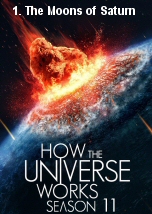
The magnificent ringed planet Saturn, along with its more than 80 moons, forms the most dynamic planetary system in our neighborhood. With underground oceans and protective magnetic fields, experts are exploring how this collective of satellites has the potential to rewrite the rules of the Solar System. The closer that we look, the more we see these extraordinary moons like worlds of their own -- so dynamic, so Earth-like. Almost a billion miles from the Sun, these icy worlds could be home for Life 2.0. The moons of Saturn offer possibly the best chance of finding extraterrestrial life in our solar system. With each new mission, we get closer to unraveling the mysteries of Saturn's moons.
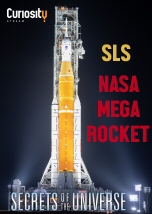
NASA’s Space Launch System (SLS) is the most powerful rocket ever built. This is the story of the incredible engineering that went into building it, told first-hand by NASA’s best rocket engineers. Building the rocket that will take us back to the Moon is no easy task, but the payoff will be phenomenal.
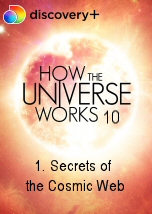
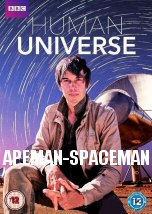
The tenth season of this acclaimed series. A users guide to the cosmos from the big bang to galaxies, stars, planets and moons. Where did it all come from and how does it all fit together. A primer for anyone who has ever looked up at the night sky and wondered. In the first episode, new astronomical research is beginning to reveal an invisible scaffold of dark matter known as the Cosmic Web, an intergalactic network that transformed the Universe from a chaotic Big Bang into the structured beauty of the present day cosmos.
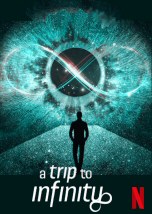
Does Infinity exist? Can we experience the Infinite? In an animated film created by artists from 10 countries, the world's most cutting-edge scientists and thinkers go in search of the infinite and its mind-bending implications for the universe. It doesn’t behave like we’re used to. It’s a monster that needs to be tamed. It creates and destroys mathematicians. It’s infinity! You know, the thing that goes on and on and on and never ends. Here we have theoretical physicists, mathematicians, philosophers, theoretical cosmologists talking about infinity – what it is, how it works, where we can find it, etc., and their concepts and explanations are illustrated by a variety of nifty animations in a variety of visual styles ranging from literal to metaphorical. Directors Jonathan Halperin and Drew Takahashi solicit experts to help them tackle the most maximal topic in the history of everything from a few different angles. Y when you think about it for a second, the only possible conclusion one can arrive at is a sublime and confounding realization that, on a cosmic scale, humans are naught but grand ignoramuses.
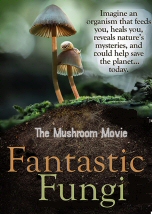
The film is a descriptive time-lapse journey about the magical, mysterious and medicinal world of fungi and their power to heal, sustain an contribute to the regeneration of life on Earth that began 3.5 billion years ago. Imagine an organism that feeds you, heals you, reveals secrets of the universe and could help save the planet. You'll see it through the eyes of mycologists, like renowned Paul Stamets, about the unlimited potential of fungi in the fields of food, medicine, expanding consciousness, bioremediation, neurogenesis and treating end-of-life anxiety.
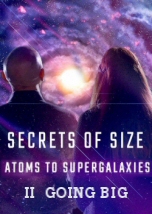
In the concluding episode of the series, Jim encounters ever larger cosmic structures to reveal the latest breakthroughs in our understanding of the universe. For example, Jim comes face to face with our galactic home, the Milky Way, a monstrous structure sculpted by the gravitational forces of dark matter. Jim finds out from pioneering researcher Adrian Fabian about the black hole at its centre, whose strange behaviour includes emitting the lowest note that can be heard in the cosmos. At an even greater scale, Jim encounters huge structures such as the Laniakea Supercluster, of which the Milky Way is only a tiny part. Then there’s the 'Giant Arc', a collection of galaxies that account for more than three per cent of the observable universe. Jim learns from its discoverer, British PhD student Alexia Lopez, that this gargantuan structure is forcing scientists to reassess their theory of how the universe evolves and may overturn some of the most fundamental principles in physics.























The closer that we look, the more we see these extraordinary moons like worlds of their own -- so dynamic, so Earth-like. Almost a billion miles from the Sun, these icy worlds could be home for Life 2.0. The moons of Saturn offer possibly the best chance of finding extraterrestrial life in our solar system. With each new mission, we get closer to unraveling the mysteries of Saturn's moons.