






Last Watched

"Wind"  Sort by

The Other Side

   2015    Culture
In an invisible territory at the margins of society lives a wounded community who face the threat of being forgotten by political institutions and having their rights as citizens trampled. Disarmed veterans, taciturn adolescents, drug addicts trying to escape addiction through love; ex-special forces soldiers still at war with the world; floundering young women and future mothers; and old people who have not lost their desire to live. Through this hidden pocket of humanity, renowned documentarian Roberto Minervini opens a window to the abyss of today's America.
Dawg Fight

   2015    Culture
West Perrine, Florida is a suburban ghetto in Southwest Miami. Over 63% of its residents are African-American and the unemployment rate is three times higher than the national rate. Violent crimes occur on a daily basis in this neighborhood of less than two square miles, where much of its adult male population winds up dead or in prison before their 30th birthday. But there is hope in the hood... Dhafir 'Dada 5000' Harris has built a ring in his momma's backyard and transforms himself into the Don King of illegal backyard fights in Perrine". Dada 5000 (6'3", 270lbs., bench presses 670lbs) grew up blocks away from Perrine's MMA sensation, Kimbo Slice, and spent a year traveling the world as Kimbo's bodyguard. When Kimbo's manager buried video of Dada's spectacular backyard fight debut, for fear of Dada overshadowing his rising superstar, Dada leaves Kimbo's crew and makes a life-changing decisión. In his ring there is no doctors, no ambulance. Just two men in a 12'x12' ring battling in a savage bare-knuckle fight to the finish. Dada's gladiators give everything in the the backyard to feed their families and to try to fight their way out of hood. Meanwhile Dada returns to the ring, is discovered by professional scouts and gets his shot at turning pro in the octagon at the Hard Rock Hotel and Casino.

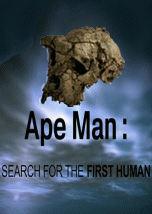
Ape Man: Search for the First Human

   2005    Science
After eight grueling years of hunting in the hot, wind-scoured desert of central Africa, an international team of researchers has uncovered one of the most sensational fossil finds in living memory: the well-preserved 7 million years old skull of a chimp-size animal, probably a male, that doesn't fit any known species. According to paleontologist Michel Brunet of the University of Poitiers in France, whose team reported the find in Nature last week, there is no way it could have been an ape of any kind. It was almost certainly a hominid — a member of a subdivision of the primate family whose only living representative is modern man.

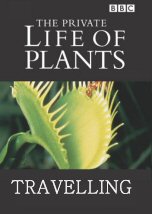
The Private Life of Plants: Travelling

   1994    Nature
Sir David Attenborough reveals plants as they have never been seen before - on the move and dangerously devious. About the major problems of life - growing, finding food, reproduction - and the varied ways plants have evolved to solve it. Filmed from the plant's point of view, using computer animations, fibre-optics and unique time-lapse photography. The first episode looks at how plants are able to move". The bramble is an aggressive example: it advances forcefully from side to side and, once settled on its course, there is little that can stand in its way. An altogether faster species is the birdcage plant, which inhabits Californian sand dunes. When its location becomes exposed, it shifts at great speed to another one with the assistance of wind — and it is this that allows many forms of vegetation to distribute their seeds. While not strictly a plant, the spores of fungi are also spread in a similar fashion. One of the most successful (and intricate) flowers to use the wind is the dandelion, whose seeds travel with the aid of 'parachutes'. They are needed to travel miles away from their parents, who are too densely packed to allow any new arrivals. Trees have the advantage of height to send their seeds further, and the cottonwood is shown as a specialist in this regard. The humidity of the tropical rainforest creates transportation problems, and the liana-species Alsomitra macrocarpa is one plant whose seeds are aerodynamic 'gliders'. Some, such as those of the sycamore, take the form of 'helicopters', while others, such as the squirting cucumber release their seeds by 'exploding'. Water is also a widely used method of propulsion. The tropical sea bean Entada gigas has one of the biggest fruits of all plants and is dispersed by water streams. However, most plants use living couriers, whether they be dogs, humans and other primates, ants or birds, etc., and to that end, they use colour and smell to signify when they are ripe for picking.
Series: The Private Life of Plants

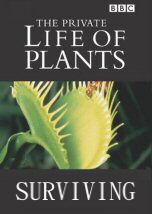
Surviving

   1995    Nature
the final episode deals with plants that live in hostile environments. Attenborough visits Ellesmere Island, north of the Arctic Circle, to demonstrate that even in a place that is unconducive to life, it can be found. Algae and lichens grow in or on rock, and during summer, when the ice melts, flowers are much more apparent. However, they must remain close to the ground to stay out of the chilling wind. In the Tasmanian mountains, plants conserve heat by growing into 'cushions' that act as solar panels, with as many as a million individual shoots grouped together as one. Others, such as the lobelia in Mount Kenya, have a 'fur coat' of dense hairs on their leaves. The saguaro cactus in the Sonoran Desert flourishes because of its ability to retain vast amounts of water, which can't be lost through leaves because it has none. Many desert dwellers benefit from an accelerated life cycle, blooming rapidly within weeks after rainfall. Conversely, Mount Roraima is one of the wettest places on Earth. It is a huge sandstone plateau with high waterfalls and nutrients are continuously washed away, so plants have to adapt their diet if they are to survive. A bladderwort is shown invading a bromeliad. Inhabitants of lakes have other problems to contend with: those that dominate the surface will proliferate, and the Amazon water lily provides an apt illustration. Attenborough ends the series with an entreaty for the conservation of plant species.
Series: The Private Life of Plants

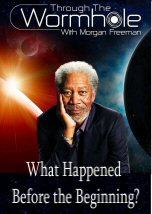
What Happened Before the Beginning

   2011    Science
Every cosmologist and astronomer agrees: our Universe is 13.7 billion years old. Using cutting-edge technology, scientists are now able to take a snapshot of the Universe a mere heartbeat after its birth. Armed with hypersensitive satellites, astronomers look back in time to the very moment of creation, when all the matter in the Universe exploded into existence. It is here that we uncover an unsolved mystery as old as time itself -- if the Universe was born, where did it come from? Meet the leading scientists who have now discovered what they believe to be the origin of our Universe, and a window into the time before time.
Series: Through the Wormhole
Vice

Vice

2013  Culture
Arnold

Arnold

2023  History
How Earth Made Us

How Earth Made Us

2010  Science
One Strange Rock

One Strange Rock

2018  Science
Building Giants

Building Giants

2019  Technology
Love On The Spectrum

Love On The Spectrum

2019  Culture