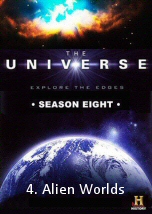
We are the generation of human beings that are going to know whether or not we're alone in the universe. This episode explores the search of exoplanets, from ancient Greek philosophers to the discoveries made possible with the Kepler Telescope. Unbelievable new worlds, planets made of diamond, planets of raining glass, worlds in collision, some plunging into stars, and others that just might harbor life. Thanks to today's planet hunters, our views of the universe and of our place in it are undergoing one of the greatest revolutions in scientific history.
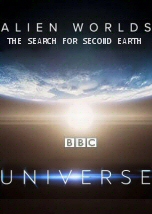
Humans have long gazed up at the night sky, wondering whether other lifeforms and intelligences could be thriving on worlds far beyond our own. But over the last few decades, ultra-sensitive telescopes and dogged detective work have transformed alien planet-hunting from science fiction into hard fact. We expected to find worlds similar to the planets in our own solar system, but we instead discovered a riot of exotic worlds. Vivid animation based on data from the most successful planet hunter of them all, the Kepler space telescope, brings these worlds into view: puffy planets with the density of polystyrene, unstable worlds orbiting two suns and 1,000-degree, broiling gas giants with skies whipped into titanic winds. But perhaps the most startling discovery was the number of worlds that may be contenders for a second Earth, at the right distance from their sun to have that ingredient so crucial for life as we know it, liquid water. Amongst them, we witness the most tantalizing discovery of all: a so-called ‘super-Earth’, situated in the Goldilocks zone - the area just the right distance from a sun to potentially support life - and with the faint signal of water in its atmosphere.
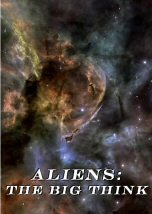
The hunt for aliens is on! After a distinguished career in cosmology Professor Martin Rees, the astronomer royal, has taken up the search for extra-terrestrials. Looking for aliens is no longer science fiction - it is a question that's engaging some of the greatest minds in science." As our knowledge of the universe has increased, we're getting closer to answers. Many scientists now think we live in galaxy with a billion Earth-like planets, many of which may be teeming with life. But what kind of life? Has anything evolved into beings we could communicate with? This film gets inside the minds of the scientists considering one of the most exciting and profound questions we can ask - are we alone in the universe? Professor Rees thinks we may have our idea of what an alien is like all wrong. If he's right, it's not organic extra-terrestrials we should look for, it's machines.
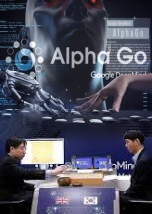
With more board configurations than there are atoms in the observable universe, the ancient Chinese game of 'Go' has long been considered a grand challenge for artificial intelligence. On March 9, 2016, the worlds of Go and AI collided in South Korea for an extraordinary best-of-five-game competition, coined the Google DeepMind Challenge Match. Hundreds of millions of people around the world watched as a legendary Go master took on an unproven AI challenger for the first time in history. AlphaGo chronicles a journey from the halls of Cambridge, through the backstreets of Bordeaux, past the coding terminals of DeepMind in London, and, ultimately, to the seven-day tournament in Seoul. As the drama unfolds, more questions emerge: What can artificial intelligence reveal about a 3000-year-old game? What can it teach us about human mind?
A daring covert operation, a decade of relentless pursuit, and the manhunt that changed history. This gripping documentary pulls back the curtain on the classified strategies, intelligence breakthroughs, and high-stakes decisions that led to one of the most consequential missions of the 21st century. With exclusive access to military insiders, CIA analysts, and rarely seen footage, it reconstructs the tense hours before the raid and the global aftermath that followed. All three episodes of this riveting series are available now on our website—immerse yourself in the full story as it unfolds from start to finish.
We offer this captivating full documentary series in a single video, inviting viewers to question everything they think they know about prehistory. Journalist Graham Hancock embarks on a global journey, exploring archaeological sites in search of clues to an advanced civilization that may have thrived thousands of years ago. Hancock presents a bold theory: during the last ice age, a sophisticated society existed but was wiped out by catastrophic meteor impacts roughly 12,000 years ago. He suggests that survivors of this lost civilization shared their knowledge with hunter-gatherers across the globe, sparking the development of early societies. Hancock visits intriguing sites and natural formations, presenting what he claims is evidence of this forgotten culture. He also asserts that mainstream archaeology may be overlooking—or even concealing—critical findings that support his theory. The series offers a fresh perspective on ancient history, blending mystery, controversy, and the thrill of discovery for those ready to rethink humanity's distant past. All eight episodes are available in a single, continuous video exclusively on our website.


















Thanks to today's planet hunters, our views of the universe and of our place in it are undergoing one of the greatest revolutions in scientific history.