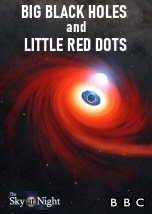
Professor Brian Cox joins Chris Lintott and the team to investigate one of the most intriguing new mysteries in modern astronomy. Observations from the James Webb Space Telescope have revealed hundreds of compact, extraordinarily bright objects known as “little red dots”, appearing less than a billion years after the Big Bang. Many may hide rapidly growing supermassive black holes, raising a profound question: how could such enormous objects have formed so early in cosmic history? The journey begins with the strange physics of black holes themselves, from event horizons and singularities to the supermassive black hole at the centre of the Milky Way and the gigantic black hole in the galaxy M87. With cosmologist Emma Chapman and Professor Sadegh Khochfar, the programme explores radical explanations for these ancient monsters, including primordial black holes born soon after the Big Bang and massive black holes formed directly from collapsing clouds of gas, bypassing stars altogether. Cutting-edge computer simulations recreate the first billion years of the universe and reveal how the earliest galaxies and black holes may have emerged within the cosmic web. These discoveries are forcing astronomers to reconsider not only how supermassive black holes grow, but how galaxies and the early universe itself evolved.
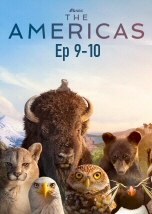
In the final two episodes, the journey reaches the Pacific edge of North America and the remote wilderness of Patagonia, two spectacular regions shaped by powerful oceans, towering forests and extreme weather. Along the West Coast, wolves comb the shoreline for food, sea otters battle crashing surf, blue whales gather in a rare display of speed and movement, and giant Pacific octopuses devote everything to protecting the next generation. High in the redwood canopy, even tiny salamanders perform extraordinary leaps to survive, revealing how life has adapted to one of the continent’s most dramatic coastal environments. The series then travels to the far south of the Americas, where Patagonia delivers a fittingly wild finale. Pumas stalk guanacos through snowy mountains, rockhopper penguins fight their way through violent waves to reach their colonies, giant stag beetles climb immense trees to compete for mates, and elephant seals clash for dominance along the coast. In one of the most remarkable scenes, a family of orcas passes down a dangerous hunting technique from one generation to the next, showing how survival here depends not only on strength, but also on experience, cooperation and learning.
In the final two episodes of Season 2, Ragnar’s hopes of securing land in Wessex collide with King Horik’s hunger for revenge. As the Vikings advance towards King Ecbert’s villa, they walk straight into a carefully prepared Saxon response. The resulting battle is brutal, leaving Rollo gravely wounded and forcing Ragnar to reconsider what victory should really mean. While Horik still dreams of plunder and vengeance, Ragnar begins to see a different future: Farmland for his people, an alliance with Ecbert and the possibility of using Viking strength in the struggle for Mercia. Back in Kattegat, however, the most dangerous battle is no longer being fought with Saxons. Horik becomes convinced that Ragnar has grown too powerful and secretly prepares to destroy him and his entire family. Floki appears to turn against Ragnar, Siggy is drawn into Horik’s plans and every friendship suddenly becomes suspect. But beneath the deception, Ragnar is quietly testing the loyalty of those closest to him. What follows is a tense and violent reckoning in which betrayal is answered with betrayal, old alliances are shattered and Ragnar’s rise reaches a decisive new stage.
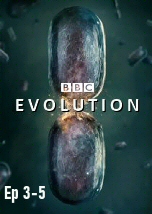
In the final three episodes of the series, Chris Packham follows three extraordinary evolutionary journeys to discover how the relentless demands of survival transformed simple early animals into some of the most remarkable creatures alive today. In Borneo, the voracious appetite of the bat leads back more than half a billion years to the origins of the through-gut, the first anus, heads and jaws, revealing how the need to find and consume food helped reshape animal life and ultimately produced the bat’s extraordinary powers of hearing. In the Bahamas, the intelligence of dolphins opens an even deeper story: from ancient cells able to sense light to the evolution of eyes, complex brains, sophisticated senses and the remarkable minds of modern dolphins. The journey culminates with one of nature’s supreme athletes. Tracing the horse’s ancestry through hundreds of millions of years, Packham reveals how primitive muscle cells evolved into increasingly powerful systems for movement, how beating hearts supplied those muscles with oxygen, and how limbs became ever more effective tools for locomotion. Slithering, swimming, walking and running eventually converge in an animal built for extraordinary speed and endurance. Together, these final episodes reveal a breathtaking truth: hunger, perception and movement were not merely necessities of survival—they were powerful evolutionary forces that helped create the astonishing complexity of animal life.
James Blake returns to the front line of online crime to investigate one of the darkest threats facing young people today: a hidden world of sextortion, grooming, harmful algorithms, and sexual exploitation moving across social media platforms with frightening speed. What begins with victims in the UK and warnings from police, experts, and whistle-blowers soon reveals a much larger and more disturbing picture, where online predators, organized networks, and global demand turn private screens into places of fear, blackmail, and abuse. The investigation takes him from Britain to the Philippines, where he joins a specialist international task force during police operations targeting livestreamed sexual exploitation linked to offenders abroad. Through survivor testimony, frontline officers, digital evidence, and the reality of raids on suspected abusers, the documentary exposes how technology, money, and anonymity can connect criminals thousands of miles away with vulnerable children. Urgent, shocking, and deeply human, it asks who is really protecting young people when the worst crimes online are only a few clicks away.
Few figures in history have inspired as much fear and mystery as Attila the Hun, the ruthless warrior king who brought the Roman Empire to the brink of collapse. This gripping documentary delves into his rise to power, exploring how a nomadic leader forged a terrifying force capable of shaking the foundations of Europe and rewriting the balance of power in the 5th century. But the greatest mystery remains unsolved: where is Attila buried? Using cutting-edge technology, new archaeological discoveries and expert analysis across multiple continents, the film embarks on a fascinating quest to uncover the truth behind his origins, his empire and his elusive tomb — a secret that has remained hidden for over 1,500 years.






















With cosmologist Emma Chapman and Professor Sadegh Khochfar, the programme explores radical explanations for these ancient monsters, including primordial black holes born soon after the Big Bang and massive black holes formed directly from collapsing clouds of gas, bypassing stars altogether. Cutting-edge computer simulations recreate the first billion years of the universe and reveal how the earliest galaxies and black holes may have emerged within the cosmic web. These discoveries are forcing astronomers to reconsider not only how supermassive black holes grow, but how galaxies and the early universe itself evolved.