
Last Watched

"EU"  Sort by

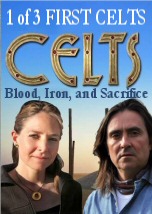
First Celts

   2015    History
The Celts - one of the world's most mysterious ancient people. In Britain and Ireland, we are never far from our Celtic past but in this series Prof. Alice Roberts and archaeologist Neil Oliver travel much further afield, discovering the origins and beliefs of these Iron Age people in artefacts and human remains right across Europe, from Turkey to Portugal. What emerges is not a wild people on the western fringes of Europe, but a highly sophisticated tribal culture that influenced vast areas of the ancient world - and even Rome". Rich with vivid drama reconstruction, we recreate this pivotal time and meet some of our most famous ancient leaders - from Queen Boudicca to Julius Caesar - and relive the battles they fought for the heart and soul of Europe. Alice and Neil discover that these key battles between the Celts and the Romans over the best part of 500 years constituted a fight for two very different forms of civilisation - a fight that came to define the world we live in today. In the first episode, we see the origins of the Celts in the Alps of central Europe and relive the moment of first contact with the Romans in a pitched battle just north of Rome - a battle that the Celts won and that left the imperial city devastated.
Series: The Celts: Blood, Iron, and Sacrifice
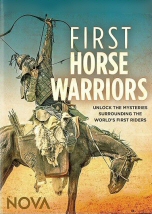
First Horse Warriors

   2019    History
Horses. Powerful, graceful, and thunderously fast. No animal has made a greater impact on society or given humans more freedom and mobility. In a spectacular adventure, the film unlocks the mystery of the first horse warriors on the vast, grassy plains of Kazakhstan, where horses still roam free, and nomadic herders follow their traditional way of life.
Investigating clues from archaeology and genetics, researchers reveal vivid evidence of the very first horsemen. They also discover warriors who swept across Europe and turn out to be the ancestors of millions today.

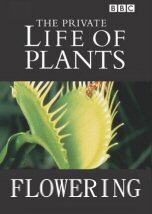
Flowering

   1995    Nature
The third episode is devoted to the ways in which plants reproduce. Pollen and a stigma are the two components needed for fertilisation. Most plants carry both these within their flowers and rely on animals to transport the pollen from one to the stigma of another. To do this, they attract their couriers with colour, scent and nectar. It isn't just birds that help pollination: some mammals and reptiles also do so. However, it is mostly insects that are recruited to carry out the task. To ensure that pollen is not wasted by being delivered to the wrong flower, some species of plant have developed exclusive relationships with their visitors, and the gentian and its attendant carpenter bees is one example. Since pollen can be expensive to produce in terms of calories, some plants, such as orchids, ration it by means of pollinia and a strategically placed landing platform. Other orchids offer no reward for pollination, but instead mislead their guests by mimicking their markings and aroma, thus enticing males to 'mate' with them (Pseudocopulation). The most extreme fertilisation method is one of imprisonment, and one plant that uses it is the dead horse arum. It is often found near gull colonies, and mimics the appearance and smell of rotting flesh. Blow-flies are attracted to it, and are forced to stay the night before being allowed to depart in the morning, laden with pollen. Finally, Attenborough introduces the world's largest inflorescence: that of the titan arum.
Series: The Private Life of Plants

Food Inc

   2009    Technology
Filmmaker Robert Kenner lifts the veil on our nation's food industry, exposing the highly mechanized underbelly that's been hidden from the American consumer with the consent of our government's regulatory agencies, USDA and FDA. Our nation's food supply is now controlled by a handful of corporations that often put profit ahead of consumer health, the livelihood of the American farmer, the safety of workers and our own environment. We have bigger-breasted chickens, the perfect pork chop, insecticide-resistant soybean seeds, even tomatoes that won't go bad, but we also have new strains of e coli--the harmful bacteria that cause illness for an estimated 73,000 Americans annually. We are riddled with widespread obesity, particularly among children, and an epidemic level of diabetes among adults Featuring interviews with such experts as Eric Schlosser (Fast Food Nation), Michael Pollan (The Omnivore's Dilemma) along with forward thinking social entrepreneurs like Stonyfield Farms' Gary Hirschberg and Polyface Farms' Joe Salatin, the film reveals surprising--and often shocking truths--about what we eat, how it's produced, who we have become as a nation and where we are going from here.

Friends The Reunion

   2021    Art
For the first time after seventeen years and their last appearance on the final episode of the TV series in 2004, Jennifer Aniston; Courteney Cox; Lisa Kudrow; Matt LeBlanc; Matthew Perry, and David Schwimmer, find themselves under the same roof for a reunion special. Hosted by James Corden, and produced by the show's co-creators, Marta Kauffman, David Crane, and Kevin Bright, the show's main cast feels at home in the original sets of Friends (1994), taking a trip down memory lane while sitting on Central Perk's couch.
Brimming with emotion, laughter, and tears of joy, 'Friends: The Reunion' sheds light on ambivalent endings, the casting process, and many more, as the main cast re-enacts older Friends episodes and meets with a plethora of celebrity guests, including Maggie Wheeler, the show's Janice Litman-Goralnik; Justin Bieber; Cindy Crawford; Cara Delevingne; Lady Gaga; David Beckham; Tom Selleck, and Nobel Peace Prize laureate, Malala Yousafzai.

Frozen Planet II: Frozen Worlds

   2022    Nature    HD
Journeying from pole to pole, The series 'Frozen Planet II' reveals surprising worlds that exist across the planet and the remarkable animals that make them their home. In a fragile world of beauty and hostility, nature finds a way to survive and thrive. David Attenborough explores a planet on the brink of major change.
In the first episode, we begin our journey in the far south, in the most hostile place on earth, the frozen continent of Antarctica. After being raised on the ice in winter, emperor penguin chicks find themselves abandoned by their parents in spring. To survive, they must find their own way across the treacherous sea ice to the rich waters of the Southern Ocean.
The waters surrounding Antarctica may be the richest of all, but they are also home to an exceptionally sophisticated predator, the killer whale. To reach their favored prey, Weddell seals, a family of killer whales have learnt to generate their own waves, washing the seals off their ice floes. It’s a technique that has been passed down over generations and is coordinated by the family matriarch, who can be over 100 years old.
Leaving Antarctica and travelling north, we discover frozen habitats that are created by altitude. The greatest of these is the Himalaya, the tallest mountain range on earth, which contains so much ice and snow it is known as the third pole. In the shadow of the Himalaya lies a vast frozen grassy plain that is home to the fluffiest cat in the world, Pallas’s cat. It may have extremely dense fur, but if it’s to survive the Mongolian winter, it needs to catch lots of gerbils and voles. Easier said than done when you only have short legs and paws that are sensitive to the cold.
North of the Great Steppe lies the boreal forest, which encircles the continents of North America, Europe and Asia, and remains frozen for six months of the year. Prowling these forests in the far east of Russia is the Siberian tiger, the largest cat in the world. In winter, it is on the lookout for black bears hibernating in caves, a high-risk strategy that only a cat of this size would attempt.
Above the boreal forest, we cross into the Arctic Circle, where conditions become so extreme that trees can no longer grow. This is the tundra. Living here are relics of the last ice age, musk ox. In spring, their calves face a far greater danger than the cold, grizzly bears. Encounters can be brutal, but if just a few calves survive the gauntlet, the herd’s future is secure.
To the north of the tundra is the Arctic Ocean, the only ocean that can completely freeze over. Living here is one of the most peculiar animals on earth, the hooded seal. Males have extraordinary inflatable noses, producing a bright red balloon out of their left nostrils. One male hopes this will make him irresistible.
All of the frozen habitats share one thing in common: the threat posed by today’s climate change. Travelling to the island of Greenland, home to the largest body of ice in the northern hemisphere, we witness how global warming is melting its ice cap at faster rates than ever before, with profound consequences for global sea levels. Lastly, we visit the Arctic’s most iconic resident, the polar bear, as a mother bear struggles to provide for her cubs in a world of shrinking sea ice.
Series: Frozen Planet II
Ancient Aliens

Ancient Aliens

2014  Culture
Human

Human

2025  History
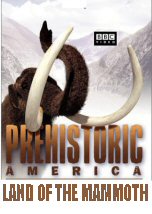
Prehistoric America

Prehistoric America

2003  Nature
Frozen Planet

Frozen Planet

2011  Nature
Wild Isles

Wild Isles

2023  Nature
Planet Earth

Planet Earth

2007  Nature
Follow This

Follow This

2018  Medicine