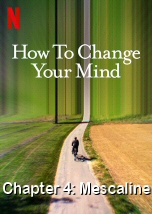
The last episode explores Mescaline, the psychoactive molecule in San Pedro and peyote cacti, a sacred medicine that Native Americans have had to fight for the right to use. At the Indigenous practices there's always an elder, someone who knows the territory very well, who's presiding. There's usually a group, a community is involved, There's always an intention, a purpose to what you're doing, and you're treating it as sacred, in order to achieve altered states of consciousness, which contribute to worship in various ways, or celebration or healing. But maybe all this is not so new to Western culture after all. In the old Greek histories of Eleusis, people who were initiated there got the drink, the kykeon, and then they had the illumination. The precise recipe is a mystery, but we know that the kykeon was a psychoactive brew that was used at the Eleusinian mysteries, a sacred annual ritual of enlightenment practiced by some of the world's greatest minds including Socrates, Plato, and Aristotle. So why did this ritual come to an end more than 1,000 years ago? Was the possibility of illumination or achieving a higher consciousness considered threatening to the powers that be? Have the drug wars been merely an extension of that fear? Psychedelics has a major part in how we can heal as a community, how we can heal as a city, and how we can heal as a country. The current renaissance of psychedelics could not come at a better time as the world confronts a crisis in mental health. But psychedelics have much to offer. The psychedelic experience changes the mind in ways that will help scientists better understand how it works. All these altered states allow us to probe what is the greatest mystery in all of nature. The emergence from mere matter of something as miraculous as consciousness. But an even bigger question is whether psychedelics might help us address the environmental crisis of how we think about our place in nature. One of the greatest gifts of psychedelics is how they reanimate the natural world, allowing us to perceive the subject, the spirit of all species, not just our own. And to feel a deeper sense of interconnectedness with nature.
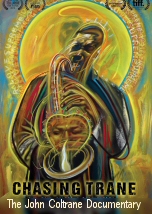
The definitive documentary about an outside-the-box thinker with extraordinary talent whose boundary-shattering music continues to impact and influence people around the world. This smart, passionate, thought-provoking and uplifting documentary is for anyone who appreciates the power of music to entertain, inspire and transform. the film is produced with the full participation of the Coltrane family and the support of the record labels that collectively own the Coltrane catalog. The film-maker John Scheinfeld brings his strong story-telling skills to the creation of a rich, textured and compelling narrative that takes the audience to unexpected places. Set against the social, political and cultural landscape of the times, 'Chasing Trane' brings John Coltrane to life as a fully dimensional being, inviting the audience to engage with Coltrane the man.
From the small town of Lynchburg, Tennessee, where every drop of Jack Daniel's is made, to the outback of Australia, from Beverly Hills to the streets of Havana, Cuba, 'Chasing Whiskey' documents a cultural exploration into why a world of people identifies with a distinctly American brand. Through it all, Jack Daniel's serves as the compass on a journey that offers a glimpse into humanity, shared values and differing views, dreams and delusions
A catastrophe still reverberating today with Chernobyl on the front line of war. Formerly secret KGB files reveal the astonishing truth about the 1986 explosion of the Chernobyl nuclear reactor in Ukraine, with leading experts and eyewitness accounts. Newly declassified evidence from KGB archives reveals that the KGB had concerns about the safety of the Chernobyl nuclear plant even as it was being built. The film includes first-hand accounts from survivors, including Oleksiy Ananenko, who braved radioactive waters to prevent a second explosion, and Maryna Sivets, whose unborn child's life was put at risk.
Foo Fighters commemorate their 20th anniversary by documenting the eight-city recording odyssey that produced their latest, and eighth, studio album. Foo Fighters founder Dave Grohl directs the series, which taps into the musical heritage and cultural fabric of eight cities: Chicago, Austin, Nashville, Los Angeles, Seattle, New Orleans, Washington D.C. and New York. The band based themselves at a legendary recording studio integral to the unique history and character of each location. One song was recorded in each city, and every track features local legends. Even the lyrics were developed in an experimental, unprecedented way: Grohl held off on writing them until the last day of each session, letting himself be inspired by the experiences, interviews and personalities that became part of the process. Foo Fighters Sonic Highways is, in Grohl’s words, “a love letter to the history of American music.” Each episode delves into the identity of each city -- showing how each region shaped these musicians in their formative years and, in turn, how they impacted the cultural fabric of their hometowns. Every artist who appears in the show, regardless of genre or locale, started as an average kid with universal dreams of making music and making it big. Grohl made his feature film directorial debut in 2013 with the universally acclaimed Grammy-winning Sound City, a celebration of the human element in the creation and recording of music. Foo Fighters have won 11 Grammy Awards, including four for Best Rock Album, more than any other band. Premiering on the eve of Foo Fighters’ 20th anniversary, Foo Fighters Sonic Highways aims to “give back” to the next generation of young musicians. As guitarist and singer Buddy Guy, an interviewee from the Chicago blues scene, explains, “Everything comes from what’s come before.” In the first episode, Dave Grohl and friends discuss the rise of the famous Chicago music scene from the roots blues of Muddy Waters and Buddy Guy to the Rock and roll of Cheap Trick.
Putin's new law that forbids 'propaganda of non-traditional sexual relations to minors' hits millions of gay/lesbian youngsters in Russia. Parents and friends of gay kids now are obliged to tell them they are sick, sinful and abnormal. These teens have no forum, find no help in Russia, you won't even find them on the internet: Error 404. For the first time, the bravest of them turn to the camera in the new film of 'Winter Go Away'



























But maybe all this is not so new to Western culture after all. In the old Greek histories of Eleusis, people who were initiated there got the drink, the kykeon, and then they had the illumination. The precise recipe is a mystery, but we know that the kykeon was a psychoactive brew that was used at the Eleusinian mysteries, a sacred annual ritual of enlightenment practiced by some of the world's greatest minds including Socrates, Plato, and Aristotle. So why did this ritual come to an end more than 1,000 years ago? Was the possibility of illumination or achieving a higher consciousness considered threatening to the powers that be? Have the drug wars been merely an extension of that fear?
Psychedelics has a major part in how we can heal as a community, how we can heal as a city, and how we can heal as a country. The current renaissance of psychedelics could not come at a better time as the world confronts a crisis in mental health. But psychedelics have much to offer. The psychedelic experience changes the mind in ways that will help scientists better understand how it works. All these altered states allow us to probe what is the greatest mystery in all of nature. The emergence from mere matter of something as miraculous as consciousness. But an even bigger question is whether psychedelics might help us address the environmental crisis of how we think about our place in nature. One of the greatest gifts of psychedelics is how they reanimate the natural world, allowing us to perceive the subject, the spirit of all species, not just our own. And to feel a deeper sense of interconnectedness with nature.