











Last Watched

"Owl"  Sort by

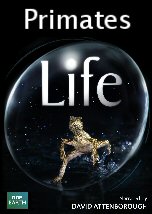
Life: Primates

   2009    Nature
Intelligence and adaptability allow primates to tackle the many challenges of life, and this is what makes our closest relatives so successful. This resourcefulness has enabled primates to conquer an incredible diversity of habitat. Hamadryas baboons live on the open plains of Ethiopia in groups up to 400 strong. Strength in numbers gives them some protection from potential predators. But, should their path cross with other baboon troops, it can lead to all-out battle, as males try to steal females from one another, and even settle old scores. Japanese macaques are the most northerly-dwelling primates and they experience completely different challenges. Some beat the freezing conditions by having access to a thermal spa in the middle of winter. But this privilege is only for those born of the right female bloodline. For western lowland gorillas, it's the male silverback that leads his family group in the rich forests of the Congo basin. He advertises his status to all with a powerful chest-beating display. Most primates are forest dwellers, and one of the strangest is the tarsier – the only purely carnivorous primate. As it hunts for insects the tarsier leaps from tree to tree in the dead of night, using its huge forward-facing eyes to safely judge each jump. Good communication is essential for success in primate society.
Series: Life
Lost Horizons: The Big Bang

   2008    Science
Professor Jim Al Khalili from the University of Surrey delves into over 50 years of the BBC science archive to tell the story behind the emergence of one of the greatest theories of modern science, the Big Bang. The remarkable idea that our universe simply began from nothing has not always been accepted with the conviction it is today and, from fiercely disputed leftfield beginnings, took the best part of the 20th century to emerge as the triumphant explanation of how the universe began. Using curious horn-shaped antennas, U-2 spy planes, satellites and particle accelerators, scientists have slowly pieced together the cosmological jigsaw, and this documentary charts the overwhelming evidence for a universe created by a Big Bang.

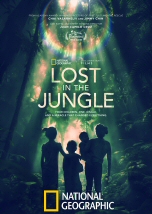
Lost in the Jungle

   2025    History    HD
Deep in the Colombian rainforest, four young siblings are left stranded after a devastating plane crash. With nothing but their instincts and fragments of ancestral knowledge, they endure forty days of relentless rain, hunger, and danger while the world above holds its breath. Every step in the dense jungle becomes a test of resilience, as their fragile hope collides with the harshest of environments.
At the same time, Indigenous trackers and the Colombian military launch an extraordinary rescue mission, weaving tradition and modern tactics in a desperate race against time. Through the voices of the children and their rescuers, this gripping account captures a story of survival and unity, where courage and determination triumph against impossible odds.

Magellan Crossing

   2021    History
Ferdinand Magellan and Juan Sebastian Elcano set sail to gain control of the global spice trade, but end up becoming the first expedition to circumnavigate the earth. The yearslong voyage—along with the suffering, the violence and the loss of life and property—were all in pursuit of a shorter route to the so-called Spice Islands (now the Maluku Islands) and their much-coveted aromatics.
The film puts in perspective the 16th century—the Age of Exploration, the Age of Discovery and the Age, problematically, of Colonialism. It also was an age of heroes. As the documentary insists, the journeys undertaken by the men whose names we learned in grade school and whose exploits straddled the 1400s and 1500s—including Ponce de Leon, Vasco da Gama, Lope de Aguirre and even Columbus—were about money, sometimes trade, sometimes plunder. But just as advances in medicine have often been propelled by war, knowledge about the world has been a byproduct of profit-seeking. Likewise, heroism.

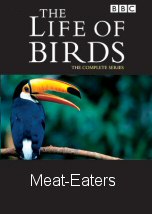
Meat-Eaters

   1998    Nature
This episode examines those birds whose sustenance comes from flesh and their methods of hunting. In New Zealand, Sir Attenborough observes Keas, parrots that do not eat meat exclusively, raiding a shearwater's burrow for a chick. However, it is the dedicated birds of prey, such as owls, buzzards, eagles, falcons and vultures, to which much of the programme is devoted. In order to spot and pursue their victims, senses of sight and hearing are very acute. Vultures are the exception, in that they eat what others have left, and once a carcass is found, so many birds descend on it that the carrion seems submerged beneath them. The Turkey Vulture is an anomaly within its group, as it also has a keen sense of smell. Eagles defend their territory vigorously, and a pair of sea eagles are shown engaging in an aerial battle. The Galápagos Hawk hunts Marine Iguanas, but can only do so when its quarry is vulnerable, during the breeding season. The African Harrier Hawk has adapted to extracting burrowing animals by virtue of an especially long, double-jointed pair of legs. By contrast, a shrike is not equipped with the requisite sharp beak and talons needed for butchery, and so dismembers its kill by impaling it on the thorns of acacias. The Lammergeier eats bones, and will drop them on to rocks from a great height in order to break them down to a digestible size. Also featured are the Eurasian Sparrowhawk, Goshawk and Peregrine Falcon.
Series: The Life of Birds

Natural History Museum Alive

       Science    3D    HD
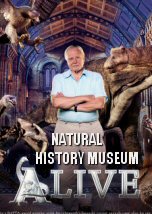
In this ground-breaking film, Sir David Attenborough takes us on a journey through the world-famous Natural History Museum in London in a captivating tale of discovery, adventure, and magic, where state-of-the-art CGI, science, and research combine to bring the museum's now long-extinct inhabitants to life to discover how these animals once roamed the planet. As the doors are locked and night falls, Attenborough stays behind and meets some of the most fascinating extinct creatures which come alive in front of his eyes; dinosaurs, ice age beasts, and giant reptiles.
The film fulfils a lifelong dream of him, who said: 'I have been coming to the Natural History Museum since I was a boy. It's one of the great places to come to learn about natural history. In this film we have the technology to bring back to life some of the most romantic and extraordinary extinct creatures that can be conceived; some are relatively recent animals like the dodo, others older like the dinosaurs, and some we only know through fossil evidence. Using our current scientific knowledge, this film brings these creatures alive, allowing me to look at some of the biggest questions surrounding them.'
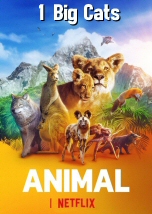
Animal

Animal

2021  Nature
Ancient Aliens

Ancient Aliens

  History
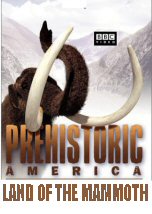
Prehistoric America

Prehistoric America

2003  Nature
Earthflight

Earthflight

2012  Nature
The Sky at Night

The Sky at Night

2025  Science