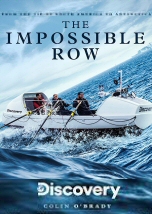
The film documents the historic journey of a team of adventurers as they strive to complete the world's first completely human powered ocean row from Cape Horn to the Antarctic Peninsula across The Drake Passage, the most dangerous 600 miles of open ocean on Earth. The expedition was captained by Icelandic explorer Fiann Paul, who was joined by a team of six record-holding explorers and athletes from four nations and three continents, including Colin O'Brady. The row pushes the entire crew to their limits, testing their physical and mental strength as they work to accomplish something many think was impossible.
The journey continues into Asia, the world's greatest land mass, in a quest to discover how early hunter-gatherers managed to survive in one of the most inhospitable places on earth - the Arctic region of Northern Siberia. Alice also explores what may have occurred during human migration to produce Chinese physical characteristics, and considers a controversial claim about Chinese evolution: that the Chinese do not share the same African ancestry as other peoples.
The Indian Ocean is the third largest body of water on Earth at more than 6,000 miles wide and covering 13% of the world's surface. It is home to 5,000 species of fish, many of which only exist in the Indian Ocean. But it is also an ocean under threat from global issues such as over-fishing and climate change, which make this an ocean on the edge.
Scorched by their proximity to the sun, Mercury and Venus are hostile worlds; one gouged with craters from cosmic collisions and the other a vortex of sulphur, carbon dioxide and acid rain. Prime examples of planets gone awry, do they serve as a warning for ominous scenarios that might someday threaten Earth?
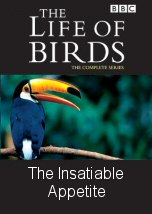
The next instalment focuses on dietary needs and how different species have evolved beaks to suit their individual requirements. The latter come in a multitude of forms. Blue tits and goldfinches have beaks akin to tweezers, with which to extract seeds, while the hawfinch's razor-like bill can deal with a cherry-stone. However, the crossbill is the only finch that can twist its mandibles in opposite directions. Jays store acorns for winter by burying them in the ground, whereas woodpeckers can keep up to 60,000 of them in one tree trunk. Sap is also desirable, and there are a variety of methods used to obtain it. The hoatzin is the only specialised leaf-eater, and accordingly has a digestive system more akin to that of cattle. Plants recruit birds to aid pollination, and offer nectar as a reward. Hummingbirds eat little else, and the sword-bill's beak is the longest of any bird in relation to its body. Insects are also highly prized, and Galapagos finches are shown to possess some ingenuity as they not only strip bark, but also use 'tools' to reach their prey. Crows are hailed as being among the most intelligent birds, and one is shown using a twig to spear a grub within a fallen log. The robin is an opportunist, and Sir Attenborough observes one seizing morsels as he digs a patch of earth. In South America, a cattle tyrant sits atop an obliging capybara and uses its vantage point to spot passing food that may be dislodged by its grazing partner.
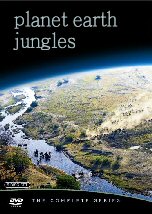
Jungles cover roughly three per cent of our planet yet contain 50 per cent of the world's species. High-definition cameras enable unprecedented views of animals living on the dark jungle floor. In the Ngogo forest the largest chimpanzee group in the world defends its territory from neighbouring groups. Other jungle specialists include parasitic fungi which infiltrate an insect host, feed on it, and then burst out of its body.
















The expedition was captained by Icelandic explorer Fiann Paul, who was joined by a team of six record-holding explorers and athletes from four nations and three continents, including Colin O'Brady. The row pushes the entire crew to their limits, testing their physical and mental strength as they work to accomplish something many think was impossible.