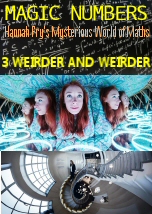
Dr Hannah Fry explores a paradox at the heart of modern maths, discovered by Bertrand Russell, which undermines the very foundations of logic that all of maths is built on. These flaws suggest that maths isn't a true part of the universe but might just be a human language - fallible and imprecise. However, Hannah argues that Einstein's theoretical equations, such as E=mc2 and his theory of general relativity, are so good at predicting the universe that they must be reflecting some basic structure in it. This idea is supported by Kurt Godel, who proved that there are parts of maths that we have to take on faith. Hannah then explores what maths can reveal about the fundamental building blocks of the universe - the subatomic, quantum world. The maths tells us that particles can exist in two states at once, and yet quantum physics is at the core of photosynthesis and therefore fundamental to most of life on earth - more evidence of discovering mathematical rules in nature. But if we accept that maths is part of the structure of the universe, there are two main problems: firstly, the two main theories that predict and describe the universe - quantum physics and general relativity - are actually incompatible; and secondly, most of the maths behind them suggests the likelihood of something even stranger - multiple universes. We may just have to accept that the world really is weirder than we thought, and Hannah concludes that while we have invented the language of maths, the structure behind it all is something we discover. And beyond that, it is the debate about the origins of maths that has had the most profound consequences: it has truly transformed the human experience, giving us powerful new number systems and an understanding that now underpins the modern world.
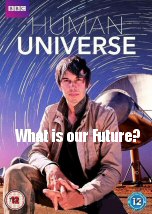
Professor Brian Cox concludes his exploration of our place in the universe by asking what next for the ape that went to space. Our future is far from certain. In Florida, Brian joins the latest efforts to protect Earth from potential catastrophic events. He joins a team of Nasa astronauts who are training for a future mission to an asteroid - should we ever discover one coming our way - under 30 feet of water in a submerged laboratory that simulates space. It is just one example of how, for our long-term survival, space exploration may well be vital. It is a view shared by Apollo 16 astronaut Charlie Duke, who tells Brian what it was like to escape the confines of the planet. It is a dream that both Nasa and now commercial companies share as they race to get humans back into deep space. But space travel, like every leap our civilisation has ever made, requires energy. Here too, scientists are hard at work attempting to safeguard our future. At the National Ignition Facility in California, Brian witnesses the world's most successful fusion experiment in action. He believes that if their mission succeeds, our civilisation will have unlocked a way to the stars that will not destroy the planet in the process. Brian concludes by returning to the top of the world in Svalbard, where he gains access to our civilisation's greatest treasure, locked away in a vault buried deep in the permafrost.
This series takes viewers on a journey to the frontiers of science, where researchers are tackling some of the biggest questions about life and the cosmos. The universe is hiding something. In fact, it is hiding a lot. Everything we experience on Earth, the stars and galaxies we see in the cosmos—all the 'normal' matter and energy that we understand—make up only 5% of the known universe. The other 95% is made up of two mysterious components: 'dark matter' and 'dark energy.' We can’t see them, but we know they’re there. And what’s more —these two shadowy ingredients are locked in an epic battle to control the very fate of the universe. Now, scientists are trying to shed light on the so-called 'dark sector' as the latest generation of detectors rev up, and powerful telescopes peer deeper into space than ever before to observe how it behaves. Will the discoveries help reveal how galaxies formed? In the series finale, Nova Wonders journeys to the stars and back to investigate what we know —and don’t know. Find out how scientists are discovering new secrets about the history of the universe, and why they’re predicting a shocking future.
The episode begins with Tyson describing how pattern recognition manifested in early civilization as using astronomy and astrology to predict the passing of the seasons, including how the passage of a comet was often taken as an omen. Tyson continues to explain that the origin of comets only became known in the 20th century due to the work of Jan Oort and his hypothesis of the Oort cloud. Tyson then continues to relate the collaboration between Edmond Halley and Isaac Newton in the last part of the 17th century in Cambridge. The collaboration would result in the publication of Philosophiæ Naturalis Principia Mathematica, the first major work to describe the laws of physics in mathematical terms, despite objections and claims of plagiarism from Robert Hooke and financial difficulties of the Royal Society of London. Tyson explains how this work challenged the prevailing notion that God had planned out the heavens, but would end up influencing many factors of modern life, including space flight. Tyson further describes Halley's contributions including determining Earth's distance to the sun, the motion of stars and predicting the orbit of then-unnamed Halley's Comet using Newton's laws. Tyson contrasts these scientific approaches to understanding the galaxy compared to what earlier civilizations had done, and considers this advancement as mankind's first steps into exploring the universe. The episode ends with an animation of the Milky Way and Andromeda galaxies' merging based on the principles of Newton's laws.
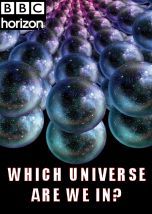
Imagine a world where infinite copies of you are playing out every storyline of your life. It sounds like a plot stolen straight from Hollywood, but far from it. This is the multiverse. Until very recently the whole idea of the multiverse was dismissed as a fantasy, but now this strangest of ideas is at the cutting edge of science. And for a growing number of scientists, the multiverse is the only way we will ever truly make sense of the world we are in. Do multiple universes exist? And if so, which one are we actually in?" Imagine a world where dinosaurs still walk the earth. A world where the Germans won World War II and you are president of the United States. Imagine a world where the laws of physics no longer apply.
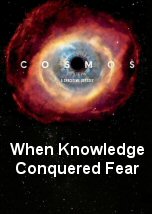
Sagan reflects on the future of humanity and the question of 'who speaks for Earth?' when meeting extraterrestrials. He discusses the very different meetings of the Tlingit people and explorer Jean-François de La Perouse with the destruction of the Aztecs by Spanish conquistadors, the looming threat of nuclear warfare, and the threats shown by destruction of the Library of Alexandria and the murder of Hypatia. The episode ends with an overview of the beginning of the universe, the evolution of life, and the accomplishments of humanity and makes a plea to mankind to cherish life and continue its journey in the cosmos. The Cosmos Update notes the preliminary reconnaissance of planets with spacecraft, the fall of the Berlin Wall and the end of apartheid in South Africa, and measures towards the reduction of nuclear weapons.














Hannah then explores what maths can reveal about the fundamental building blocks of the universe - the subatomic, quantum world. The maths tells us that particles can exist in two states at once, and yet quantum physics is at the core of photosynthesis and therefore fundamental to most of life on earth - more evidence of discovering mathematical rules in nature. But if we accept that maths is part of the structure of the universe, there are two main problems: firstly, the two main theories that predict and describe the universe - quantum physics and general relativity - are actually incompatible; and secondly, most of the maths behind them suggests the likelihood of something even stranger - multiple universes.
We may just have to accept that the world really is weirder than we thought, and Hannah concludes that while we have invented the language of maths, the structure behind it all is something we discover. And beyond that, it is the debate about the origins of maths that has had the most profound consequences: it has truly transformed the human experience, giving us powerful new number systems and an understanding that now underpins the modern world.