Nathan Fielder returns with a daring new season that elevates the concept of constructed reality to extraordinary extremes. This season dives even deeper into ethically charged scenarios, where real people rehearse life-altering choices inside meticulously engineered simulations. As the line between performance and authenticity dissolves, the series confronts our deepest questions about control, identity, and the limits of preparation. Disturbing, brilliant, and darkly hilarious—it’s an experience like no other. The opening three episodes raise the stakes immediately. A father struggles to reveal a devastating truth to his son—but the rehearsal begins to unravel his own sense of self. A woman prepares for a proposal that may never arrive, as emotional tension distorts her reality. And in a startling turn, Fielder inserts himself into the most personal rehearsal yet, facing consequences he may no longer be able to manage. With emotional weight, narrative twists, and biting satire, these episodes pull you in and don’t let go.
This brilliant docuseries is an exploration of the feudal Japan from 1551 to 1616 , during the final phase of the Sengoku period (The Age of Warring States), when several powerful daimyo (warlords) fought to become absolute ruler. It features reenactments of historical events and commentary by voice-over artist Hiro Kanagawa and outstanding historians. In the first episode, Oda Nobunaga becomes head of the Oda clan upon the death of his father, but this causes problems with family members who compete for control.
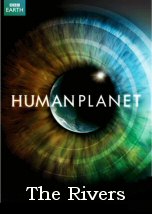
Rivers provide the essentials of life: fresh food and water. They often provide natural highways and enable us to live in just about every environment on Earth. But rivers can also flood, freeze or disappear altogether!Cities - Surviving the Urban Jungle Human Planet joins Sam Niang, a Laotian fisherman, as he walks a high wire strung above the raging Mekong River rapids on an extraordinary commute to work. There's also a look at the remarkable partnership between Samburu tribesmen and wild elephants in their search for water in the dried-out river beds of Northern Kenya. Plus, a father who must take his two children on a six-day trek down a frozen river - the most dangerous school run on Earth, and the ice dam busters of Ottowa with their dynamite solution to a city centre hold-up.
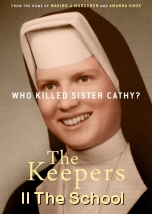
Former students of Archbishop Keough High School reveal allegations of sexual abuse by Father Joseph Maskell, the chaplain of the school. It details the personal story of 'Jane Doe' (Jean Hargadon Wehner) who claims that Father Maskell took her to see the dead body of Sister Catherine Cesnik in Lansdowne, Maryland.
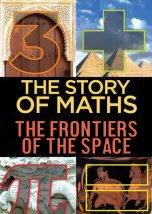
In the third episode we will see Europe by the 17th century taking over from the Middle East as the powerhouse of mathematical ideas. Great strides had been made in understanding the geometry of objects fixed in time and space. The race was on to discover the mathematics to describe objects in motion. This programme explores the work of Rene Descartes, Pierre Fermat, Isaac Newton, Leonard Euler and Carl Friedrich Gauss. Du Sautoy proceeds to describes René Descartes realisation that it was possible to describe curved lines as equations and thus link algebra and geometry. He talks with Henk J. M. Bos about Descartes. He shows how one of Pierre de Fermat’s theorems is now the basis for the codes that protect credit card transactions on the internet. He describes Isaac Newton’s development of math and physics crucial to understanding the behaviour of moving objects in engineering. He covers the Leibniz and Newton calculus controversy and the Bernoulli family. He further covers Leonhard Euler, the father of topology, and Gauss' invention of a new way of handling equations, modular arithmetic. The further contribution of Gauss to our understanding of how prime numbers are distributed is covered thus providing the platform for Bernhard Riemann's theories on prime numbers. In addition Riemann worked on the properties of objects, which he saw as manifolds that could exist in multi-dimensional space.
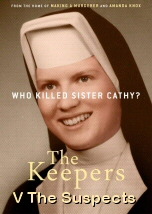
Lil Hughes Knipp recalls meeting Father Maskell near his end... and knowing that he would never be charged. The search for Brother Bob and a potential killer begins, and the revelation of a potential suspect named Edgar Davidson comes forward with an interesting story. With more people coming forward, more suspects appear including a man named Billy Schmidt who lived in Cathy’s apartment. A contact from one of Cathy’s sisters could give new insight on the case.











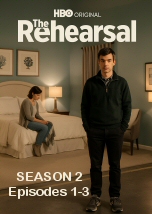







The opening three episodes raise the stakes immediately. A father struggles to reveal a devastating truth to his son—but the rehearsal begins to unravel his own sense of self. A woman prepares for a proposal that may never arrive, as emotional tension distorts her reality. And in a startling turn, Fielder inserts himself into the most personal rehearsal yet, facing consequences he may no longer be able to manage. With emotional weight, narrative twists, and biting satire, these episodes pull you in and don’t let go.