











Last Watched

"Cave"  Sort by

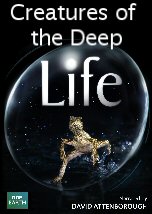
Life: Creatures of the Deep

   2009    Nature
Marine invertebrates are some of the most bizarre and beautiful animals on the planet, and thrive in the toughest parts of the oceans. Divers swim into a shoal of predatory Humboldt squid as they emerge from the ocean depths to hunt in packs. When cuttlefish gather to mate, their bodies flash in stroboscopic colours. Time-lapse photography reveals thousands of starfish gathering under the Arctic ice to devour a seal carcass. A giant octopus commits suicide for her young. A camera follows her into a cave which she walls up, then she protects her eggs until she starves. The greatest living structures on earth, coral reefs, are created by tiny animals in some of the world's most inhospitable waters.
Series: Life


Frozen Planet: The Last Frontier

   2011    Culture
The documentary series reveals the extraordinary riches and wonders of the Polar Regions that have kept people visiting them for thousands of years. Today, their survival relies on a combination of ancient wisdom and cutting-edge science. Most Arctic people live in Siberia, either in cities like Norilsk - the coldest city on earth - or out on the tundra, where tribes like the Dogan survive by herding reindeer, using them to drag their homes behind them. On the coast, traditional people still hunt walrus from open boats - it is dangerous work, but one big walrus will feed a family for weeks. Settlers are drawn to the Arctic by its abundant minerals; the Danish Armed Forces maintain their claim to Greenland's mineral wealth with an epic dog sled patrol, covering 2,000 miles through the winter. Above, the spectacular northern lights can disrupt power supplies so scientists monitor it constantly, firing rockets into it to release a cloud of glowing smoke 100 kilometres high. In contrast, Antarctica is so remote and cold that it was only a century ago that the first people explored the continent. Captain Scott's hut still stands as a memorial to these men. Science is now the only significant human activity allowed; robot submarines are sent deep beneath the ice in search of new life-forms, which may also be found in a labyrinth of ice caves high up on an active volcano. Above, colossal balloons are launched into the purest air on earth to detect cosmic rays. At the South Pole there is a research base designed to withstand the world's most extreme winters. Cut off from the outside world for six months, the base is totally self-sufficient, even boasting a greenhouse.
Series: Frozen Planet

Neanderthal Apocalypse

   2015    History
40,000 years ago the steppes of Eurasia were home to our closest human relative, the Neanderthals. Recent genetic and archaeological discoveries have proven that they were not the dim-witted cave dwellers we long thought they were. In fact, they were cultured, technologically savvy and more like us than we ever imagined! So why did they disappear? We accompany scientists on an exciting search for an answer to this question and come to a startling conclusion... A climate change due to a cataclysmic event.

Walking with Cavemen: First Ancestors

   2003    History
It's 3.5 million years ago and in East Africa a remarkable species of ape roams the land. Australopithecus afarensis has taken the first tentative steps towards humanity by standing and walking on two legs. The rift valley was forming, and the rain forests dying as Africa dried out - turning the landscape into a mosaic of scattered trees and grass. In this new environment afarensis found it more efficient to move about on two legs rather than four.
Series: Walking with Cavemen

Walking with Cavemen: The Survivors

   2003    History
Nearly half a million years ago, the most advanced human yet roams Europe. Strong and powerful, Homo heidelbergensis are fierce hunters, use sophisticated tools and live in close-knit family groups. Over 200,000 years they become split into two populations by extremes of weather and environment and evolve separately into two very different species. In the North are the Neanderthals, whose physical power and resilience is the key to surviving in ice age Northern Europe. About 140,000 years ago, Africa is in the grip of a devastating drought, and something remarkable has happened to the descendants of heidelbergensis who live there. The combination of environment and chance has bred in them a unique ability that will change the course of human history. It will be this small band of southern survivors, perhaps numbering just a few tens of thousands, who will come to dominate the world and be known as Homo sapiens.
Series: Walking with Cavemen

Banksy Does New York

       Art
On Oct. 1, 2013, the elusive British street artist known as Banksy launched a self-proclaimed month-long residency in New York City, posting one unique exhibit a day in an unannounced location, sparking a 31-day scavenger hunt both online and on the streets for Banksy’s work. Capturing this month of madness, this featured film incorporates user-generated content, from YouTube videos to Instagram photos, from New Yorkers and Banksy hunters alike, whose responses became part of the work itself, for an exhilarating, detailed account of the uproar created by the mysterious artist.
With installations spanning all five boroughs of New York City, and including a mix of stencil graffiti, sculpture, video and performance art, Banksy touched on such wide-ranging subjects as fast-food wages, animal cruelty in the meat industry, civilian casualties in Iraq and the hypocrisy of the modern art world.
Strangest Things

Strangest Things

2021  History
Atom

Atom

2007  Science
The Crime of the Century

The Crime of the Century

2021  Medicine
The Sky at Night

The Sky at Night

2015  Culture
Frozen Planet II

Frozen Planet II

2022  Nature
Trainwreck

Trainwreck

2025  History