
Last Watched

"Sight"  Sort by

Our Blue Planet

   2017    Nature
Blue Planet II explores parts of the ocean that nobody has ever visited, encountered extraordinary animals, and discovered new insights into life beneath the waves. In Our Blue Planet, Sir David Attenborough examines the impact of human life on life in the ocean. In this final episode, we uncover the impact that our modern lives are having on our best-loved characters from across the series, including devoted albatross parents unwittingly feeding their chicks discarded plastic and mother dolphins potentially exposing their new born calves to pollutants through their contaminated milk. Scientists have even discovered that increasing noise levels may stop baby clownfish finding their way home.
Series: Blue Planet II
How to Sleep Well

   2022    Medicine
A third of the population regularly struggle with our sleep, which rose to one in two during the pandemic - the highest it's ever been. However, as more and more people seek help, an explosion in sleep science is enabling the study of sleep in ways not possible before. What's more, recent breakthroughs are uncovering what's happening in our brains and bodies while we're asleep, getting us closer than ever to understanding the importance of sleep for our health. Michael Mosley shows why cutting our sleep short can be linked to a host of illnesses, including serious diseases like Alzheimer's.
Revealing the very latest science breakthroughs and packed with personal anecdotes, this programme is a useful guide to anyone looking for tips and insights on how to get the benefits from learning how to sleep well.

Is the Universe a Hologram

   2019    Science    HD
Shocking new evidence has convinced some of the world's greatest physicists that the universe is a hologram. Using cutting-edge technology, they investigate the secrets of black holes and space-time to build the case for this game-changing discovery.
The holographic principle is a supposed property of quantum gravity that states that the description of a volume of space can be thought of as encoded on a lower-dimensional boundary to the region like a gravitational horizon. First proposed by Gerard 't Hooft, it was given a precise string-theory interpretation by Leonard Susskind.
The holographic principle was inspired by black hole thermodynamics, which conjectures that the maximal entropy in any region scales with the radius squared, and not cubed as might be expected. In the case of a black hole, the insight was that the informational content of all the objects that have fallen into the hole might be entirely contained in surface fluctuations of the event horizon.
Series: Space Deepest Secrets

Beatles 64

   2024    Art
Step into the Beatlemania Era: Beatles '64 takes you back to February 1964, when four young musicians from Liverpool turned the United States upside down. Relive the frenzy of their iconic debut on The Ed Sullivan Show, watched by over 73 million viewers, and feel the pulse of their groundbreaking performance at the Washington Coliseum. Featuring rare, never-before-seen footage captured by acclaimed filmmakers Albert and David Maysles, digitally restored, this documentary unearths the Beatles’ meteoric rise to superstardom and the cultural revolution they ignited.
Experience History Reimagined: With fresh insights from Paul McCartney and Ringo Starr, and audio remixed using cutting-edge technology by Giles Martin, Beatles '64 brings the spirit of the era to life like never before. Explore the personal dynamics of the Fab Four as they navigate a whirlwind of fame, fan hysteria, and musical innovation. Accompanied by a vibrant soundtrack featuring their timeless hits, this film immerses you in an extraordinary moment when music and culture collided, changing the world forever.

Seeing in Colour

   2021    Nature
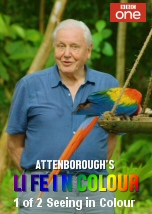
The natural world is full of colours. For us, they are a source of beauty, but for animals they are a tool for survival. David Attenborough reveals the extraordinary ways in which animals use colour: to win a mate, to fight off rivals and to warn enemies. New camera technologies - some developed especially for this series – also allow us to see colours and patterns usually invisible to human eyes.
Ultraviolet cameras reveal bright signals on a butterfly’s wings and facial markings on yellow damselfish that are used as secret communication channels. Some animals can also detect polarized light, and specialist cameras can now show us how fiddler crabs see the world, and how mantis shrimp have strange polarization patterns on their bodies to signal to a mate or rival.
Series: Attenborough Life in Colour

Inside Einstein Mind

   2015    Science
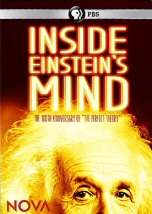
On November 25th, 1915, Einstein published his greatest work: General Relativity. The theory transformed our understanding of nature’s laws and the entire history of the cosmos, reaching back to the origin of time itself. Now, in celebration of the 100th anniversary of Einstein’s achievement, discover the inside story of Einstein’s masterpiece". The story begins with the intuitive thought experiments that set Einstein off on his quest and traces the revolution in cosmology that is still playing out in today’s labs and observatories. Discover the simple but powerful ideas at the heart of relativity, illuminating the theory—and Einstein’s brilliance—as never before. From the first spark of an idea to the discovery of the expanding universe, the Big Bang, black holes, and dark energy, NOVA uncovers the inspired insights and brilliant breakthroughs of “the perfect theory.”
Human

Human

2025  History
Prehistoric Planet

Prehistoric Planet

2022  Science
The Jinx

The Jinx

2015  History
Strangest Things

Strangest Things

2021  History
Atom

Atom

2007  Science
The Crime of the Century

The Crime of the Century

2021  Medicine
The Sky at Night

The Sky at Night

2015  Culture