










Last Watched

"War "  Sort by

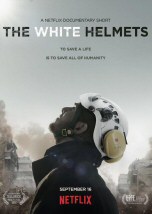
The White Helmets

   2016    Culture
Syria Civil Defense (SCD), also known as the White Helmets, is a volunteer civil defense organization that operates in rebel-controlled Syria during the Syrian Civil War as a response to indiscriminate bombardment of civilian communities. This group of indomitable first responders risk their lives to rescue victims from the rubble.
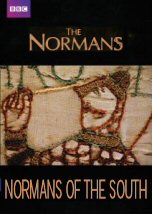
The Normans: Normans of the South

   2010    History
Professor Robert Bartlett explores the impact of the Normans on southern Europe and the Middle East. The Normans spread south in the 11th century, winning control of southern Italy and the island of Sicily. There they created their most prosperous kingdom, where Christianity and Islam co-existed in relative harmony and mutual tolerance. It became a great centre of medieval culture and learning. But events in the Middle East provoked the more aggressive side of the Norman character. In 1095, the Normans enthusiastically answered the Pope's call for holy war against Islam and joined the first crusade. They lay siege to Jerusalem and eventually helped win back the holy city from the muslims. This bloody conquest left a deep rift between Christianity and Islam which is still being felt to this day.

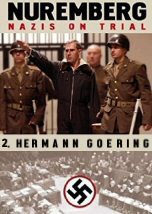
Hermann Goering

       History
The second episode tells the story of the trial of Hermann Goering, Hitler's charismatic and ruthless second-in-command. On trial for his life at Nuremberg, the unrepentant Reich Marshal turned the tables on the Allies. So much so that Chief Prosecutor Justice Robert Jackson began to wish the Allies had followed Churchill's suggestion and shot the leading Nazis out of hand. This documentary drama traces the behind-the-scenes story of Goering's attempt to re-ignite Nazism from the courtroom.
Series: Nuremberg: Nazis on Trial

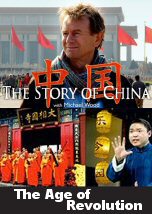
The Age of Revolution

   2016    History
Between 1850 and 1950, three cataclysmic revolutions shook China to the core, but out of them, today's China emerged. The film begins in Canton with the meeting of a US missionary and a Chinese student. Inspired by the Christian story and calling himself God's second son, Hong unleashed the bloodiest war of the 19th century, the Taiping Rebellion.
As imperial China weakened, foreign influence grew. Treaty ports expanded, bringing growth and wealth, trams, railways and western sensibilities. But this provoked another surge of violence, the Boxer Rebellion, an attack against the foreigners, which was crushed by those same foreigners, who extorted a huge indemnity - $60 billion in today's money.
Then in 1912, the empire fell, and many groups contested China's future. In World War I, China sent 100,000 men to the western front, only to be humiliated at Versailles when German colonies in China were handed to Japan. Between the two world wars, the disparity between rich and poor, city and countryside increased. We visit Hong Kong's Peninsular Hotel in the jazz age and then follow Mao on the Long March to Yan'an, the heartland of revolution.
World War II came to China two years earlier than it did in the west. Wood talks to a survivor of the Japanese massacre of Nanjing in 1937 and then charts the triumph of the communists, before ending the story with Mao's death and the boom time of the last 30 years. The series ends with the warmth of the Chinese family and, at Beijing's Altar of Heaven, a final haunting glimpse of eternal China.
Series: The Story of China

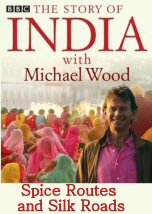
The Story of India: Spice Routes and Silk Roads

   2007    History
In this episode he traces India in the days of the Roman Empire. In Kerala the spice trade opened India to the world, whilst gold and silk bazaars in the ancient city of Madurai were a delight for visiting Greek traders. From the deserts of Turkmenistan Michael travels down the Khyber Pass to Pakistan to discover a forgotten Indian Empire that opened up the Silk Route and at Peshawar built a lost Wonder of the World.
Series: The Story of India

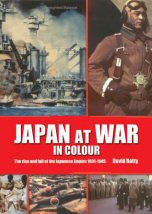
Japan at War

       History
Japan's role in World War II gets a whole new perspective in this consisting entirely of full colour footage, including colour films from Japan that were recently discovered. As the visuals of the world war take on a new vivid immediateness, the story of the rise of the militarists in Japan is told through the personal writings of the Japanese themselves. From the first overconfident tastes of victory, to the devastating losses that led to an unthinkable defeat amidst the ruins, the Pacific Theater of World War II is told through the Japanese's eyes.