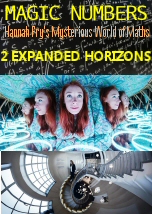
Dr Hannah Fry travels down the fastest zip wire in the world to learn more about Newton's ideas on gravity. His discoveries revealed the movement of the planets was regular and predictable. James Clerk Maxwell unified the ideas of electricity and magnetism, and explained what light was. As if that wasn't enough, he also predicted the existence of radio waves. His tools of the trade were nothing more than pure mathematics. All strong evidence for maths being discovered. But in the 19th century, maths is turned on its head when new types of geometry are invented. No longer is the kind of geometry we learned in school the final say on the subject. If maths is more like a game, albeit a complicated one, where we can change the rules, surely this points to maths being something we invent - a product of the human mind. To try and answer this question, Hannah travels to Halle in Germany on the trail of perhaps one of the greatest mathematicians of the 20th century, Georg Cantor. He showed that infinity, far from being infinitely big, actually comes in different sizes, some bigger than others. This increasingly weird world is feeling more and more like something we've invented. But if that's the case, why is maths so uncannily good at predicting the world around us? Invented or discovered, this question just got a lot harder to answer.
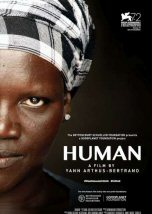
Filmmaker and artist Yann Arthus-Bertrand spent 3 years collecting real-life emotional stories from more than 2,000 women and men in 60 countries. Those emotions, those tears and smiles, those struggles and those laughs are the ones uniting us all. A combination of testimonies and exclusive aerial images, HUMAN is a unique documentary. This sensitive experience is an introspection into whom we are today as a community but also and most importantly as an individual. Through wars, inequalities, discriminations, HUMAN confronts us with the realities and the diversity of our human conditions. Beyond this darker side, testimonies show the empathy and the solidarities which we are capable of. All these contradictions are ours and HUMAN leads us to reflect about the future we wish to give to people and the planet today.
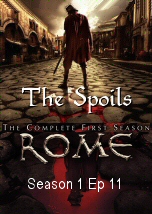
Rejected by Vorenus and Eirene and racked by guilt for the killing of Eirene's fiancé out of a jealous rage, Pullo has sunk to working as an assassin for the gangster Erastes. When Pullo gets arrested for killing one of Caesar's popular opponents, he condemns himself by refusing to name who hired him, despite Octavian's attempts to defend him. Meanwhile, Vorenus finds his new official duties as magistrate tedious, especially when he gets caught between Caesar and the demands made by veterans' spokesman Mascias.
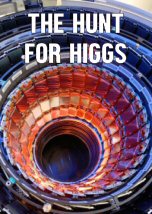
Go with us behind the scenes at CERN to follow one of the most epic and expensive scientific quests of all time: the search for the Higgs particle, believed to give mass to everything in our universe. However, the hunt for Higgs is part of a much grander search for how the universe works. It promises to help answer questions like why we exist and is a vital part of a Grand Unified Theory of nature". At the heart of the pursuit of the elusive particle is the same feature that makes snowflakes beautiful and human faces attractive: the simple and enchanting idea of symmetry. Presenter Jim Al-Khalil
Every 17 minutes in America, someone is killed with a gun. Politicians can't seem to stop the violence. But epidemiologists, psychologists and big data crunchers are discovering that gun crime spreads like a virus -and science may be able to stop its spread.
We think of comets as beautiful glowing balls of light streaking across our skies with their long sweeping tails, yet comets are so much more than just a cosmic firework display. Comets have a uniquely important place in modern science. As time machines from the early universe, they could hold the key to unlock the secrets of the cosmos. Comets could even be the origin of life itself. We follow the incredible odyssey of a comet as it sails through the solar system, watching it's every move as it evolves from a dormant chunk of ice and rock into a tumbling, violently active nucleus engulfed in a gaseous haze. What we learn is a revelation; comets are even more mysterious and fascinating than we had ever imagined.











But in the 19th century, maths is turned on its head when new types of geometry are invented. No longer is the kind of geometry we learned in school the final say on the subject. If maths is more like a game, albeit a complicated one, where we can change the rules, surely this points to maths being something we invent - a product of the human mind. To try and answer this question, Hannah travels to Halle in Germany on the trail of perhaps one of the greatest mathematicians of the 20th century, Georg Cantor. He showed that infinity, far from being infinitely big, actually comes in different sizes, some bigger than others. This increasingly weird world is feeling more and more like something we've invented. But if that's the case, why is maths so uncannily good at predicting the world around us? Invented or discovered, this question just got a lot harder to answer.