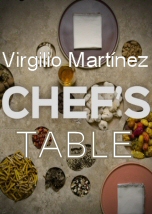
Virgilio Martínez is the chef/owner of Central, a restaurant in Lima, Peru that currently sits at number four on the World’s 50 Best Restaurants list. After a decade spent cooking in kitchens around the world, Martínez only found his true identity as a chef when he began exploring the different regions of his native Peru, from the ocean to the Andes. While some chefs are obsessed with a 'sense of place,' Martínez strives to offer his guests a sense of many places — entire ecosystems over the course of a tasting menu. Martínez always had an adventurous spirit, but growing up in Peru during the 70s and ‘80s meant that many parts of the country were closed off to him. As a teenager, he learned that pursuing a career in the kitchen would allow him the freedom to travel all over the world. The chef ended in charge of a restaurant in Madrid. This is really where Virgilio started to develop his experimental style. Martínez decided to leave Spain to go and work on opening his own restaurant in Peru. He decided to explore the idea of cooking dishes based on altitudes and ecosystems. Martínez runs Central’s kitchen with his wife, Pia León. They developed the altitude-based menu concept together. Martínez’s sister, Malena, has a science background, so he brought her on as part of the team to explore different terrains in search of ingredients that they could use at the restaurant. Virgilio remarks: 'We use 180 ingredients, and 50 percent of them are unknown.' The altitude-themed tasting menu was introduced in 2012, and the following year, Central landed at the bottom of the World’s 50 Best Restaurants list. Two years later, it soared to number four.
Jeremy Bowen presents a look back at the creation of the state of Israel, examining the the events leading up to the Israeli war of Independence in 1949, its impact on Arab/Israeli relations and the implications for the Middle East. It's a one hour crash course in some of the underlying causes of the current problems in the Middle East.
The film looks at the concept of the corporation throughout recent history up to its present-day dominance. Since the late 18th century American legal decision that the business corporation organizational model is legally a person, it has become a dominant economic, political and social force around the globe. This documentary takes an in-depth psychological examination of the organization model through various case studies. What the study illustrates is that in the its behaviour, this type of 'person' typically acts like a dangerously destructive psychopath without conscience. Furthermore, we see the profound threat this psychopath has for our world and our future, but also how the people with courage, intelligence and determination can do to stop it.
Rockefeller, Carnegie and Morgan team up to help elect William McKinley to the U.S. presidency by paying for his 1896 campaign, to avoid a possible attack on monopolies. However, fate intervenes when McKinley is suddenly assassinated, and vice president Theodore Roosevelt assumes the presidency and promptly begins dissolving monopolies and trusts in America. Meanwhile, Morgan buys out Carnegie Steel to make Carnegie the richest man in the world, and Henry Ford designs an affordable automobile with his Model T and starts his own business, Ford Motor Company, which sets a new business model for companies to follow.
The story of how a group of working-class kids growing up in post-industrial Glasgow dared to dream. Those kids became Simple Minds, the most iconic and influential Scottish band in history. The film is a captivating journey into the heart and soul of one of the most influential bands in rock history. From their humble beginnings in Glasgow to their meteoric rise on the world stage, this documentary unveils the untold stories behind Simple Minds' groundbreaking music and enduring legacy. Through rare archival footage, intimate interviews, and electrifying performances, discover how this iconic group defined an era, inspired generations, and proved that with passion and resilience, everything truly is possible. For fans and newcomers alike, this is more than a documentary—it's a celebration of the unyielding power of music to transform lives.
The filmmakers challenge former Indonesian death-squad leaders to reenact their mass-killings in whichever cinematic genres they wish, including classic Hollywood crime scenarios and lavish musical numbers. Anwar Congo and his friends have been dancing their way through musical numbers, twisting arms in film noir gangster scenes, and galloping across prairies as yodeling cowboys. Their foray into filmmaking is being celebrated in the media and debated on television, even though Anwar Congo and his friends are mass murderers. Medan, Indonesia. When the government of Indonesia was overthrown by the military in 1965, Anwar and his friends were promoted from small-time gangsters who sold movie theatre tickets on the black market to death squad leaders. They helped the army kill more than one million alleged communists, ethnic Chinese, and intellectuals in less than a year. As the executioner for the most notorious death squad in his city, Anwar himself killed hundreds of people with his own hands. The Act of Killing is about killers who have won, and the sort of society they have built. Unlike ageing Nazis or Rwandan génocidaires, Anwar and his friends have not been forced by history to admit they participated in crimes against humanity. Instead, they have written their own triumphant history, becoming role models for millions of young paramilitaries. The Act of Killing is a journey into the memories and imaginations of the perpetrators, offering insight into the minds of mass killers. And The Act of Killing is a nightmarish vision of a frighteningly banal culture of impunity in which killers can joke about crimes against humanity on television chat shows, and celebrate moral disaster with the ease and grace of a soft shoe dance number.




















Martínez always had an adventurous spirit, but growing up in Peru during the 70s and ‘80s meant that many parts of the country were closed off to him. As a teenager, he learned that pursuing a career in the kitchen would allow him the freedom to travel all over the world. The chef ended in charge of a restaurant in Madrid. This is really where Virgilio started to develop his experimental style. Martínez decided to leave Spain to go and work on opening his own restaurant in Peru. He decided to explore the idea of cooking dishes based on altitudes and ecosystems. Martínez runs Central’s kitchen with his wife, Pia León. They developed the altitude-based menu concept together. Martínez’s sister, Malena, has a science background, so he brought her on as part of the team to explore different terrains in search of ingredients that they could use at the restaurant. Virgilio remarks: 'We use 180 ingredients, and 50 percent of them are unknown.' The altitude-themed tasting menu was introduced in 2012, and the following year, Central landed at the bottom of the World’s 50 Best Restaurants list. Two years later, it soared to number four.