Psychopaths have long captured the public imagination. Painted as charismatic, violent predators lacking in all empathy, they provide intrigue and horror in equal measure. But what precisely is a psychopath? What is it that drives them to cause harm, even kill? And can they ever be cured? The film also features a series of candid interviews with prison inmates who not only describe their crimes but why they think they committed them. 'What Makes a Psychopath?' explores not only how each individual's crimes were shaped by their own life experiences, but also gives an insight into how these people think and behave. Working with the world's experts in the field, the film sheds light on the biological, psychological and environmental influences that shape a psychopath. And it looks to the future, with ground-breaking research that suggests a lifetime of incarceration is not the only option to manage violent and dangerous psychopaths.
The essence of baseball is the primal battle between the pitcher and batter, but the magic of the game arises from that confrontation, only 396 milliseconds in the making. The mysteries and memories of Baseball's greatest heroes are revealed, featuring interviews with dozens of former players, from legendary Hall of Famers to up-and-coming All-Stars, including Hank Aaron, Nolan Ryan, and Derek Jeter, and narrated by Kevin Costner
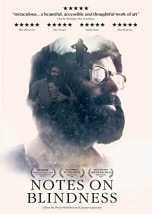
In the summer of 1983, just days before the birth of his first son, writer and theologian John Hull went blind. In order to make sense of the upheaval in his life, he began keeping a diary on audiocassette. Upon their publication in 1990, Oliver Sacks described the work as 'the most extraordinary, precise, deep and beautiful account of blindness I have ever read. It is to my mind a masterpiece.' With exclusive access to these original recordings, Notes On Blindness encompasses dreams, memory and imaginative life, excavating the interior world of blindness.
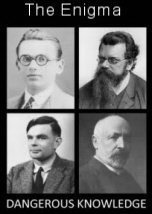
brilliant mathematicians whose genius has profoundly affected us, but which tragically drove them insane and eventually led to them all committing suicide. Kurt Gödel, the introverted confidant of Einstein, proved that there would always be problems which were outside human logic. His life ended in a sanatorium where he starved himself to death. Finally, Alan Turing, the great Bletchley Park code breaker, father of computer science and homosexual, died trying to prove that some things are fundamentally unprovable.
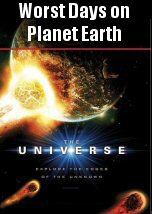
Earth may seem like the most hospitable planet in the solar system. But look again. Startling new discoveries reveal the blue planet has been plagued by more chaos and destruction than scientists once imagined. Stand on the Earth billions of years ago as a primitive planet called Theia slams into it. Shiver as our entire globe is frozen over like a gigantic snowball. Feel the heat as mammoth volcanoes scorch the landscape and darken the sky. From a cosmic gamma ray burst frying away the ozone layer to an Everest-size asteroid slamming into the ocean, we'll reveal new information about how these unparalleled events drove life to the brink of total extinction. Out of this continuous devastation, how has our planet--and life--got to where it is today? Are the worst days behind us--or lurking in the distant future?
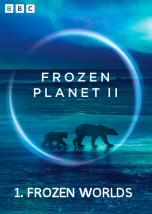
Journeying from pole to pole, The series 'Frozen Planet II' reveals surprising worlds that exist across the planet and the remarkable animals that make them their home. In a fragile world of beauty and hostility, nature finds a way to survive and thrive. David Attenborough explores a planet on the brink of major change. In the first episode, we begin our journey in the far south, in the most hostile place on earth, the frozen continent of Antarctica. After being raised on the ice in winter, emperor penguin chicks find themselves abandoned by their parents in spring. To survive, they must find their own way across the treacherous sea ice to the rich waters of the Southern Ocean. The waters surrounding Antarctica may be the richest of all, but they are also home to an exceptionally sophisticated predator, the killer whale. To reach their favored prey, Weddell seals, a family of killer whales have learnt to generate their own waves, washing the seals off their ice floes. It’s a technique that has been passed down over generations and is coordinated by the family matriarch, who can be over 100 years old. Leaving Antarctica and travelling north, we discover frozen habitats that are created by altitude. The greatest of these is the Himalaya, the tallest mountain range on earth, which contains so much ice and snow it is known as the third pole. In the shadow of the Himalaya lies a vast frozen grassy plain that is home to the fluffiest cat in the world, Pallas’s cat. It may have extremely dense fur, but if it’s to survive the Mongolian winter, it needs to catch lots of gerbils and voles. Easier said than done when you only have short legs and paws that are sensitive to the cold. North of the Great Steppe lies the boreal forest, which encircles the continents of North America, Europe and Asia, and remains frozen for six months of the year. Prowling these forests in the far east of Russia is the Siberian tiger, the largest cat in the world. In winter, it is on the lookout for black bears hibernating in caves, a high-risk strategy that only a cat of this size would attempt. Above the boreal forest, we cross into the Arctic Circle, where conditions become so extreme that trees can no longer grow. This is the tundra. Living here are relics of the last ice age, musk ox. In spring, their calves face a far greater danger than the cold, grizzly bears. Encounters can be brutal, but if just a few calves survive the gauntlet, the herd’s future is secure. To the north of the tundra is the Arctic Ocean, the only ocean that can completely freeze over. Living here is one of the most peculiar animals on earth, the hooded seal. Males have extraordinary inflatable noses, producing a bright red balloon out of their left nostrils. One male hopes this will make him irresistible. All of the frozen habitats share one thing in common: the threat posed by today’s climate change. Travelling to the island of Greenland, home to the largest body of ice in the northern hemisphere, we witness how global warming is melting its ice cap at faster rates than ever before, with profound consequences for global sea levels. Lastly, we visit the Arctic’s most iconic resident, the polar bear, as a mother bear struggles to provide for her cubs in a world of shrinking sea ice.







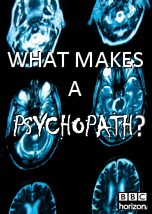








'What Makes a Psychopath?' explores not only how each individual's crimes were shaped by their own life experiences, but also gives an insight into how these people think and behave. Working with the world's experts in the field, the film sheds light on the biological, psychological and environmental influences that shape a psychopath. And it looks to the future, with ground-breaking research that suggests a lifetime of incarceration is not the only option to manage violent and dangerous psychopaths.