






Last Watched

"Water"  Sort by

Speed Limits

   2010    Science
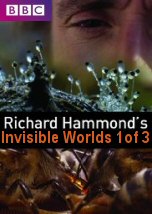
Richard Hammond explores the extraordinary wonders of the world of detail hidden in the blink of an eye. It takes our brain around a hundred and fifty milliseconds to process what we see. We're not aware of this time lag going on, but in those few milliseconds, there are extraordinary things happening that completely pass us by. But what if we could break through this speed limit? Bend and stretch time in ways never thought possible. What new marvels would we see? Now, using the latest high-speed cameras, Richard takes us on a journey beyond our eye's limits, letting us see secrets hidden in every element of our planet. A world where thin air can shatter rock. And water can tear through metal. A world where the fastest thing on earth lies right beneath our feet. And where a spectacular celestial display is finally captured, even though many have claimed it doesn't even exist.
Series: Invisible Worlds
Dragons of the Dry

   2008    Nature
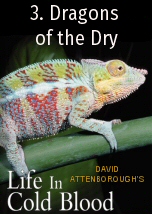
About 340 million years ago a brand new family of animals was evolving in the primeval swamps. They were to go one step further than the amphibians who had emerged onto dry and before them. For they would eventually completely cut their ties with water. They were the ancestors of todays lizards. They evolved scaly impermeable skins and moved up into the forests. They diversified into a multitude of different shapes and sizes. They developed signalling systems to communicate with one another. And they squabbled as animals do. For food they hunted insects that were already well established on the land in great numbers. And here without returning to water they produced their families. They powered their bodies not only with food but with the heat that they drew directly from the sun.
As they diversified so they spread into the harshest of the lands habitats. The baking waterless deserts which eventually they would come to dominate. Discover jacky lizards that wave, wrestling beaded lizards and the the world's smallest chameleon, which is no bigger than his thumbnail, and the biggest lizard in Australia.
Series: Life In Cold Blood

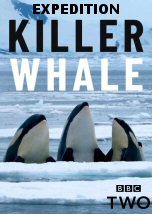
Expedition Killer Whale

   2024    Nature    HD
In Antarctica, one the most sophisticated hunting behaviours in the animal kingdom takes place – killer whales creating waves to wash seals off pieces of floating ice. A team of scientists and filmmakers travel heads to these freezing waters to find out more about these unique animals and how they do it. But their mission is not just to deepen our understanding of this extraordinary hunting behaviour. The team are also intent on learning more about the secret – and more tender side – of the lives of these killer whales.

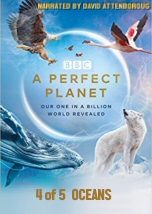
Oceans

   2021    Nature
Oceans are the largest ecosystem on earth, covering two thirds of our world’s surface and providing half the oxygen in our atmosphere. They are home to as much as 80 per cent of all life on earth, and nearly three billion people rely on them for their primary source of food.
But our planet’s oceans would be little more than stagnant wastelands, and life on planet earth would cease to exist, were it not for one simple factor: a global network of powerful ocean currents. Every drop of seawater on earth rides these currents, taking 1,000 years to complete a single circuit. Without the constant mixing of currents, tides and waves, our oceans would stop supporting life - and a healthy ocean is vital to a healthy planet.
Series: A Perfect Planet

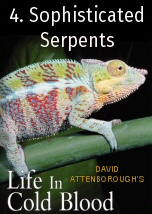
Sophisticated Serpents

   2008    Nature
David Attenborough reveals the fascinating lives of snakes, the most misunderstood group of reptiles. A CCTV stakeout of wild rattlesnakes hunting shows, for the first time, what sophisticated predators they truly are. Attenborough is also on the receiving end of a spitting cobra's chemical weapons system, while the surprisingly beautiful and tender side of snakes is displayed in the sinuous courtship of kingsnakes, and the water birth of 15 beautiful yellow anaconda babies.
Series: Life In Cold Blood

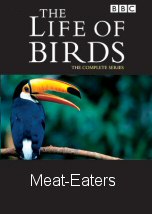
Meat-Eaters

   1998    Nature
This episode examines those birds whose sustenance comes from flesh and their methods of hunting. In New Zealand, Sir Attenborough observes Keas, parrots that do not eat meat exclusively, raiding a shearwater's burrow for a chick. However, it is the dedicated birds of prey, such as owls, buzzards, eagles, falcons and vultures, to which much of the programme is devoted. In order to spot and pursue their victims, senses of sight and hearing are very acute. Vultures are the exception, in that they eat what others have left, and once a carcass is found, so many birds descend on it that the carrion seems submerged beneath them. The Turkey Vulture is an anomaly within its group, as it also has a keen sense of smell. Eagles defend their territory vigorously, and a pair of sea eagles are shown engaging in an aerial battle. The Galápagos Hawk hunts Marine Iguanas, but can only do so when its quarry is vulnerable, during the breeding season. The African Harrier Hawk has adapted to extracting burrowing animals by virtue of an especially long, double-jointed pair of legs. By contrast, a shrike is not equipped with the requisite sharp beak and talons needed for butchery, and so dismembers its kill by impaling it on the thorns of acacias. The Lammergeier eats bones, and will drop them on to rocks from a great height in order to break them down to a digestible size. Also featured are the Eurasian Sparrowhawk, Goshawk and Peregrine Falcon.
Series: The Life of Birds