The centre of our galaxy is home to an invisible monster of unimaginable power – a supermassive black hole named Sagittarius A star, with four million times the mass of the Sun. Recent astronomical breakthroughs have confirmed not only that black holes like Sagittarius A star exist, but that these bizarre invisible objects may be the ultimate galactic protagonists. Stunning CGI takes us back to witness the fiery origins of our galaxy’s black hole 13.6 billion years ago, when the early universe was home to colossal blue stars, and when they ran out of fuel, they collapsed under their own enormous mass, crushing down into an object so small and so dense it punched a hole in the fabric of the universe. Over billions of years, Sagittarius A star feasted on nearby gas, stars, and through cataclysmic mergers with other black holes. A breakthrough discovery by Nasa’s Fermi gamma-ray telescope has shown that our black hole had the power to sculpt the entire galaxy, creating vast bubbles of gas above and below our galaxy and even protecting stars systems as ours. In a mind-bending conclusion, Brian Cox reveals how our modern understanding of black holes is challenging our concepts of reality to the breaking point. In trying to understand the fate of objects that fall into Sagittarius A star, scientists have come to a stunning conclusion: space and time, concepts so foundational to how we experience the world around us, are not as fundamental as we once thought.
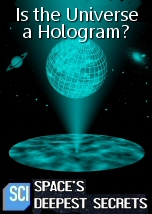
Shocking new evidence has convinced some of the world's greatest physicists that the universe is a hologram. Using cutting-edge technology, they investigate the secrets of black holes and space-time to build the case for this game-changing discovery. The holographic principle is a supposed property of quantum gravity that states that the description of a volume of space can be thought of as encoded on a lower-dimensional boundary to the region like a gravitational horizon. First proposed by Gerard 't Hooft, it was given a precise string-theory interpretation by Leonard Susskind. The holographic principle was inspired by black hole thermodynamics, which conjectures that the maximal entropy in any region scales with the radius squared, and not cubed as might be expected. In the case of a black hole, the insight was that the informational content of all the objects that have fallen into the hole might be entirely contained in surface fluctuations of the event horizon.
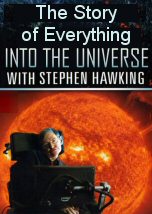
In less than two eye-popping hours, Stephen Hawking reveals the wonders of the cosmos to a new generation. Delve into the mind of the world's most famous living scientist and reveal the splendor and majesty of the universe as never seen before. See how the universe began, how it creates stars, black holes and life -- and how everything will end.
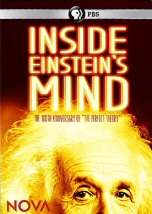
On November 25th, 1915, Einstein published his greatest work: General Relativity. The theory transformed our understanding of nature’s laws and the entire history of the cosmos, reaching back to the origin of time itself. Now, in celebration of the 100th anniversary of Einstein’s achievement, discover the inside story of Einstein’s masterpiece". The story begins with the intuitive thought experiments that set Einstein off on his quest and traces the revolution in cosmology that is still playing out in today’s labs and observatories. Discover the simple but powerful ideas at the heart of relativity, illuminating the theory—and Einstein’s brilliance—as never before. From the first spark of an idea to the discovery of the expanding universe, the Big Bang, black holes, and dark energy, NOVA uncovers the inspired insights and brilliant breakthroughs of “the perfect theory.”
They are the most powerful objects in the universe. Nothing, not even light, can escape the gravitational pull of a black hole. Astronomers now think there are billions of them out in the cosmos, swallowing up planets, even entire stars in violent feeding frenzies. New theoretical research into the twisted reality of black holes suggests that three-dimensional space could be an illusion. That reality actually takes place on a two-dimensional hologram at the edge of the universe.
Orbits are the dynamics that drive the universe. From the smallest asteroid to the largest super-cluster, everything in the universe is in orbit. We owe our very existence to the stability of earth's orbit — it gave us life and keeps us safe. But we are the freaks. Everywhere else we look we find orbits are chaotic, unstable, and violent. Beyond our solar system we find planets that are blow-torched, stars that eat each other, and black holes that destroy everything in their path. Yet on the very largest scale, orbits are also a creative force. clashing galaxies give birth to new stars and new worlds. on the galactic scale orbits even construct the fabric of the universe itself.
















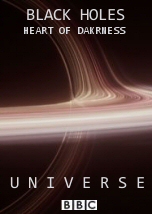







Stunning CGI takes us back to witness the fiery origins of our galaxy’s black hole 13.6 billion years ago, when the early universe was home to colossal blue stars, and when they ran out of fuel, they collapsed under their own enormous mass, crushing down into an object so small and so dense it punched a hole in the fabric of the universe. Over billions of years, Sagittarius A star feasted on nearby gas, stars, and through cataclysmic mergers with other black holes. A breakthrough discovery by Nasa’s Fermi gamma-ray telescope has shown that our black hole had the power to sculpt the entire galaxy, creating vast bubbles of gas above and below our galaxy and even protecting stars systems as ours.
In a mind-bending conclusion, Brian Cox reveals how our modern understanding of black holes is challenging our concepts of reality to the breaking point. In trying to understand the fate of objects that fall into Sagittarius A star, scientists have come to a stunning conclusion: space and time, concepts so foundational to how we experience the world around us, are not as fundamental as we once thought.