



Last Watched

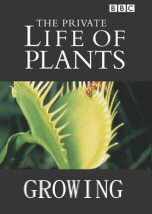
Growing

   1994    Nature
The second episode is about how plants gain their sustenance. Sunlight is one of the essential requirements if a seed is to germinate, and Attenborough highlights the cheese plant as an example whose young shoots head for the nearest tree trunk and then climb to the top of the forest canopy, developing its leaves en route. Using sunshine, air, water and a few minerals, the leaves are, in effect, the "factories" that produce food. However, some, such as the begonia, can thrive without much light. To gain moisture, plants typically use their roots to probe underground. Trees pump water up pipes that run inside their trunks, and Attenborough observes that a sycamore can do this at the rate of 450 litres an hour — in total silence. Too much rainfall can clog up a leaf's pores, and many have specially designed 'gutters' to cope with it. However, their biggest threat is from animals, and some require extreme methods of defence, such as spines, camouflage, or poison. Some can move quickly to deter predators: the mimosa can fold its leaves instantly when touched, and the Venus flytrap eats insects by closing its leaves around its prey when triggered. Another carnivorous plant is the trumpet pitcher that snares insects when they fall into its tubular leaves. Attenborough visits Borneo to see the largest pitcher of them all, Nepenthes rajah, whose traps contain up to two litres of water and have been known to kill small rodents.
Series: The Private Life of Plants
What is the World Made of

   2010    History
In this episode, Michael demonstrates how our society is built on our search to find the answer to what makes up everything in the material world. This is a story that moves from the secret labs of the alchemists and their search for gold by the stone of the philosophers to the creation of the world's first synthetic dye - Purple - and onto the invention of the transistor. This quest may seem abstract and highly theoretical. Yet it has delivered the greatest impact on humanity. By trying to answer this question, scientists have created theories from elements to atoms, and the strange concepts of quantum physics that underpin our modern, technological world.
Series: The Story of Science

Battle of Little Bighorn

   2018    History
The Battle of Little Bighorn lasted nearly 24 hours on June 25, 1876, but the stage had been set decades earlier as settlers, prospectors, and business people began encroaching on Native Americans' sacred land. From the Lakota Sioux facing broken treaties to the attacks that ultimately led up to Bighorn, follow these events unfold. Then, see how this pivotal moment in history marked the beginning of the end of freedom on the Great Plains, the birth of an American cliche, and an ongoing fight for identity against the tyranny of progress.

Catholicism The unpredictable rise of Rome

   2011    Culture
Over one billion Christians look to Rome, more than half of all Christians on the planet. But how did a small Jewish sect from the backwoods of 1st-century Palestine, which preached humility and the virtue of poverty, become the established religion of western Europe - wealthy, powerful and expecting unfailing obedience from the faithful? Amongst the surprising revelations, Professor MacCulloch tells how confession was invented by monks on a remote island off the coast of Ireland, and how the Crusades gave Britain the university system. Above all, it is a story of what can be achieved when you have friends in high places.
Series: A History of Christianity

One Voice in the Cosmic Fugue

   1980    Science
Sagan discusses the story of the Heike crab and artificial selection of crabs resembling samurai warriors, as an opening into a larger discussion of evolution through natural selection (and the pitfalls of intelligent design). Among the topics are the development of life on the Cosmic Calendar and the Cambrian explosion; the function of DNA in growth; genetic replication, repairs, and mutation; the common biochemistry of terrestrial organisms; the creation of the molecules of life in the Miller-Urey experiment; and speculation on alien life (such as life in Jupiter's clouds). In the Cosmos Update ten years later, Sagan remarks on RNA also controlling chemical reactions and reproducing itself and the different roles of comets (potentially carrying organic molecules or causing the Cretaceous–Paleogene extinction event).
Series: Cosmos

Tales by Light Wild

   2015    Art
In the fourth episode of the series, legendary nature and cultural photographer Art Wolfe captures the great brown bear with the stunning backdrop of Alaska’s mountains and glaciers, immigrating wildebeests in the plains East Africa, and the hard-to-find gorillas of Uganda.
Series: Tales by Light
Cooked

Cooked

2016  Culture
The Human Body

The Human Body

1998  Medicine
Neanderthal

Neanderthal

  History
How Earth Made Us

How Earth Made Us

2010  Culture
Spectacular Earth

Spectacular Earth

2022  Nature
Kingdom of Plants

Kingdom of Plants

2012  Nature
Evolution

Evolution

2004  Science