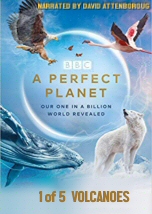
We routinely talk about healthy food and clean water, but how often do we spare a thought for what enters our lungs? The World Health Organization calls air pollution the silent killer. Air pollution is proven to shorten our lifetimes and it hits the vulnerable - children, the sick and the elderly - hardest of all. Prince William, Sir David Attenborough and astronaut Naoko Yamazaki hear the personal stories of people who are directly affected by air pollution and show us incredible solutions.
Our lifespan is increasing by 2.5 years every decade - and a third of all babies born today can expect to live to 100. But living longer can come at a cost. Old age itself brings with it a range of debilitating illnesses, many of which are the result of accumulating damage during our lifetime. Three diseases in particular have become the main killers in the developed world - cancer, heart disease and dementia. But a revolution in bio-medicine is now offering new hope for the treatment of these ailments, and the potential to extend our lives still further. Methods such as gene editing and stem cell therapies are transforming the way medicine can conquer disease today. "How to Live Longer" counts with the guide of the Nobel laureate Sir Paul Nurse, for whom the big question isn't just what science can do to fix our bodies and extend our lives, but whether it's right to use all the tools and techniques available.
Writing itself is 5,000 years old, and for most of that time words were written by hand using a variety of tools. The Romans were able to run an empire thanks to documents written on papyrus. Scroll books could be made quite cheaply and, as a result, ancient Rome had a thriving written culture. With the fall of the Roman Empire, papyrus became more difficult to obtain. Europeans were forced to turn to a much more expensive surface on which to write: Parchment. Medieval handwritten books could cost as much as a house, they also represent a limitation on literacy and scholarship. No such limitations were felt in China, where paper had been invented in the second century. Paper was the foundation of Chinese culture and power, and for centuries how to make it was kept secret. When the secret was out, paper mills soon sprang up across central Asia. The result was an intellectual flourishing known as the Islamic Golden Age. Muslim scholars made discoveries in biology, geology, astronomy and mathematics. By contrast, Europe was an intellectual backwater. That changed with Gutenberg’s development of movable type printing. The letters of the Latin alphabet have very simple block-like shapes, which made it relatively simple to turn them into type pieces. When printers tried to use movable type to print Arabic texts, they found themselves hampered by the cursive nature of Arabic writing. The success of movable type printing in Europe led to a thousand-fold increase in the availability of information, which produced an explosion of ideas that led directly to the European Scientific Revolution and the Industrial Revolution that followed.
Last year, just before Thanksgiving, I approached my dad, Leonard Nimoy, about the possibility of working together on a film about Mr. Spock. I had skimmed through some of the books on the making of Star Trek and felt there was so much more to explore about the creation and development of Mr. Spock. And the timing seemed right, as the 50th anniversary of Star Trek the original series was not that far away. Dad agreed that now was the right time, and that he was 100% committed to collaborating with me on this project. He also reminded me that we were (then) just days away from the 50th anniversary of the start of production on 'The Cage,' the original pilot for Star Trek in which dad first appeared as Mr. Spock.
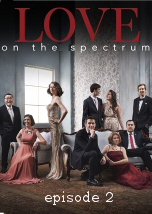
It's Valentine's Day and Maddi steps out on her first ever date with a romantic man. Kelvin works with a relationship specialist and puts his dating skills to the test. Michael is overwhelmed when he meets the woman of his dreams.
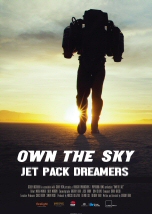
How what began as a passion for the tantalising possibilities of jetpacks became an obsession. Shot over ten years, this documentary chronicles Australian David Mayman's seemingly impossible quest to fulfil his childhood dream to build and fly the world’s first jetpack. His ambition, which nearly cost him his life and family, culminates in an attempt to make the world's first jetpack flight around the Statue of Liberty.




Prince William, Sir David Attenborough and astronaut Naoko Yamazaki hear the personal stories of people who are directly affected by air pollution and show us incredible solutions.