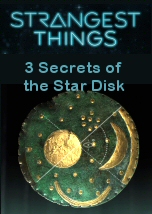
An ancient bronze disk adorned with gold may contain the oldest images of the cosmos ever discovered; using new research and the latest tech, experts investigate if this artefact could be the work of a prehistoric astrologer. Is it just a decorative disc or is there some hidden meaning? A strange 11,000-year-old deer skull can have links to a British Atlantis.
The global cyberwar is heating up and the stakes are no longer limited to the virtual world of computers. Now, thanks in part to secret documents released by Edward Snowden, the true scale of the National Security Agency's scope and power is coming to light. Besides spending billions of dollars to ingest and analyze the worlds' electronic communications, the NSA has set out to dominate a new battlefield—cyberspace. We examine the science and technology behind cyber warfare and asks if we are already in the midst of a deadly new arms race". Already, highly sophisticated, stealthy computer programs such as the notorious Stuxnet worm can take over and even destroy the control systems that regulate everything from food factories to gas pipelines, power plants, and chemical facilities—even our cars. While the destruction of Iranian centrifuges may have delayed Iran’s bomb program and forestalled an Israeli attack, the attack has opened a Pandora's Box, and now America's own critical infrastructure is vulnerable to retaliation and attack. With leading defense experts and investigative journalists who have probed the murky realm of criminal and strategic hacking, NOVA examines the chilling new reality of cyberwar in which no nation or individual is safe from attack.
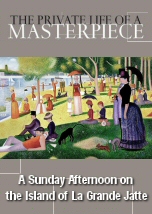
This award-winning series, Private Life of a Masterpiece, reveals the full and fascinating stories behind famous works of art, not just how they came to be created, but also how they influenced others and came to have a life of their own in the modern world. The works of art featured here are both instantly familiar and profoundly mysterious. Revolutionary in their conception, and iconic years after their execution, they each have their own compelling stories. For behind the beautiful canvases and sculptures are tales of political revolution, wartime escapes, massive ego clashes, social scandal, financial wrangling and shocking violence. In this fascinating series key works of art are investigated and the intricate details of their lives revealed - the history, contemporary reactions, and legacies of each are illustrated. A Sunday Afternoon on the Island of La Grande Jatte is a popular masterpiece and yet an enduring enigma. It seems to show a quiet scene in a Paris park but there are hints at the demi-monde, if you know where to look. The most remarkable aspect of this vast canvas however remains Seurat's technique his revolutionary pointillism.
Dr Thomas Dixon delves into the BBC's archive to explore the troubled relationship between religion and science. From the creationists of America to the physicists of the Large Hadron Collider, he traces the expansion of scientific knowledge and asks whether there is still room for God in the modern world. He looks at what happens when new scientific discoveries start to explain events that were once seen as the workings of God, and explains how some of our most famous scientists have seen God in the grandest laws of the universe. Finally, he finds intriguing evidence from brain science which hints that belief in God is here to stay.
An engineering revolution is underway. Driven by dedicated individuals who are building extraordinary machines that will change our lives. The first episode follows the race to generate vast power from thin air - the wind. One of the world’s biggest wind farms is being built off the English coast where the harsh conditions pose great challenges for the team. Meanwhile, a Norwegian team is striving to build the first-ever floating wind farm.
Dr. Thomas Asbridge explains how in the thirteenth century, after almost two hundred years of Holy Wars, the titanic conflict between Christianity and Islam, known to history as The Crusades, reached a decisive and shocking conclusion – a chapter that despite its drama has been virtually forgotten. He explains how, in the end, the fate of the Holy Land was decided not on the hallowed ground of Jerusalem, but in Egypt; and how the ultimate outcome of the Crusades was dictated not by Christians, but by the Mongol successors to Genghis Khan, and by a Muslim slave – a fearsome warrior whose story is now all but lost to western history.











A strange 11,000-year-old deer skull can have links to a British Atlantis.